Generate a new frequency by expanding the material response
In a transparent, nonmagnetic dielectric take one relevant polarisation and a specified tensor projection. For moderate fields write \(P=\epsilon_0(\chi^{(1)}E+\chi^{(2)}E^2+\cdots)\). For \(E=E_0\cos(k_1z-\omega t)\) the quadratic term contains both a steady component and an oscillatory one:
In a centrosymmetric bulk medium the electric-dipole response must change sign when the electric field changes sign. This symmetry forces the bulk electric-dipole \(\chi^{(2)}\) to vanish. Surfaces, suitable noncentrosymmetric crystals or other coupling mechanisms can supply a nonzero response.
Add the radiation from successive slices of crystal
At \(2\omega\) the wave equation has the driven form \((\partial_z^2+k_2^2)E_{2\omega}=-\mu_0(2\omega)^2P^{(2)}_{2\omega}\) in the frequency domain. The linear optical response is already included in \(k_2\). Set \(E_{2\omega}=A_2(z)e^{ik_2z}\) and neglect \(A_2''\) compared with \(2ik_2 A_2'\). For a plane, monochromatic undepleted pump the source envelope is constant. Apart from an immaterial constant phase, the derivative is proportional to \(e^{i\Delta k z}\), with \(\Delta k=2k_1-k_2\).
The intensity thus scales as \(I_1^2L^2\operatorname{sinc}^2(\Delta kL/2)\) under these assumptions. Define \(\operatorname{sinc}(x)=\sin x/x\). The coherence length \(\pi/|\Delta k|\) gives the first maximum for fixed nonzero mismatch. At twice that length equal contributions from opposite phase regions cancel. A crystal growing longer can therefore reduce the harmonic output.
Predict the coherence length and use the index tensor
For vacuum pump wavelength \(\lambda\), \(k_1=2\pi n_1/\lambda\) and \(k_2=4\pi n_2/\lambda\). In this collinear geometry \(L_c=\lambda/[4|n_1-n_2|]\). Taking \(\lambda=1.0\) µm and an index difference of 0.050 gives \(L_c=5.0\) µm. Birefringent phase matching selects propagation direction and polarisation so the indices felt by the two fields can coincide. The tensor component driving the generated polarisation must also be nonzero for those directions.
Another route periodically reverses the sign of \(\chi^{(2)}\) every coherence length. When the source would begin to cancel the previous contribution, reversal restores its sign. For a square-wave reversal of period \(\Lambda\), the fundamental reciprocal vector \(2\pi/\Lambda\) can cancel the mismatch. First-order quasi-phase matching needs \(\Lambda=2L_c\) and gives an ideal first-harmonic coupling magnitude \(2/\pi\) times the corresponding uniformly phase-matched value. Finite bandwidth, walk-off and absorption further limit the interaction length.
Recall · Distinguish frequency conversion from spatial harmonics
The second temporal harmonic carries frequency \(2\omega\). A linear diffraction grating can contain twice a spatial frequency while scattering light at the original optical frequency. A spectrometer separates these two mechanisms even if intensity images alone look similar.
Include the pump energy balance
At high conversion the assumed constant source term overestimates the pump. Scale amplitudes so \(|a|^2\) and \(|b|^2\) are the fractions of incident power at \(\omega\) and \(2\omega\). Let \(z\) now denote distance in nonlinear coupling lengths and \(\delta\) the correspondingly scaled mismatch. A lossless two-wave model after a phase choice is
Multiply the first equation by \(a^*\) and the second by \(b^*\), add complex conjugates and observe the cancellation. Total power is conserved. At \(\delta=0\), \(a(0)=1\), \(b(0)=0\) give real solutions \(a=\operatorname{sech}z\) and \(b=\tanh z\). This supplies an independent check for integrations with nonzero mismatch, for which power can return to the fundamental.
OneSimulation experiment · Pump depletion and phase mismatch in a lossless crystal
Try phase mismatch, depletion and time-step error
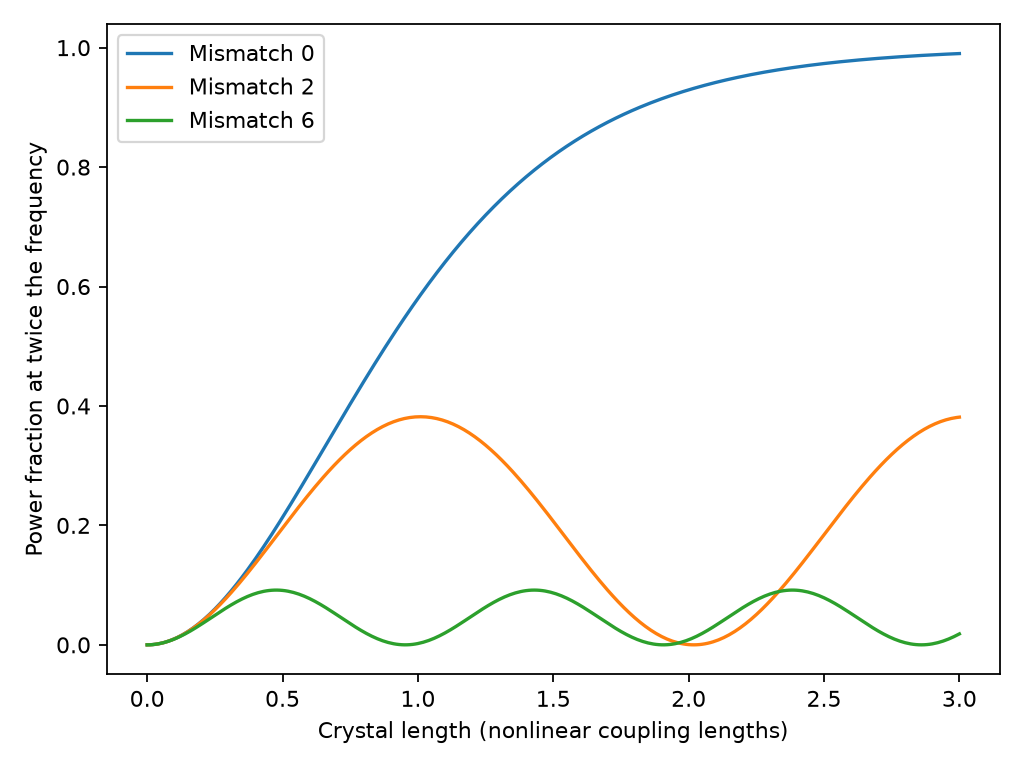
Change the phase mismatch and crystal length to locate a conversion maximum. At zero mismatch the computed second harmonic should follow tanh²(z/Lnl). At nonzero mismatch conversion can reverse; increasing length need not increase the output. Reduce the RK4 step while checking the separate power-balance residual.
The browser integrates the same four real envelope equations as the OneSimulation notebook below. Length and step are measured in nonlinear coupling lengths; mismatch is ΔkLnl. The lossless plane-wave model omits diffraction, absorption and temporal walk-off. Match mismatch, step and count in the notebook's propagate call to repeat a selected run.
Reproduce with OneSimulation
Change the mismatch and step size. Inspect harmonic output and the conserved power separately. At exact phase matching compare the entire returned curve with the analytic hyperbolic-tangent solution.
Run the downloaded notebook with OneSimulation, NumPy and Matplotlib installed. The output below was recorded with the displayed calculation.
"""Normalised fundamental and second-harmonic envelopes in a lossless crystal."""
import numpy as np
import matplotlib.pyplot as plt
from onesim.numerics.time import ClassicalRungeKutta4TimeIntegrator

def propagate(mismatch, step, count):
    def rates(state, z):
        a, b = complex(*state[:2]), complex(*state[2:])
        phase = np.exp(1j*mismatch*z)
        da = -a.conjugate()*b/phase
        db = a*a*phase
        return da.real, da.imag, db.real, db.imag
    method = ClassicalRungeKutta4TimeIntegrator()
    state = (1., 0., 0., 0.)
    trajectory = [state]
    for i in range(count):
        state = method.advance(state, rates, step, time=i*step)
        trajectory.append(state)
    ar, ai, br, bi = np.array(trajectory).T
    return ar**2+ai**2, br**2+bi**2

z = np.linspace(0, 3, 301)
for mismatch in (0., 2., 6.):
    pump, harmonic = propagate(mismatch, .01, 300)
    print(f"Mismatch {mismatch:g}: harmonic fraction at z=3 = {harmonic[-1]:.5f}")
    print(f"Max energy residual = {max(abs(pump+harmonic-1)):.2e}")
    plt.plot(z, harmonic, label=f"Mismatch {mismatch:g}")
    if mismatch == 0:
        assert np.max(abs(harmonic-np.tanh(z)**2)) < 1e-7
plt.xlabel("Crystal length (nonlinear coupling lengths)")
plt.ylabel("Power fraction at twice the frequency")
plt.legend()
plt.tight_layout()
plt.savefig("physics-harmonic-generation.png", dpi=160)
Computed output
Mismatch 0: harmonic fraction at z=3 = 0.99013
Max energy residual = 5.36e-11
Mismatch 2: harmonic fraction at z=3 = 0.38128
Max energy residual = 3.68e-10
Mismatch 6: harmonic fraction at z=3 = 0.01833
Max energy residual = 6.10e-10
Tutorial on coherence length and power
1 · Infer a dispersion difference
Work through the solution
A 1.064 µm pump has its first weak-conversion maximum at length 20 µm. The index difference is \(\lambda/(4L_c)=0.0133\). The next zero is near 40 µm if mismatch and pump intensity remain fixed.
2 · Separate weak conversion and depletion
Work through the solution
Doubling length under perfect phase matching multiplies weak harmonic power by four. For a depleted pump at \(z=1\) and 2 the fractions are \(\tanh^2(1)=0.580\) and \(\tanh^2(2)=0.929\). Multiplying 0.580 by four would exceed the available power.
3 · Tune a grating with a measured mismatch
Work through the solution
For \(|\Delta k|=6.28\times10^5\) m⁻¹ first-order quasi-phase matching needs period approximately 10.0 µm and sign reversal every 5.0 µm. A residual mismatch of \(10^3\) m⁻¹ in a 4 mm sample yields a weak-conversion intensity factor \(\operatorname{sinc}^2(2)=0.207\) relative to exact matching.
For further study see Hecht, Optics, 5th edition, chapter 13 on nonlinear optics and optical frequency conversion.