Start with the electromagnetic wave equation in a medium
For a nonmagnetic, neutral, homogeneous dielectric with no free currents, Maxwell's curl equations give \(\nabla\times\nabla\times\mathbf E=-\mu_0\partial_t^2(\epsilon_0\mathbf E+\mathbf P)\). A transverse plane wave in an isotropic material has \(\mathbf k\cdot\mathbf E=0\). Substitution for time dependence \(e^{-i\omega t}\) gives \(k^2=(\omega^2/c^2)(1+\chi)\). The local linear response is \(\mathbf P=\epsilon_0\chi(\omega)\mathbf E\). If \(k=(\omega/c)(n+i\kappa)\), the real index controls phase accumulation while positive \(\kappa\) attenuates intensity as
Two samples of the same material with identical polished interfaces can separate bulk attenuation from a nearly constant surface loss. If increasing thickness by 5.0 mm reduces transmitted intensity by a factor of 0.80, the apparent bulk coefficient is \(-\ln(0.80)/0.005=44.6\) m⁻¹. Multiple internal reflections, stray light and different surface treatments would spoil this cancellation.
Derive the dispersive and absorptive parts of the response
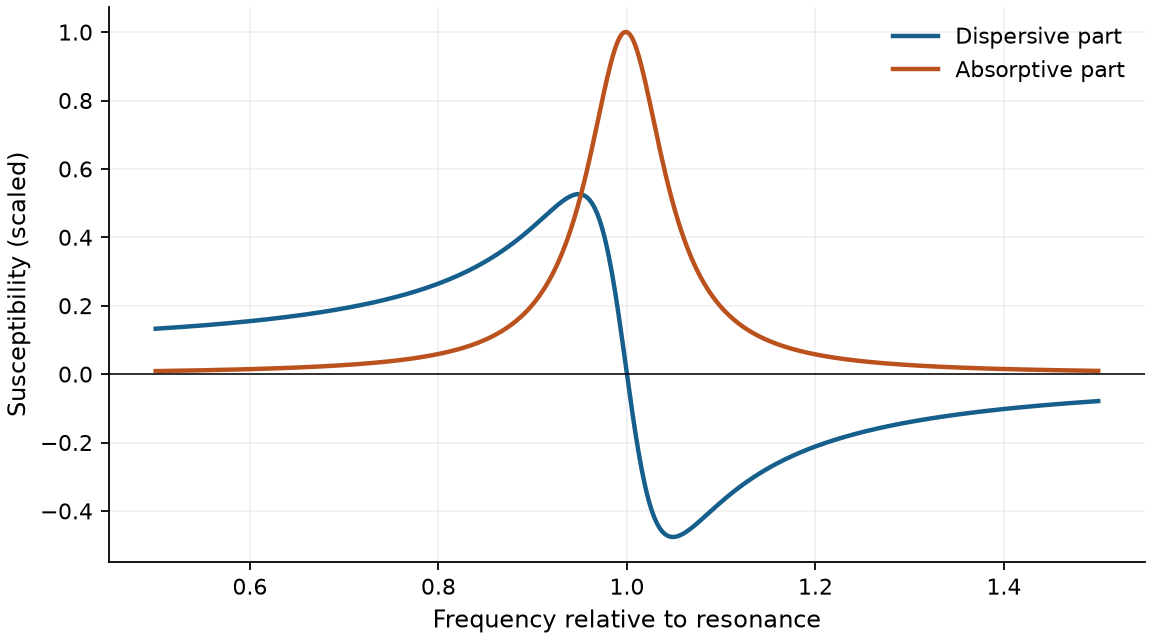
Let a bound charge of magnitude \(e\) and mass \(m\) have a restoring frequency \(\omega_0\) and damping rate \(\Gamma\). A charge \(-e\) obeys \(m(\ddot x+\Gamma\dot x+\omega_0^2x)=-eE\). The polarisation is the number density \(N\) times the dipole \(-ex\). Solving the driven equation gives
Below resonance the induced dipole tends to follow the applied field. Near resonance the imaginary part peaks and the real part evolves rapidly through a sign change. In a transparent region a narrow pulse has group index \(n_g=n+\omega\,dn/d\omega\) from differentiating \(k(\omega)\). Near strong absorption the pulse reshapes. A time-of-peak measurement alone may then give an unreliable travel time. The model links the two pieces of material response through a causal equation of motion.
Recall · Sign convention for a lossy material
With \(e^{i(kz-\omega t)}\) a positive imaginary part of the wave number makes the amplitude decay. A time convention with the opposite sign reverses how the imaginary susceptibility is written while the positive measured attenuation stays the same.
Try it · Em dispersion
Explore the same physical relation with adjustable inputs. This independent parameter study has its own displayed reference settings; compare its assumptions and units before matching the static example.
Give a lossless particle a radiative channel
For a particle much smaller than the wavelength in vacuum use its electrostatic dipole amplitude \(p=\epsilon_0\alpha_V E\), with \(\alpha_V\) in cubic metres. For a sphere of radius \(a\) and relative permittivity \(\epsilon_r\) the electrostatic boundary conditions give \(\alpha_V=4\pi a^3(\epsilon_r-1)/(\epsilon_r+2)\). Its transverse far field is proportional to \(k^2 p\sin\theta/(4\pi\epsilon_0 r)\). Squaring and integrating \(\sin^2\theta\) over solid angle gives
Here the scattering angle is measured from the driven dipole direction. For a dilute independent suspension the collimated intensity approximately obeys \(I=I_0e^{-N\sigma_{\rm ext}z}\) with \(\sigma_{\rm ext}=\sigma_{\rm abs}+\sigma_{\rm sca}\). The static polarizability gives the leading scattering power. For a quantitatively consistent forward amplitude include the small radiation-reaction term in the dipole response. If \(ka\) ceases to be small, higher multipoles contribute and the Rayleigh scaling ceases to hold.
For equally sized dilute scatterers with weakly dispersive contrast the cross-section ratio at 450 and 650 nm is \((650/450)^4=4.35\). Doubling radius at fixed particle number gives a factor of 64 when Rayleigh conditions hold at both radii. At fixed total particle volume, the number falls by eight on doubling the radius, so the attenuation instead increases by a factor of eight.
Tutorial on measuring optical constants
1 · Recover the imaginary index
Work through the solution
At 600 nm the example attenuation 44.6 m⁻¹ corresponds to \(\kappa=\alpha\lambda_0/(4\pi)=2.13\times 10^{-6}\) if attenuation is purely absorptive and scattering is negligible. Angularly resolved or integrating-sphere measurements test that last condition.
2 · Separate phase and pulse travel times
Work through the solution
A transparent 2 cm slab has \(n=1.50\) and \(n_g=1.56\). The phase and group times are 100 ps and 104 ps respectively using \(c=3.0\times10^8\) m/s. A narrowband phase measurement alone does not determine the slope of the index.
3 · Test whether attenuation is molecular absorption
Work through the solution
Measure transmitted collimated power and total scattered power with matched geometries. A wavelength-dependent loss proportional to \(\lambda^{-4}\) and increasing strongly with particle size supports Rayleigh scattering. Material absorption may also vary with wavelength, so independently test size and angular dependence.
For further study see Hecht, Optics, 5th edition, chapters 2–4 on electromagnetic waves and the propagation of light.