Derive the image displacement associated with a pupil error
In a circular pupil of radius \(a\) write the normalised Cartesian coordinates \(u=x/a\), \(v=y/a\). A phase plate or optical error contributes a path difference \(W(u,v)\) in units of length. Under monochromatic, paraxial conditions a pupil wave has the extra phase \(kW\). Its local wave-vector tilt is \(k^{-1}\nabla_\perp(kW)=\nabla_\perp W\). A focal-length \(f\) lens converts a small tilt into a displacement in its focal plane. With phase convention \(e^{ikW}\),
A constant piston gives no displacement. A linear tilt gives the same displacement to every ray. A quadratic rotationally symmetric term gives a radial displacement proportional to radius and can be cancelled by shifting the detector. The relation gives a geometrical spot construction. Near the diffraction limit, integrate the complex pupil amplitude to obtain the point-spread function.
Distinguish removable defocus from a fourth-order pupil error
On axis the pupil error of a centred rotationally symmetric lens has even powers of \(\rho=\sqrt{u^2+v^2}\). After choosing a focus the next independent term is \(W=S\rho^4\). Its radial slope is \(4S\rho^3\). Moving the detector can add a slope proportional to \(\rho\) and sharpen some zones while leaving others out of focus. Closing the aperture reduces the outer-radius contribution quickly, but increases the diffraction width on the sensor.
A lens whose full physical pupil is trimmed to half the radius still has the same physical curvature errors. For a fourth-power physical-height term, the edge value of \(W\) drops by \(2^4\) and its edge slope by \(2^3\). These scalings are measurements that can separate an aberrated lens from a diffraction-limited one.
Derive two off-axis spot signatures
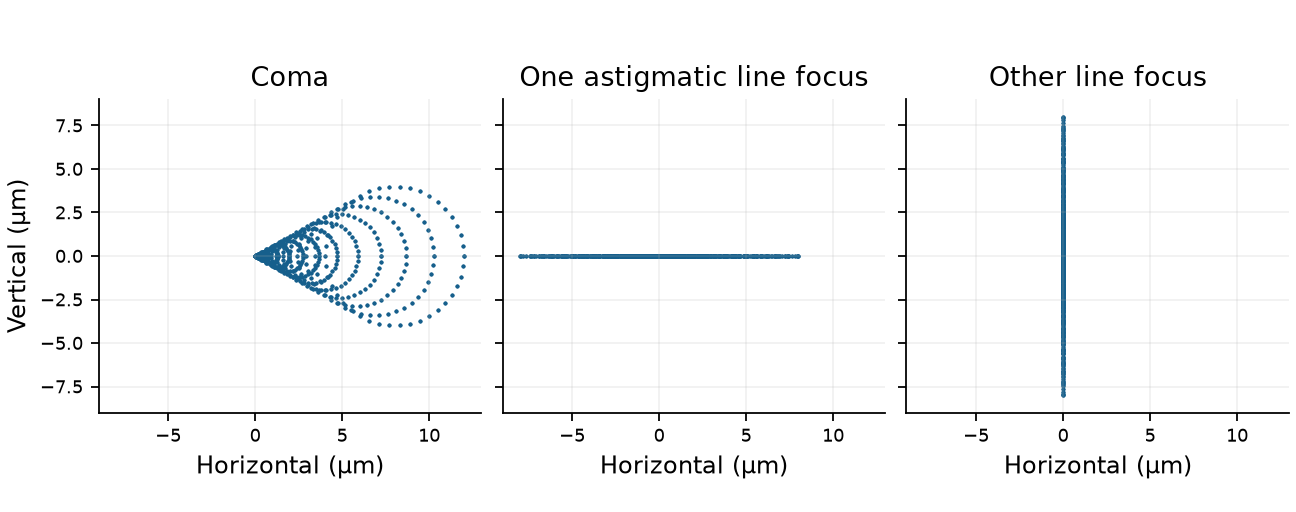
Let the field point lie along the horizontal direction and let \(h\) be a dimensionless field coordinate. The leading coma term allowed by symmetry has the form \(W_C=C h\,u(u^2+v^2)\). Differentiating gives
At opposite edges of the horizontal diameter the horizontal error has the same sign. A round pupil therefore maps to an asymmetric fan with a brighter concentration of rays on one side. Reversing the field direction reverses the fan. With \(f=100\) mm, \(a=5\) mm and \(Ch=0.20\) µm, marginal horizontal rays shift by 12 µm.
After subtraction of a field-dependent common focus error an astigmatic term can be written \(W_A=A h^2(u^2-v^2)\). Horizontal slopes vary as \(+2Ah^2u\), vertical slopes as \(-2Ah^2v\). Add a small detector defocus with radial slope of adjustable sign. It can bring either meridional family to its own line focus, but cannot make both vanish together. A longitudinal detector shift \(\Delta z\) changes a marginal ray position by about \(a\Delta z/f\). Equating its magnitude to \(2f|A|h^2/a\) gives separation of the two line foci
For \(|A|h^2=0.10\) µm and the same geometry this gives 0.160 mm. Translating the detector between the two foci rotates the long axis of the spot by roughly 90°. Reversing field leaves this term even, giving an independent distinction from coma.
Recall · Separate field curvature and distortion
A common quadratic pupil term varying with the square of field shifts the best image surface. A field-dependent pupil tilt shifts the image position without blurring a single field point in this approximation. Measure multiple field positions and focus settings before attributing all deviations to coma.
Try it · Aberration
Change the inputs and compare the recalculated curves with the preceding derivation and baseline figure. The axes give the units; the numerical readout states the model assumptions and any limiting cases. Reset the inputs to return to the reference setting.
Tutorial on recovering an aberration from data
1 · Diagnose an aperture sweep
Work through the solution
A measured edge contribution to blur falls approximately eightfold when diameter is halved while the centre stays fixed. In geometrical optics that agrees with a cubic ray slope from primary spherical aberration. For coma the marginal physical-height dependence is quadratic at fixed field. At small apertures the Airy contribution eventually grows.
2 · Extract an astigmatic path error
Work through the solution
A line-focus separation of 0.08 mm at \(f=100\) mm and \(a=5\) mm implies \(|A|h^2=\Delta z\,a^2/(4f^2)=0.050\) µm. A single image at best focus would not distinguish the signs of the two principal wavefront curvatures.
3 · Test a tilted detector as an alternative explanation
Work through the solution
Record a grid of pinhole images on both sides of the axis and scan focus. A detector tilt creates a systematic best-focus gradient across the field. Coma changes sign with reversed field, and astigmatism produces two line foci at the same field position. These measurements separate errors that can look similar in a single frame.
For further study see Hecht, Optics, 5th edition, chapters 5–6 on instruments, ray tracing and aberrations.