Compose refraction and translation with an explicit sign convention
Light travels left to right. Write a paraxial ray as \((y,u)\) with \(u=n\theta\). A positive radius has its centre of curvature to the right of the surface. Small-angle Snell refraction at a spherical surface gives \(u_2=u_1-\Phi_i y\) with \(\Phi_i=(n_2-n_1)/R_i\). Translation by \(d\) in material of index \(n\) gives \(y_2=y_1+(d/n)u_1\). Heights and slopes can therefore be propagated in the same two-component vector even when refractive index changes.
Multiply refraction at surface 1, internal translation through thickness \(d\), and refraction at surface 2, writing the last transformation on the left. Let \(\ell=d/n\). The elements of the vertex-to-vertex matrix in air are
Its determinant is one. In the thin limit the surface powers add. Treating widely separated surfaces as one zero-thickness refractor discards the product term and generally changes both the power and where distances must be measured.
Factor the matrix and locate the cardinal points
For any air-to-air matrix with entries \(A,B,C,D\) and nonzero \(\Phi=-C\), factor it into an air translation \(l_1\) to the first principal plane, a thin lens of power \(\Phi\), and an air translation \(l_2\) from the second principal plane to the back vertex. Matrix multiplication fixes \(l_1=(1-D)/\Phi\) and \(l_2=(1-A)/\Phi\). The effective focal length is \(f=1/\Phi\). Hence the back focal distance from the back vertex is \(f-l_2=A/\Phi\).
For a symmetric biconvex lens with \(R_1=+50\) mm, \(R_2=-50\) mm, \(n=1.50\) and \(d=10\) mm, each surface contributes 10 m⁻¹ and \(\Phi=19.333\) m⁻¹. The effective focal length is 51.72 mm. Each principal plane is 3.45 mm inside its adjacent vertex and the back focal distance is 48.28 mm. An object 200 mm left of the first principal plane gives an image 69.77 mm right of the second plane with lateral magnification \(-0.349\).
Recall · What is fixed when the medium changes?
The expressions \(f=1/\Phi\) and unit angular magnification at nodal points here use equal unit indices in the incident and image media. With unequal external indices the front and back focal distances differ. An afocal system has \(\Phi=0\) and is handled directly by the ray matrix.
Identify the entrance and exit pupils
An axial point emits a bundle of possible rays. The element that first rejects an increasing cone angle in object space is the aperture stop. The entrance pupil is its image formed by the optics before it, viewed from the object. The exit pupil is its image formed by later optics, viewed from the image. A field stop constrains which off-axis object points are visible. It can be physically different from the aperture stop.
Put a 6 mm diameter iris 25 mm behind an air thin lens of focal length 50 mm. To find what an observer in front sees, trace rays backward from the iris. The thin-lens equation with propagation now to the left gives image distance \(-50\) mm relative to the lens in that reversed convention. The stop therefore appears as a virtual 12 mm diameter opening 50 mm behind the lens. An axial object 150 mm in front of the lens sees a half-angle near \(6/200=0.030\) rad. A sufficiently small lens rim would become the actual stop instead, invalidating this calculation.
Place the eye and relate field to throughput
An afocal two-positive-lens telescope separates its objective and eyepiece by \(f_o+f_e\). A distant angle \(\theta\) makes an intermediate height \(f_o\theta\). The eyepiece then sends that point into an approximately parallel bundle at angle \(-f_o\theta/f_e\). If the objective rim is the stop, its image through the eyepiece is the exit pupil. The eyepiece images an object at \(f_o+f_e\) to distance \(f_e(f_o+f_e)/f_o\) behind it. The exit-pupil diameter is \(D_o f_e/f_o\).
With \(f_o=200\) mm, \(f_e=25\) mm and a 32 mm objective, angular magnification is \(-8\), the exit pupil is 4 mm across and lies 28.1 mm behind the eyepiece. Moving a camera away from that plane can vignette off-axis bundles even with a sharp central image. A field diaphragm at the intermediate image separately clips the angular field.
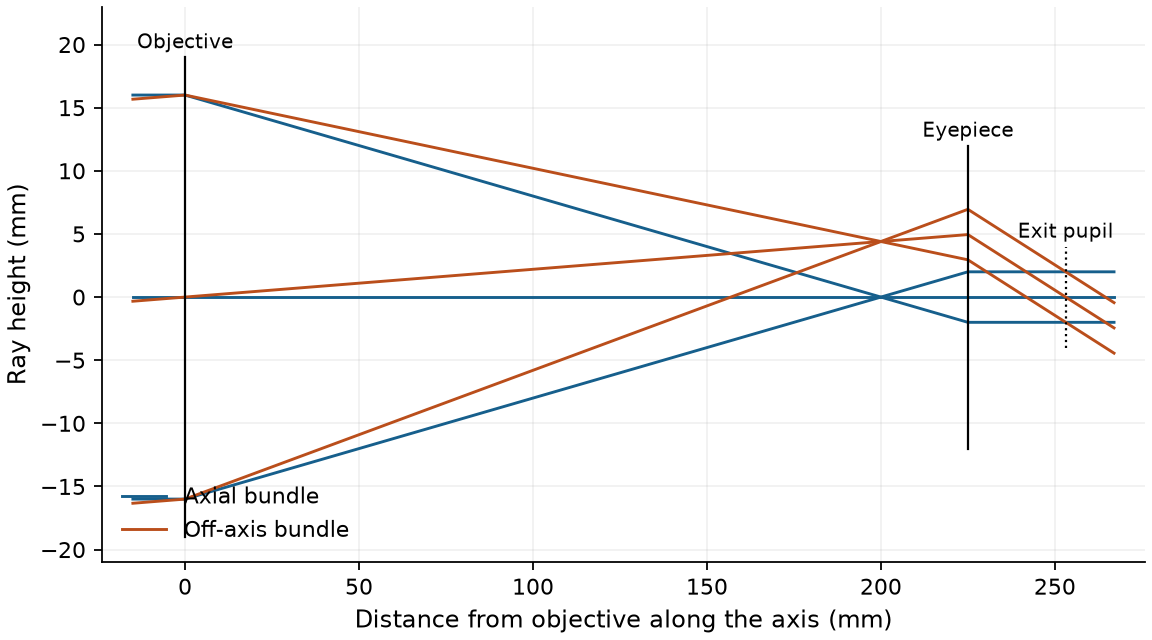
Try it · Telescope
Change the inputs and compare the recalculated curves with the preceding derivation and baseline figure. The axes give the units; the numerical readout states the model assumptions and any limiting cases. Reset the inputs to return to the reference setting.
Tutorial on lens-card and aperture measurements
1 · Focus a sensor from the vertex
Work through the solution
In the thick-lens example the image for the 200 mm object is 69.77 mm from the second principal plane, hence 66.32 mm beyond the back lens vertex. A ruler referenced to the vertex must use the second value.
2 · Test whether the lens rim could be the stop
Work through the solution
In the iris example an axial object at 150 mm and half-angle 0.030 rad uses a beam radius of about 4.5 mm at the lens. A 7 mm clear lens diameter clips it before the 6 mm iris can define the full bundle. Repeat the ray check for each potentially limiting aperture.
3 · Specify a telescope field stop
Work through the solution
An intermediate focal-plane field stop of 8 mm diameter with the 200 mm objective gives an approximate full angular field \(2(4/200)=0.040\) rad or 2.29°. Halving its diameter halves this field. In a system without vignetting it leaves the axial exit-pupil diameter unchanged.
For further study see Hecht, Optics, 5th edition, chapters 5–6 on geometrical optics, cardinal planes and instruments.