Specify the convention for an Einstein coefficient
Let \(E_2-E_1=h\nu\) and let \(g_i\) count the unresolved magnetic substates of level \(i\). Define \(\rho_\nu\) as energy per unit volume per hertz including both polarisations, and use coefficients averaged over equally populated lower or upper substates as appropriate. For an isolated narrow line in isotropic incoherent radiation the upward rate per atom is \(B_{12}\rho_\nu\). The downward rate is \(A_{21}+B_{21}\rho_\nu\). For a broad line average \(\rho_\nu\) against a normalised line shape.
At equilibrium \(N_2/N_1=(g_2/g_1)\exp(-h\nu/k_BT)\) while stationarity requires \(N_1 B_{12}\rho_\nu=N_2(A_{21}+B_{21}\rho_\nu)\). Isolate the unknown radiation density:
Count the cavity modes and identify the coefficients
In a large periodic volume \(V\) the count of wave vectors in a shell is \(V\,4\pi k^2dk/(2\pi)^3\). Two transverse polarisations double it. With \(k=2\pi\nu/c\) this gives \(8\pi\nu^2/c^3\) modes per volume per hertz. Each thermally occupied mode has mean energy \(h\nu/(e^{h\nu/k_BT}-1)\) above vacuum. Equality at every temperature fixes both independent factors in the rate expression.
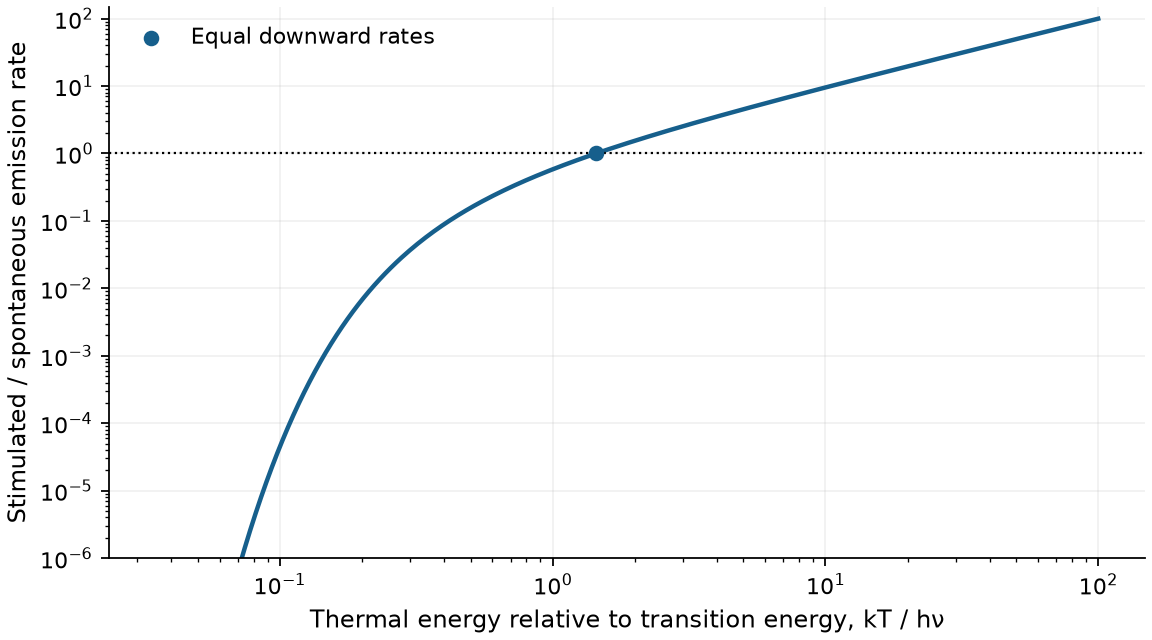
The spontaneous-to-stimulated ratio in a blackbody is \(e^{h\nu/k_BT}-1\). Knowing the line frequency fixes a ratio of coefficients, not the dipole matrix element or the absolute lifetime. An isolated upper level with several radiative channels has total decay rate \(\sum_j A_{2j}\) and emits into a specific channel with probability \(A_{2j}/\sum_j A_{2j}\).
Recall · Frequency and angular frequency conventions
Spectral energies obey \(\rho_\nu\,d\nu=\rho_\omega\,d\omega\). With \(\omega=2\pi\nu\), \(\rho_\omega=\rho_\nu/(2\pi)\). A coefficient multiplying \(\rho_\omega\) therefore changes by \(2\pi\). Comparing a printed \(A/B\) ratio requires checking this convention and whether intensity or energy density was used.
Try it · Thermal emission
Change the inputs and compare the recalculated curves with the preceding derivation and baseline figure. The axes give the units; the numerical readout states the model assumptions and any limiting cases. Reset the inputs to return to the reference setting.
Predict a lifetime and an equilibrium occupation
Consider a 10 GHz transition. Its characteristic temperature \(h\nu/k_B\) is about 0.480 K. At 4 K the mean photon occupation is \(1/(e^{0.120}-1)=7.84\), so stimulated downward transitions dominate spontaneous ones. At 0.1 K the occupation is only 0.00830. A 600 THz optical transition at room temperature has \(h\nu/k_BT\simeq96\), leaving essentially no thermal photons at that frequency.
If an upper state has two decay channels of \(4\times10^7\) and \(1\times10^7\) s⁻¹, its vacuum population after a short excitation decays as \(e^{-5\times10^7t}\). The lifetime is 20 ns. The photon yield in the stronger branch is 0.80 in the absence of quenching and losses. Rates inferred from measured photon counts also need a detector-efficiency correction.
Tutorial on reading a line measurement
1 · Correct for unresolved degeneracies
Work through the solution
If \(g_1=2\), \(g_2=6\), then \(B_{12}=3 B_{21}\) in the convention of this chapter. Population inversion for net stimulated gain requires \(N_2 B_{21}>N_1 B_{12}\), or \(N_2/g_2>N_1/g_1\).
2 · Find the bath temperature for equal downward contributions
Work through the solution
Equality requires mean occupation one, hence \(e^{h\nu/k_BT}=2\). For 10 GHz, \(T=0.480/\ln2=0.693\) K. Upward absorption may still occur at this temperature.
3 · Infer a missing nonradiative loss
Work through the solution
An isolated excited population lasts 16 ns instead of 20 ns while calibrated radiative rates still sum to \(5.0\times10^7\) s⁻¹. An independent nonradiative channel adds \(1/(16\,{\rm ns})-5.0\times10^7=1.25\times10^7\) s⁻¹. The radiative quantum yield is 0.80.
For further study see Griffiths and Schroeter, Introduction to Quantum Mechanics, 3rd edition, section 11.3 on spontaneous emission and atomic lifetimes.