Apply linearity to a calibrated copying apparatus
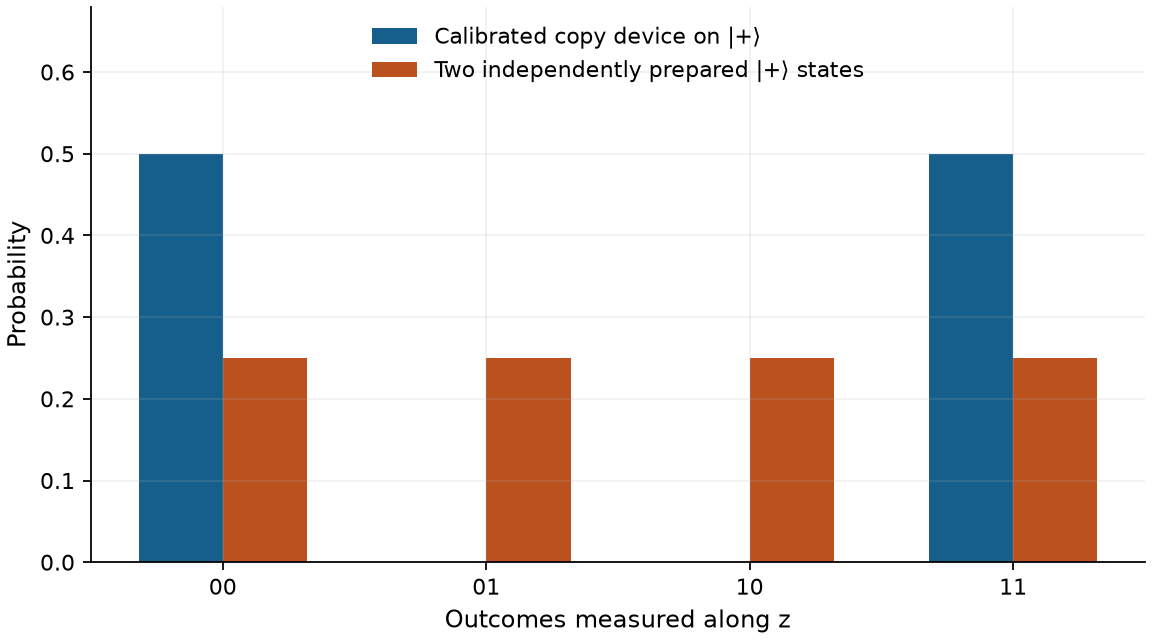
Let a blank qubit be prepared in \(|0\rangle\). A unitary device might obey \(U|0,0\rangle=|0,0\rangle\) and \(U|1,0\rangle=|1,1\rangle\). Both rules are realised by a controlled NOT on the blank. Linearity determines the device on any superposition of these inputs. For \(|+\rangle=(|0\rangle+|1\rangle)/\sqrt2\) the output is
The desired two-copy state would be \(|+,+\rangle=(|0,0\rangle+|0,1\rangle+|1,0\rangle+|1,1\rangle)/2\). Measure both qubits along \(z\). The actual output has zero probability of unequal results. The desired output has probability one half of unequal results. These are experimentally distinguishable preparations.
Try it · Spin copy
Change the inputs and compare the recalculated curves with the preceding derivation and baseline figure. The axes give the units; the numerical readout states the model assumptions and any limiting cases. Reset the inputs to return to the reference setting.
Derive the obstruction without assuming a particular basis
Suppose an apparatus with fixed blank and fixed prepared environment clones each of two pure states \(|\psi\rangle\) and \(|\phi\rangle\). After the operation any residual machine states may depend on the input. Because the two output copies are pure, they factor from the machine in each branch. Taking the magnitude of the inner product before and after unitary evolution gives
The machine overlap is at most one, so inputs with \(0<s<1\) cannot satisfy this equality. Orthogonal states form the special class for which exact, deterministic copying is possible. For \(|0\rangle\) and \(|+\rangle\), \(s=1/\sqrt2\) but two copies have overlap \(1/2\) even before multiplying by the machine overlap. Additional hidden apparatus states cannot fix this discrepancy.
Recall · Pure, correlated and mixed outputs
Partial trace of the actual two-qubit entangled output gives each single qubit \(\rho=I/2\). That result matches two fair \(z\) histograms, yet the pair has perfect \(z\) correlation. Single-axis marginals never certify that a pair consists of independent copies.
Relate disturbance to an observable record
A measurement trying to leave each state intact while recording its identity would have outputs \(|\psi\rangle|m_\psi\rangle\) and \(|\phi\rangle|m_\phi\rangle\). Inner-product preservation gives \(\langle\psi|\phi\rangle=\langle\psi|\phi\rangle\langle m_\psi|m_\phi\rangle\). If the inputs overlap, a nondisturbing measurement of both must leave the same record up to phase. This argument assumes exact preservation. Weak or approximate measurements can provide partial information at the cost of a disturbance.
With independently prepared copies, spin tomography estimates different components on different trials. If \(N\) separate \(x\) measurements have expectation \(r_x\), then \(\hat r_x=(n_+-n_-)/N\) has variance \((1-r_x^2)/N\). At \(r_x=0\) one hundred trials give standard error 0.10. Copying a single unknown preparation could not produce these independent statistics.
Tutorial on spin records
1 · Predict a transverse measurement
Work through the solution
For the Bell state above each individual \(x\) result is fair, but the product of the two \(x\) results is always \(+1\). For the desired \(|+,+\rangle\) both individual values are always \(+1\). This separates the two preparations with repeated measurements.
2 · Distinguish a classical record from an unknown state
Work through the solution
A classical bit is encoded in two distinguished orthogonal states. Controlled NOT copies that alphabet. Rotating the incoming state to an unknown basis introduces nonorthogonal alternatives relative to that alphabet, for which the same guarantee fails.
3 · How many new preparations are needed?
Work through the solution
To estimate a spin component near zero to one standard error of 0.02 requires \(N\simeq1/0.02^2=2500\) independent preparations for that axis. Splitting the same budget among three axes increases each component's error. Repeating a projective measurement on one qubit measures the prepared post-measurement state.
For further study see Griffiths and Schroeter, Introduction to Quantum Mechanics, 3rd edition, section 12.4 on the no-clone theorem.