Construct a Green function with the outgoing boundary condition
For a short-range potential and incident energy \(E=\hbar^2k^2/(2m)>0\), move the potential to the right side of the stationary Schrödinger equation. The outgoing Helmholtz kernel satisfies \((\nabla^2+k^2)e^{ikR}/R=-4\pi\delta(\mathbf R)\). Its outward phase is appropriate for incident states normalised to a plane wave \(e^{i\mathbf k\cdot\mathbf r}\) and time dependence \(e^{-iEt/\hbar}\).
Apply the differential operator to check the source and sign. Far outside the interaction region expand the distance in the phase as \(r-\hat{\mathbf r}\cdot\mathbf r'\) and in the denominator as \(r\). For elastic scattering \(\mathbf k'=k\hat{\mathbf r}\), the coefficient of \(e^{ikr}/r\) is the amplitude.
Interpret each application of the free propagator
In operator notation the integral equation reads \(|\psi\rangle=|\mathbf k\rangle+G_0^{(+)}V|\psi\rangle\). Substitution of its right side for \(|\psi\rangle\) gives a plane wave, one intermediate propagation, then two propagations and so forth. The corresponding transition operator obeys
The first term measures the transform of \(V\) at the measured momentum transfer. In the second term an intermediate momentum is integrated over with denominator \(E-\hbar^2p^2/(2m)+i0\) for \(p\) a wave number. It can differ from the incident momentum. Energy is conserved between the asymptotic states. The infinitesimal imaginary part retains the outgoing-wave condition in the integral.
Recall · A practical failure of first order
For a real potential the first Born forward amplitude is real. The exact optical theorem reads \(\sigma_{\rm tot}=(4\pi/k)\operatorname{Im} f(0)\). The first nonzero total cross section is order \(V^2\). Its consistent forward contribution comes from second order, so combining orders indiscriminately can produce an apparent violation of flux conservation.
Sum a solvable sequence and test a numerical truncation
Consider a separable interaction \(V=\lambda|g\rangle\langle g|\) with a square-integrable form factor. Each repeated propagation contributes the scalar \(I(E)=\langle g|G_0^{(+)}(E)|g\rangle\). Trying \(T=|g\rangle\tau\langle g|\) gives \(\tau=\lambda+\lambda I\tau\) and hence
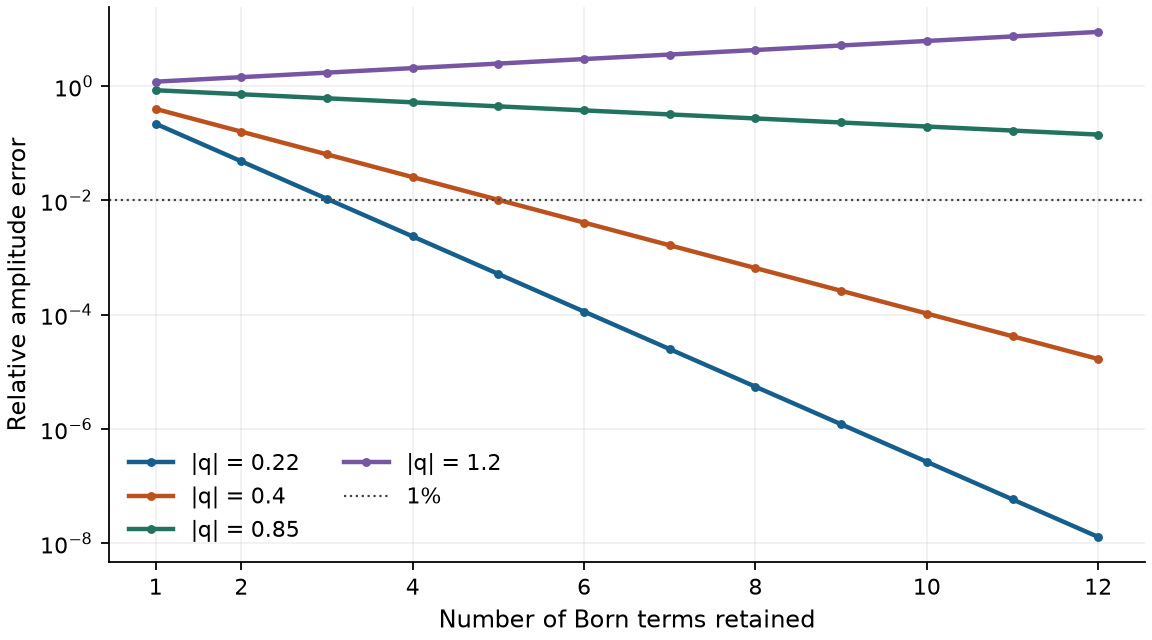
For \(q=\lambda I=0.20-0.10i\) the first-order relative amplitude error is \(|q|=0.224\). Truncating after two and three terms reduces it to \(|q|^2=0.050\) and \(|q|^3=0.0112\). A value approaching \(q=1\) signals strong enhancement. Exact poles follow by continuation to the correct energy domain. A small cross section in just one detector can arise from a form-factor zero even when the repeated-scattering factor is large.
Try it · Born
Change the inputs and compare the recalculated curves with the preceding derivation and baseline figure. The axes give the units; the numerical readout states the model assumptions and any limiting cases. Reset the inputs to return to the reference setting.
Tutorial on recognising repeated scattering
1 · Check a Born-amplitude dimension
Work through the solution
\(m/\hbar^2\) has units of inverse energy times inverse length squared. Multiplying by an energy and a three-dimensional volume produces length. Squaring the amplitude gives the area per unit solid angle.
2 · Choose the number of terms
Work through the solution
For a scalar \(|q|=0.40\), the relative truncation error is \(|q|^N\). Five terms give 0.01024, slightly above 1%. Six give 0.00410. In a general potential no single scalar controls every channel, so repeat convergence tests with multiple incident energies and angles.
3 · Distinguish invertibility from convergence
Work through the solution
At \(q=-1.2\) the exact expression \(\lambda/(1-q)\) is finite. Individual Born terms grow and alternate. Failure of the expansion need not signal an infinite physical scattering amplitude. Solving the full integral equation and checking its residual are different tests from summing the series.
For further study see Griffiths and Schroeter, Introduction to Quantum Mechanics, 3rd edition, sections 10.3–10.4 on phase shifts, the integral equation and the Born series.