Construct a Burgers circuit and the field of a screw dislocation
Follow a closed sequence of lattice steps around a suspected defect, well outside its core. Repeat the same sequence in a perfect reference lattice. The closure failure defines the Burgers vector \(\mathbf b\) up to the agreed sense of the circuit and line orientation. Its component parallel to the dislocation line is screw character and its perpendicular component is edge character. Smooth elastic deformation without a dislocation gives no persistent closure failure.
For a straight screw line along \(z\), with Burgers magnitude \(b\) along \(z\), an elastic displacement outside the core is \(u_z=b\phi/(2\pi)\) in cylindrical coordinates. After one revolution the displacement changes by \(b\). The engineering shear is \(\gamma_{\phi z}=r^{-1}\partial_\phi u_z=b/(2\pi r)\), giving \(\sigma_{\phi z}=\mu b/(2\pi r)\). Integrating the energy density \(\mu\gamma^2/2\) in an annulus gives an energy per unit line length
The core radius limits continuum elasticity at small radius. Nearby defects or surfaces set the outer cutoff. For \(\mu=30\) GPa, \(b=0.25\) nm and \(R/r_c=10^4\), the elastic term is \(1.37\times10^{-9}\) J/m. A core energy must be added to infer formation energies.
Determine how an applied shear does work on a line
A dislocation of length \(L\) moving a distance \(dx\) sweeps area \(Ldx\). Across the swept area the material slips by \(b\). A resolved shear stress \(\tau\) supplies work \(\tau b Ldx\), hence the glide force per unit length is \(\tau b\). At \(\tau=20\) MPa and \(b=0.25\) nm this gives \(5.0\times10^{-3}\) N/m. Obstacles and other dislocations oppose this driving force. Diffusion-assisted climb exchanges atoms or vacancies and depends on temperature in a different way.
Recall · Edge dislocations affect the number of planes
In an edge geometry the terminating extra half-plane ends at the dislocation line. A vacancy has no Burgers vector around a sufficiently large circuit. Concentration alone cannot describe a line's orientation, connectivity and mobility.
Recover pair order from scattering without indexing Bragg peaks
For particles of mean number density \(\rho\), define \(g(r)\) by the conditional count \(dN=4\pi r^2\rho g(r)\,dr\) about an atom in an isotropic bulk sample. The first-shell coordination is the integral from the first-neighbour peak to its first minimum, including the correct \(r^2\) weight. Scattering measures amplitudes before averaging the squared total. After averaging orientations the pair phase factor becomes \(\sin(qr)/(qr)\).
A glass may have a sharp first-neighbour peak and further damped shells with \(g(r)\to1\). This permits strong local coordination without periodic translational order. An ideal crystal produces Bragg peaks in reciprocal space. A limited sample size or instrumental resolution also broadens crystalline peaks. Compare several peak widths and a real-space correlation length before assigning amorphous structure.
A glass transition is observed when a structural relaxation time becomes comparable to a measurement or cooling time. A slower scan permits structural rearrangement to lower temperatures. The measured transition temperature may therefore shift with rate. The sharp equilibrium melting point of a pure crystal and the observed glass-transition interval answer different experimental questions.
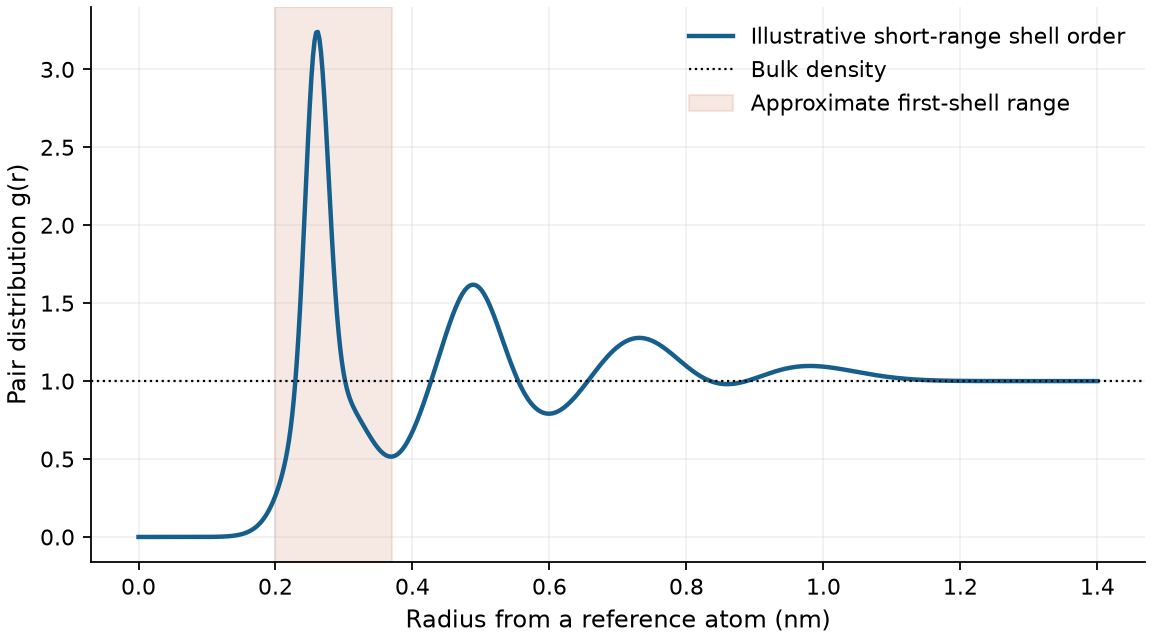
Try it · Pair order
Change the inputs and compare the recalculated curves with the preceding derivation and baseline figure. The axes give the units; the numerical readout states the model assumptions and any limiting cases. Reset the inputs to return to the reference setting.
Tutorial on disorder measurements
1 · Identify a dislocation character
Work through the solution
A line runs along \(z\) while the closure failure points along \(x\). Its screw projection is zero, so the line is pure edge. An inclined segment on a curved line generally has mixed character even with the same conserved Burgers vector.
2 · Estimate a coordination number
Work through the solution
Approximate a first shell by \(g=3\) between 0.23 and 0.27 nm with \(\rho=60\) nm⁻³ and zero elsewhere within that shell. Then \(N=4\pi\rho[0.27^3-0.23^3]\simeq5.67\). Truncating below the first minimum or failing to subtract scattering backgrounds changes the estimate.
3 · Separate line broadening from amorphous order
Work through the solution
A single broad powder maximum is insufficient. Examine whether higher peaks can be indexed on a consistent lattice, vary instrumental resolution, and estimate the range of oscillatory pair correlations. Compare thermal evolution and cooling-rate dependence for independent evidence.
For further study see Kittel, Introduction to Solid State Physics, 8th edition, chapters 19–21 on amorphous structure, point defects and dislocations.