Count configurations and derive an energy of mixing
Let \(N\) lattice sites contain \(Nx\) atoms of B. The number of random arrangements is \(N!/[(Nx)!(N(1-x))!]\). Stirling's approximation gives a configurational entropy per site \(-k_B[x\ln x+(1-x)\ln(1-x)]\). In a random alloy each of \(zN/2\) nearest-neighbour bonds is unlike with probability \(2x(1-x)\). With one bond energy \(\epsilon_{ij}\) per pair, subtract the energies of separated pure phases at the same overall composition.
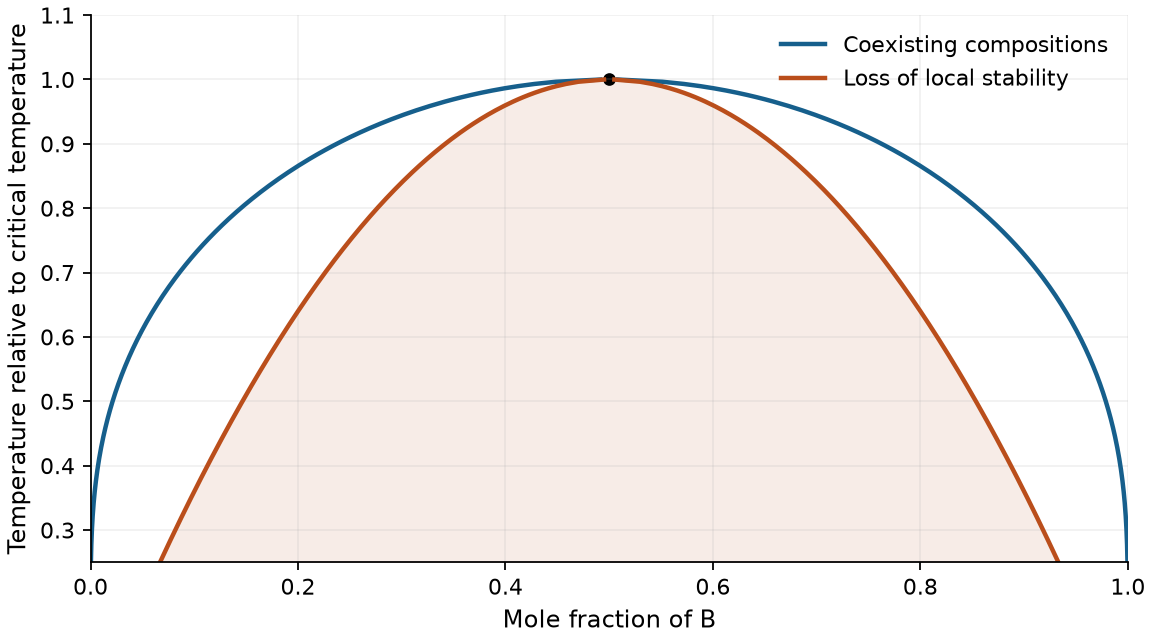
For \(\Omega>0\), unlike neighbours cost energy. The curvature at fixed temperature is \(g''=-2\Omega+k_BT/[x(1-x)]\). A homogeneous state is locally unstable when this curvature is negative. Equal chemical potentials across coexisting phases give a common tangent to \(g(x)\). For the symmetric model \(x_2=1-x_1\), the tangent is horizontal and the binodal obeys \(\Omega(1-2x)+k_BT\ln[x/(1-x)]=0\).
At \(x=1/2\) the spinodal reaches its highest temperature \(T_c=\Omega/(2k_B)\). For \(\Omega=0.10\) eV the mean-field \(T_c\) is 580 K. At 400 K the spinodal satisfies \(x(1-x)=0.1723\), or \(x\simeq0.221\) and \(0.779\). A composition between the binodal and spinodal can still have a positive local curvature while phase separation would lower the total energy after nucleation.
Try it · Regular solution
Change the inputs and compare the recalculated curves with the preceding derivation and baseline figure. The axes give the units; the numerical readout states the model assumptions and any limiting cases. Reset the inputs to return to the reference setting.
Construct an order parameter for preferential unlike neighbours
For an equiatomic alloy on a bipartite lattice let the A fractions of the two sublattices be \((1+\eta)/2\) and \((1-\eta)/2\). Then \(\eta=0\) is a random occupation and \(|\eta|=1\) is perfect order. Assuming independent occupation within each sublattice, the probability of an unlike nearest-neighbour bond is \((1+\eta^2)/2\). Put \(w=\epsilon_{AB}-(\epsilon_{AA}+\epsilon_{BB})/2\). The energy change from the random state is \(zw\eta^2/4\). Adding both sublattice mixing entropies gives the leading free-energy terms
For \(w<0\) the energetic gain favours order below \(T_{\rm ord}=-zw/(2k_B)\). Domains can choose opposite signs and have the same composition. A superlattice diffraction reflection weights the difference of sublattice scattering amplitudes. Its amplitude is proportional to \((f_A-f_B)\eta\), so its ideal intensity scales as \(\eta^2\). A measurement of the average composition alone overlooks the transition.
Recall · What makes this a mean-field model?
The product of single-site probabilities omits short-range correlations between neighbours. Clustering can therefore precede macroscopic separation and diffuse scattering can precede a sharp superlattice peak. Long-range elastic effects, unequal sublattice sizes or composition-dependent strain modify these predictions.
Distinguish an equilibrium phase boundary from slow atomic exchange
Composition changes by transport, which conserves the total fraction of each species. In a weak composition gradient a mobility \(M>0\) gives a flux proportional to \(-\nabla\mu\) with \(\mu=\partial g/\partial x\) in a locally uniform approximation. Negative curvature can drive atoms uphill in composition, amplifying fluctuations. A positive interfacial penalty proportional to \(|\nabla x|^2\) prevents indefinitely fine segregation. In ordering at fixed composition, local exchanges can develop alternating occupation without transporting a macroscopic excess from one end of a specimen to the other.
Tutorial on alloy diffraction and stability
1 · Determine the sign of the interaction
Work through the solution
If unlike bonds are 10 meV lower than the average like bond and coordination is eight, \(w=-0.010\) eV gives a mean-field ordering temperature of \(0.080/(2k_B)=464\) K on a suitable bipartite lattice. Demixing is disfavoured in this nearest-neighbour calculation.
2 · Infer an order parameter
Work through the solution
A superlattice reflection has one quarter of its intensity in a perfectly ordered single domain after correcting for geometry and thermal motion. The inferred \(|\eta|\) is 0.5. Unequal domain volumes or poor scattering contrast demand a more complete intensity model.
3 · Diagnose two microstructures with similar average composition
Work through the solution
In an equiatomic sample, composition mapping that resolves B-rich and A-rich regions indicates separation. Alternating-site superlattice peaks at essentially uniform local composition indicate ordering. Simultaneous data help when both mechanisms occur on different length scales.
For further study see Kittel, Introduction to Solid State Physics, 8th edition, chapter 22 on alloys and ordered structures.