From first principles
Turn a local spring law into a phonon dispersion relation
Consider identical atoms of mass \(m\) spaced by \(a\) along a chain. Write \(u_j\) for the displacement from the equilibrium position of atom \(j\). For small changes of bond length, expand the bond energy to second order about its minimum. Its first derivative vanishes and its positive second derivative \(K\) is the measured bond stiffness. The bond on the right pulls with force \(K(u_{j+1}-u_j)\); the left bond contributes \(K(u_{j-1}-u_j)\). Newton’s law gives
Translation of a normal mode by one site can change its phase but not its shape. Insert \(u_j=Ue^{i(kja-\omega t)}\), divide by the common amplitude, and simplify:
For wavelengths much larger than \(a\),
The slope gives the sound speed \(a\sqrt{K/m}\). At \(k=0\) all atoms move together and no bond stretches, which explains the zero frequency. More than one atom per primitive cell permits internal relative motion even at \(k=0\), the ingredient needed for an optical branch.
Derivation and applications
Count the modes that crowd against a chain’s band edge
Why can a narrow frequency bin near the top of a vibration band contain a substantial share of all modes? Take a monoatomic chain of \(N\) equal masses \(m\) with one longitudinal displacement each. Impose periodic ends and use identical harmonic nearest-neighbour springs of stiffness \(K\) with spacing \(a\). The frequency on the positive half of the first zone rises monotonically to \(\omega_m=2\sqrt{K/m}\). Inverting that branch gives the wavevector bounding the states below a trial frequency,
Allowed wavevectors are spaced by \(2\pi/(Na)\). Counting the interval of width \(2k(\omega)\) includes both propagation directions. In a large chain the fractional count and its derivative per atom are therefore
Here \(g\,d\omega\) is a fraction of the modes. The normalization follows from \(F(\omega_m)=1\), as required by the count of independent displacements. Near the edge the slope of the dispersion tends to zero, so evenly spaced wavevectors map into progressively smaller frequency intervals. This causes an integrable singularity in the continuum density. A finite spectrometer bin always contains a finite count. A measured spectrum can also weight modes differently through a probe’s coupling to atomic motion.
Worked example
Count modes within the upper tenth of the band
Change the inputs and investigate this derivation.
For \(N=10{,}000\), the interval between \(0.9\omega_m\) and the upper edge contains \(N[1-(2/\pi)\arcsin(0.9)]\simeq2871\) modes, allowing a mode or two for endpoints. A uniform distribution in frequency would give 1000. A nearly stationary wave packet near the upper edge and a large number of modes per unit frequency have the same origin in the small group velocity.
Second application
Use the spectral median to infer a spring stiffness
Change the inputs and investigate this derivation.
An ideal chain with atomic mass \(5.00\times10^{-26}\,\mathrm{kg}\) has half of its longitudinal modes below an ordinary frequency of \(4.00\,\mathrm{THz}\). Setting \(F=1/2\) gives
The upper frequency is \(5.66\,\mathrm{THz}\), and \(K=m(2\pi f_m)^2/4=15.8\,\mathrm{N/m}\). The frequency ratio is unchanged by conversion to angular frequency, but the final stiffness requires that conversion.
Try it · Chain count
Vary the physical parameters in the derived relation. Use the units and assumptions in the readout to connect the curves to the two worked examples. A parameter study can test the forward prediction; the same relation can then be inverted to infer a parameter from a measurement.
From bond extension to a travelling displacement
Let atoms of mass \(m\) on a line be coupled by springs of stiffness \(K\), spaced \(a\) apart. The spring to the right pulls site \(n\) by \(K(u_{n+1}-u_n)\); the left contributes \(K(u_{n-1}-u_n)\). A uniform shift produces no force. Translation symmetry suggests \(u_n=u e^{i(kna-\omega t)}\). Substitution gives
The sound speed at long wavelength is \(a\sqrt{K/m}\), consistent with a continuum rod whose one-dimensional stiffness is \(Ka\) and whose mass per length is \(m/a\). At \(k=\pi/a\) neighbouring atoms move in opposition and the slope of the dispersion vanishes. A wave packet made of nearby \(k\)'s moves with the group velocity \(d\omega/dk\), which can differ greatly from the phase velocity \(\omega/k\) near the boundary.
Background · Why must one vibration have exactly zero frequency?
Give every atom the same displacement. If the potential energy depends only on separations, no bond changes length and no atom experiences a restoring force. Differentiate the force with respect to this uniform translation. For one displacement direction the resulting row-sum condition on the force constants is
With unequal masses the translational eigenvector is uniform in physical displacement, while its mass-weighted components vary. A nonzero frequency at zero wavevector may reveal missing neighbour interactions in a numerical model. A real spring to a substrate also breaks translation symmetry and produces a physical gap. The boundary conditions decide which explanation is plausible.
Introduce an internal coordinate
Place masses \(m,M\) alternately, with spacing \(a/2\) between neighbours and cell period \(a\). Let their displacements in cell \(n\) be \(Ue^{ikna}\) and \(Ve^{ikna}\) times the same time factor. The two force balances contain sums of neighbouring amplitudes. For example the A mass sees B in cell \(n\) and in cell \(n-1\), giving \(m\omega^2 U=2KU-K(1+e^{-ika})V\). Exchanging the masses and conjugating the phase gives the second row. Requiring a nonzero solution yields
There are two nonnegative solutions for \(\omega^2\) per \(k\). With \(N\) cells under periodic boundary conditions this gives \(2N\) longitudinal modes, exactly matching the number of independent displacements. At \(k=0\) the lower branch has \(U=V\) and zero frequency. For the upper branch the centre of mass stays fixed, \(mU+MV=0\), with \(\omega^2=2K(1/m+1/M)\). An electric field can excite some optical modes in polar crystals; the branch name alone does not guarantee optical activity.
A gap and a sound speed answer different questions
At the zone boundary \(1+e^{ika}=0\), so the sublattices decouple. If \(M=4m\), the two edge frequencies are \(\sqrt{K/(2m)}\) and \(\sqrt{2K/m}\), a factor of two apart. When the masses become identical the two folded branches meet, recovering the original monoatomic chain in a doubled cell. An apparent branch boundary created by plotting in a smaller zone need not be a physical frequency gap.
Expand the determinant for small \(k\) on the lower branch. Since \(\omega^2\) scales as \(k^2\), discard the term of order \(k^4\). This gives
The two springs in a cell act in series for long waves, while both masses contribute to inertia. The sound speed alone determines a stiffness-to-mass ratio; measuring the upper branch supplies independent information about the internal motion.
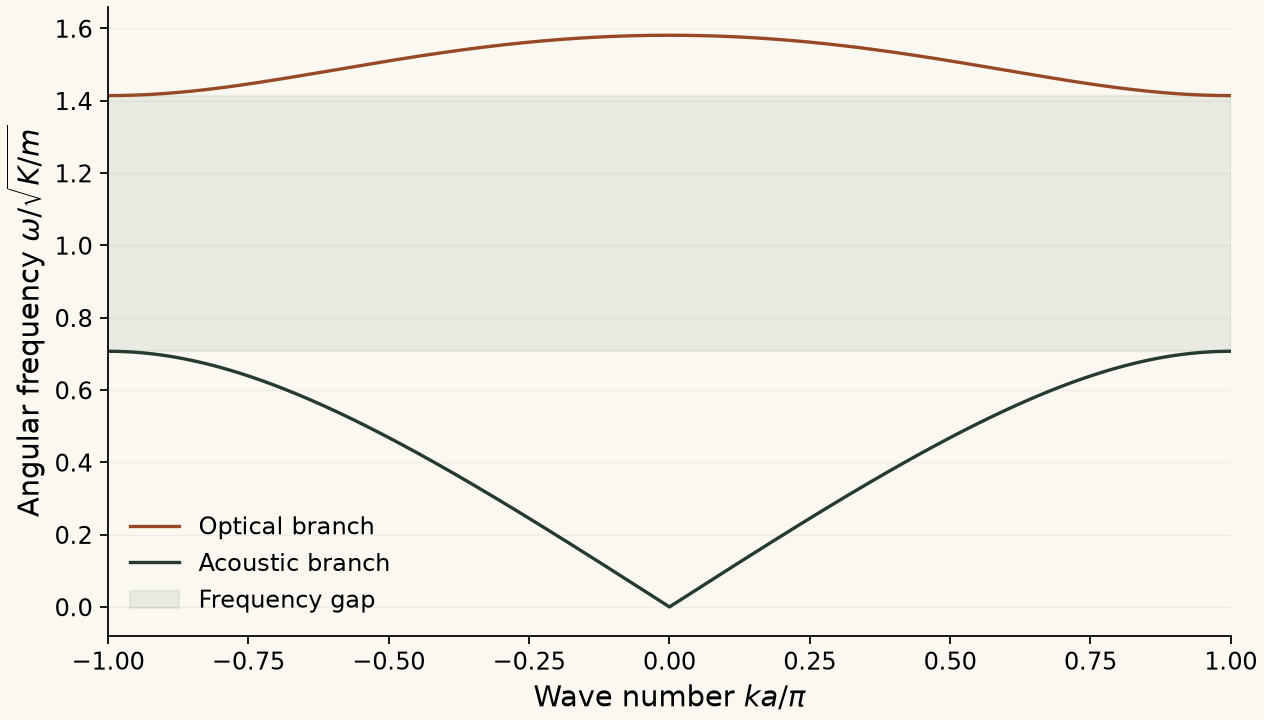
Try it · Diatomic
Change the inputs and compare the recalculated curves with the preceding derivation and baseline figure. The axes give the units; the numerical readout states the model assumptions and any limiting cases. Reset the inputs to return to the reference setting.
Convert a mode count into thermal predictions
Quantisation assigns a harmonic mode levels \(\hbar\omega(j+1/2)\). The thermal part of its mean energy is \(\hbar\omega/[\exp(\hbar\omega/k_BT)-1]\). Low-temperature excitations thus select long-wavelength acoustic modes while high-frequency optical modes remain scarcely populated. Counting states in a three-dimensional sphere gives a low-frequency density proportional to \(\omega^2\) for linear branches. Rescaling the energy integral by \(\hbar\omega/k_BT\) gives thermal energy proportional to \(T^4\) and heat capacity proportional to \(T^3\). Dimensionality and linear dispersion are essential assumptions behind that power.
Count thermally generated vacancies
A mode calculation for a perfect crystal starts with one atom on every site. Heating a real sample can leave some atoms at a surface or reservoir and some lattice sites empty. How large should that defect population be even at thermal equilibrium? Consider \(N\) equivalent sites and \(n_v\) independent vacancies. At fixed temperature and pressure let \(g_f\) be the Gibbs cost of making one vacancy and transferring its atom to the reservoir. It may contain local vibrational contributions. We count the separate entropy of choosing the missing sites explicitly.
There are \(W=N!/[n_v!(N-n_v)!]\) such arrangements. With \(x=n_v/N\) and macroscopic occupations, Stirling’s formula gives
Minimizing with respect to \(x\) gives
The second derivative is positive. Thus \(x=1/(1+e^{g_f/(k_BT)})\). For positive \(g_f\gg k_BT\) there are few vacancies and \(x\simeq e^{-g_f/(k_BT)}\). Each vacancy costs energy, but at tiny \(x\) the number of possible positions grows fast enough to favour a nonzero population. A finite microscopic specimen can still contain zero vacancies at a given instant.
Take \(g_f=0.800\,\mathrm{eV}\) as constant over the chosen range and \(k_B=8.6173\times10^{-5}\,\mathrm{eV/K}\). At \(900\,\mathrm K\), \(k_BT=0.07756\,\mathrm{eV}\) and \(x=3.31\times10^{-5}\). A region with \(10^{15}\) sites contains an expected \(3.31\times10^{10}\) empty sites. At \(600\,\mathrm K\) the equilibrium fraction drops to \(1.91\times10^{-7}\). Rapid cooling may leave an excess because vacancies must migrate to sinks before the concentration relaxes. The formation free energy in this calculation sets an equilibrium population. A migration barrier would enter the time to attain it.
Practise on sheet 1 · Infer a defect formation enthalpy from two temperatures. Further reading · Massachusetts Institute of Technology · 3.46 Photonic Materials and Devices · Notes on Defects in Solids, §3 Point Defect Equilibria.
A light substitution can localize a vibration
An infinite monatomic chain has a continuous vibration band, while a single altered atom can support a vibration spatially concentrated near one site. Let identical springs of stiffness \(K\) connect masses \(m\) on a chain of spacing \(a\), except the central mass at site zero is \(M\). Seek a symmetric localized solution with alternating neighbouring amplitudes \(u_n=A(-q)^{|n|}e^{-i\omega t}\) for \(0<q<1\). Alternation is motivated by the top of the perfect-chain band where adjacent atoms oscillate out of phase. Exponential decay supplies the localization.
At any ordinary site away from the impurity, the equation \(-m\omega^2u_n=K(u_{n+1}+u_{n-1}-2u_n)\) gives
Since \(q+q^{-1}>2\), this frequency lies above the perfect-chain band edge \(\omega_{\max}=2\sqrt{K/m}\). At site zero both neighbours have displacement \(-q u_0\), giving \(M\omega^2=2K(1+q)\). Eliminating \(\omega\) and cancelling \(1+q\) yields
The physical condition \(0<q<1\) requires a lighter central mass \(0<M<m\). A heavy isotope can still scatter travelling waves or produce resonant response within the band. This ansatz predicts no exponentially localized symmetric mode above the band for the heavier substitution. Its absence follows from the admissible decay factor rather than an assumption that a heavy impurity cannot move.
Predict a localized spectral peak
Take host atomic mass \(m=4.00\times10^{-26}\) kg, spring stiffness \(K=40.0\) N/m, lattice spacing \(a=0.300\) nm and impurity \(M=m/2\). The host upper angular frequency is
For the impurity \(q=1/3\), so \(\omega^2=(16/3)K/m\), giving \(\omega=7.30\times10^{13}\) rad/s or \(f=11.6\) THz. The ordinary chain ends near \(10.1\) THz.
The neighbour amplitude is minus one third of the central amplitude, and the second neighbour has plus one ninth. Expressing the absolute envelope as \(e^{-|n|a/\xi}\) gives localization length \(\xi=a/\ln3=0.273\) nm. As \(M\) approaches \(m\) from below, \(q\) approaches one, localization length diverges and the extra frequency merges with the band edge. A finite-chain calculation should therefore vary chain length before claiming that a very weak impurity mode is spatially localized: a box shorter than its decay length cannot separate that broad tail from a standing host mode.
Spatially resolved displacement data can provide two independent estimates of impurity mass. Invert the decay-factor relation to obtain \(M/m=2q/(1+q)\) from neighbouring displacement amplitudes. Separately insert the measured localized frequency and the same host force constant in the central equation of motion. Agreement tests the assumption that the impurity changes only inertia. A substituted atom may also change the two neighbouring springs: in that case the observed frequency and decay factor can no longer be fitted by altering mass alone. This inversion distinguishes an isotope-like substitution from a stronger local bonding perturbation.
A weak second impurity far away perturbs the localized mode only through its exponentially small tail. Bringing two such impurities within a few decay lengths allows the modes to mix and split in frequency, offering another test of their spatial localization.
Study the full derivation
Read atomic motion from Bragg attenuation and diffuse scattering · Structure, excitations and probes of solids
A crystal can retain its periodic mean positions while its diffraction pattern changes markedly with temperature. Start with the thermal average of a scattering amplitude, derive the displacement factor and learn which component of atomic motion a given reflection measures.