From first principles
Recover a lattice spacing from phase addition
Illuminate a row of \(N\) equally spaced atoms with a coherent plane wave and observe weak elastic scattering far away. Each atom sees an incident phase and contributes an outgoing phase. Their difference depends on \(\mathbf q=\mathbf k_{\rm out}-\mathbf k_{\rm in}\). With the origin at the first atom, let \(\phi=\mathbf q\cdot\mathbf a\) be the phase difference between neighbours displaced by \(\mathbf a\). Up to an overall sign convention the total amplitude is a geometric sum:
Here \(f\) is the amplitude from one atom. Use \(|1-e^{ix}|=2|\sin(x/2)|\) and take the squared magnitude. When \(\phi=2\pi m\), evaluate the original sum directly:
For a three-dimensional lattice every primitive translation must meet this phase condition. The resulting peak positions identify reciprocal-lattice vectors. For several atoms in each cell the single-cell factor becomes \(\sum_s f_s e^{i\mathbf q\cdot\mathbf r_s}\). Its squared magnitude can vanish even at a permitted reciprocal vector. An absent peak can therefore reveal interference inside the cell.
Background · Reciprocal lattice
A reciprocal-lattice vector leaves the phase unchanged under every direct-lattice translation. A basis of different atoms can still suppress a reflection.
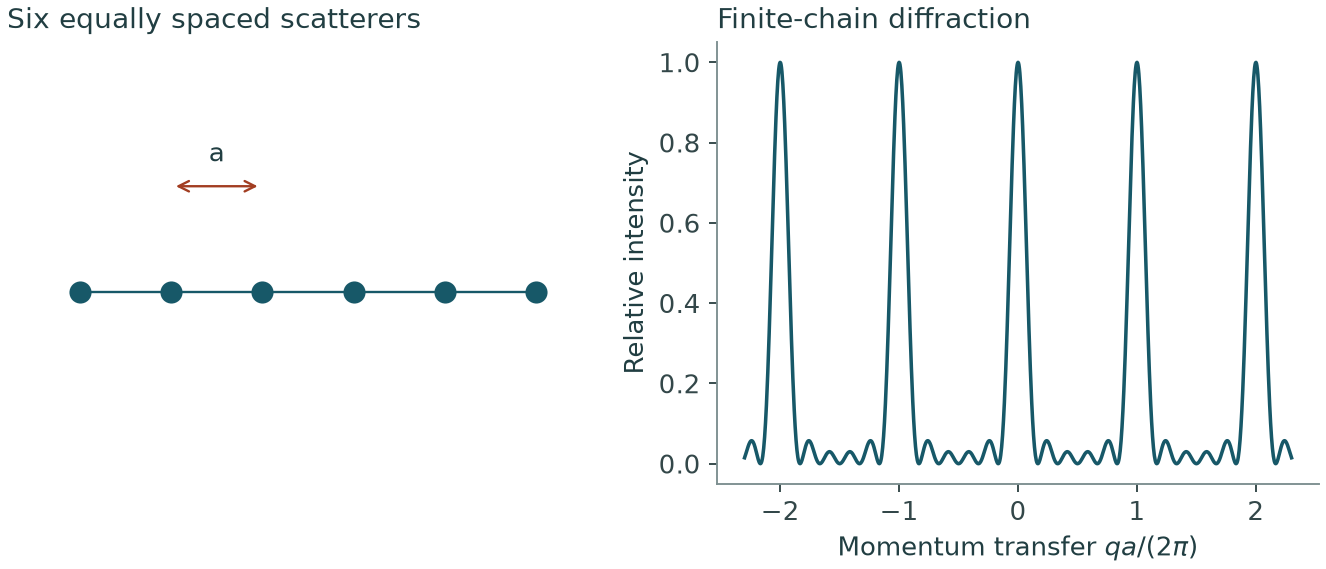 Open full-size diagram
Explore the related parameter study beside the computed figure.
Derivation and applications
Extract atomic displacement from the loss of Bragg intensity
A lattice can keep the same mean spacing while its Bragg peaks lose intensity on heating. Consider a crystal of identical atoms whose displacements about their mean positions fluctuate during the exposure. Treat scattering in the single-scattering approximation. At a reciprocal vector of magnitude \(Q\), every mean lattice position supplies the same phase. The instantaneous displacement projected along the scattering vector, \(u\), adds a phase \(Qu\). If this component is Gaussian with mean zero and variance \(s^2\), averaging the complex amplitude gives
The last equality follows by Fourier transformation of the normalized Gaussian. The coherent peak measures the square of this average amplitude. Squaring the instantaneous phase factor first would give unity and erase the effect of phase differences between sites. With \(I_0(Q)\) the coherent intensity of the perfectly stationary array, the Debye–Waller attenuation is
The formula describes the sharp coherent contribution. The difference between the total averaged intensity and the coherent intensity appears in diffuse scattering. Stronger attenuation at large \(Q\) follows because an identical displacement spans a larger fraction of a scattering phase cycle. For corrected integrated intensities of the same reflection at two temperatures, taken at essentially the same \(Q\), the unknown stationary intensity cancels,
This comparison assumes unchanged occupancies, instrument normalization and negligible changes in the mean structure. For isotropic displacement \(s^2\) is one third of the mean squared three-dimensional displacement.
Worked example
Recover a change in mean-square displacement
Change the inputs and investigate this derivation.
A reflection at \(Q=50.0\,\mathrm{nm^{-1}}\) falls from 10,000 to 8,000 corrected counts. Its projected variance increases by \(-\ln(0.800)/2500=8.93\times10^{-5}\,\mathrm{nm^2}\). If its original projected root-mean-square displacement was \(0.00600\,\mathrm{nm}\), the new value is
Adding the displacements directly would use the wrong measured quantity.
Second application
Test the angular dependence with another reflection
Change the inputs and investigate this derivation.
A second specimen retains 90.0 percent of its low-temperature peak intensity at \(Q=30.0\,\mathrm{nm^{-1}}\). For the same displacement direction at twice that wavevector, the attenuation exponent quadruples. The predicted retention is
A corrected retention near 0.90 for both reflections would instead suggest a common change in illuminated volume or flux that this displacement model cannot explain.
Try it · Debye waller
Vary the physical parameters in the derived relation. Use the units and assumptions in the readout to connect the curves to the two worked examples. A parameter study can test the forward prediction; the same relation can then be inverted to infer a parameter from a measurement.
What repeats in a crystal?
A one-dimensional chain with identical atoms every \(a\) has translations \(R=na\). Replacing every other atom by a different species doubles the primitive translation, even if the nearest-neighbour separation stays fixed. The set of equivalent cell origins is the Bravais lattice; the atoms placed relative to each origin form the basis. Choosing a larger unit cell is allowed but folds distinct waves onto extra branches. Count independent degrees of freedom per unit length as a check on any cell choice.
In three dimensions write \(\mathbf R=\sum_i n_i\mathbf a_i\). Define reciprocal vectors by \(\mathbf a_i\cdot\mathbf b_j=2\pi\delta_{ij}\). Then \(\mathbf G=\sum_i h_i\mathbf b_i\) has \(e^{i\mathbf G\cdot\mathbf R}=1\) at every equivalent origin. These vectors have units of inverse length. For a rectangular lattice doubling a real-space period halves the corresponding reciprocal spacing. The first Brillouin zone consists of wavevectors closer to the reciprocal origin than to any other reciprocal point. Later we will label collective vibrations and electronic states inside this region.
Construct reciprocal space from the primitive cell
A diffraction experiment measures momentum transfer. To predict its possible values, ask which plane waves acquire the same phase at every translated lattice point. For a Bravais lattice with translations \(\mathbf R=\sum_i n_i\mathbf a_i\), the condition is \(\exp(i\mathbf G\cdot\mathbf R)=1\) for every integer choice of \(n_i\). It suffices to require
Collect the primitive direct-lattice vectors as columns of \(A\) and their reciprocal vectors as columns of \(B\). The defining dot products become one matrix equation. Solving it gives
Each column of \(B\) has units of inverse length. Its dot product with its own direct-lattice vector is \(2\pi\) and with every other basis vector is zero. Integer combinations generate the allowed reciprocal vectors. The transpose matters whenever the direct axes are oblique.
For a triangular layer take \(\mathbf a_1=(a,0)\) and \(\mathbf a_2=(a/2,\sqrt3a/2)\). The constraints on \(\mathbf b_1\) first give \(b_{1x}=2\pi/a\) and then \(b_{1y}=-2\pi/(\sqrt3a)\). Similarly \(\mathbf b_2=(0,4\pi/(\sqrt3a))\). Verify that translating along \(\mathbf a_2\) leaves the phase of \(\mathbf b_1\) unchanged. Reciprocal vectors have units of inverse length.
How far can a wave vector move from the origin before an equivalent representative is nearer? The boundary shared with \(\mathbf G\) solves \(|\mathbf k|=|\mathbf k-\mathbf G|\), or \(\mathbf k\cdot\mathbf G=|\mathbf G|^2/2\). The half-planes around the origin define the first Brillouin zone. Here the six shortest reciprocal vectors give a hexagon. With \(a=0.300\,\mathrm{nm}\) the shortest \(|\mathbf G|\) is \(4\pi/(\sqrt3 a)=24.18\,\mathrm{nm^{-1}}\), putting a face midpoint \(12.09\,\mathrm{nm^{-1}}\) from the centre. The zone area is \((2\pi)^2/(\sqrt3a^2/2)=506.5\,\mathrm{nm^{-2}}\), equal to one reciprocal primitive-cell area. Doubling all lattice lengths halves the distances in the diffraction pattern and quarters its zone area. These reciprocal positions follow from translation symmetry. The measured intensities also depend on what occupies each cell.
Practise on sheet 1 · Fold a wave vector into the first zone. Further reading · University of Cambridge · David Tong, Solid State Physics · Chapter 2, Band Structure, §2.2.2 (construction of the reciprocal lattice).
Add amplitudes before taking intensities
An elastic plane wave scattered from positions \(na+d_j\) accumulates a phase equal to the momentum-transfer wavevector \(Q\) times position. For \(N\) identical cells the amplitude factorises:
The last sum is geometric. Its magnitude is \(|\sin(NQa/2)/\sin(Qa/2)|\), with limiting value \(N\) at \(Qa=2\pi h\). Large finite crystals have narrow peaks of height proportional to \(N^2\). The separation to the adjacent first zero is \(2\pi/(Na)\); doubling coherent length halves this width. The basis factor \(F\) sets the relative integrated strengths for a given lattice. A finite instrument resolution also broadens measured peaks and should be characterised before inferring a sample size.
Background · Why are diffraction peaks from small crystals broad?
Along one direction take \(N\) equally spaced scattering planes at \(x_n=na\). Near a reciprocal-lattice vector \(G\), an additional wavevector mismatch \(\Delta q\) accumulates phase \(n a\Delta q\) at the \(n\)th plane. Summing the complex contributions gives a geometric series.
The nearest zero lies at \(2\pi/(Na)\). A coherently scattering length of 100 nm therefore produces a first-zero offset near 0.063 nm\(^{-1}\). A finite width alone does not determine a lattice strain. Finite size sets a scale in absolute wavevector, whereas a distribution of fractional lattice spacings tends to give a width proportional to the reflection wavevector. Comparing several orders helps separate the two mechanisms.
An extinction is evidence about the basis
Place two sites at \(d=0,a/2\), with real scattering amplitudes \(f_A=3\) and \(f_B=1\) held constant over the angular range. At \(G_h=2\pi h/a\), \(F_h=3+(-1)^h\). Even and odd orders have intensities proportional to 16 and 4 respectively, before angular or instrumental corrections. If both amplitudes become equal, the odd peaks vanish. If the two sites have identical chemistry as well as identical positions up to translation, a cell of length \(a/2\) would describe the structure more economically. Equal scattering amplitudes in a particular probe alone cannot establish chemical identity.
For incident wavelength \(\lambda\), with the total scattering angle \(2\theta\),
At \(\lambda=0.154\) nm and spacing \(d=0.200\) nm the first Bragg peak therefore occurs at \(\theta=22.6^\circ\), or detector angle \(45.3^\circ\). A factor-of-two error in reading the detector would corrupt any inferred lattice constant.
What survives a change of origin?
Translating the entire basis by \(d_0\) multiplies \(A(Q)\) by \(e^{iQd_0}\). Intensity is unchanged, so diffraction cannot locate the absolute origin. More generally the phase of the amplitude is missing from a measurement of \(|A|^2\). Peak positions suggest candidate lattices, corrected intensities test a proposed basis and peak widths probe finite coherence or strain. These are different questions even when addressed with the same scan.
Derive the selection rules of a cubic powder pattern
A powdered crystal supplies many crystallite orientations, so a fixed detector angle can intercept every family of reciprocal planes with the appropriate spacing. For a cubic lattice with conventional cell parameter \(a\), reciprocal vectors have magnitude \(2\pi\sqrt{h^2+k^2+l^2}/a\). Bragg's condition then gives
The sequence of squared sines can be used to index the pattern, but only reciprocal points with nonzero structure amplitude produce peaks.
For a monatomic face-centred cubic crystal, describe the lattice with conventional cubic coordinates and basis positions \((0,0,0)\), \((0,\tfrac12,\tfrac12)\), \((\tfrac12,0,\tfrac12)\) and \((\tfrac12,\tfrac12,0)\). For identical atomic amplitude \(f\) their phase sum is
If all indices are even or all are odd, every phase factor is positive and \(F=4f\). Mixed parity makes the sum zero. Thus the first allowed squared-index sums are 3 for (111), 4 for (200), 8 for (220), 11 for (311) and 12 for (222). These extinctions encode the centring translations; adding an internal basis to each lattice site can introduce additional missing peaks. Powder intensity also depends on multiplicity and on angle-dependent scattering factors, so the strongest peak need not have the smallest indices.
Infer a lattice parameter and a strain
Suppose powder peaks under wavelength 0.1540 nm occur at detector angles \(2\theta=38.48^\circ\), \(44.74^\circ\) and \(65.10^\circ\). Their squared half-angle sines are about 0.1086, 0.1448 and 0.2896. After division by the first they give \(1:1.33:2.67\), consistent with \(3:4:8\). Indexing the middle peak as (200) yields
The other two peaks independently give the same value to the displayed precision, unlike an arbitrary assignment to successive integers.
Now let the (200) detector angle fall by \(0.100^\circ\) under load. Differentiating \(2d\sin\theta=\lambda\) gives
Here \(\Delta\theta=-0.0500^\circ=-8.73\times10^{-4}\) rad, hence
That is tensile strain along the scattering vector. A single peak shift cannot establish an isotropic volume strain without further orientations. Multiple peaks can also separate a uniform scale error in wavelength from a genuine directional strain. In the unstrained limit the lattice parameter extracted independently from every correctly indexed family should agree within instrumental uncertainty.
Peak position and width respond differently to imperfections. If all sampled crystallites undergo the same fractional change of their plane spacing, their peaks shift together by the differential Bragg relation. A distribution of tensile and compressive strains can instead broaden the peak around an almost unchanged mean angle. A finite crystallite size can also broaden it, but its angular dependence across several reflection families differs from the leading strain broadening. Comparing several indexed peaks therefore gives more information than treating a wide single line as direct evidence for a particular mean lattice parameter.
Instrumental angle calibration should be checked with a reference powder so that a detector zero shift does not masquerade as a specimen strain.
Tell a finite-size minimum from a basis extinction
Eight identical cells contain sites at 0 and half a lattice period. Sum the eight cell amplitudes coherently, then multiply by the basis amplitude \(f_A+f_B e^{iQa/2}\). Here the form factors are real, positive and independent of angle.
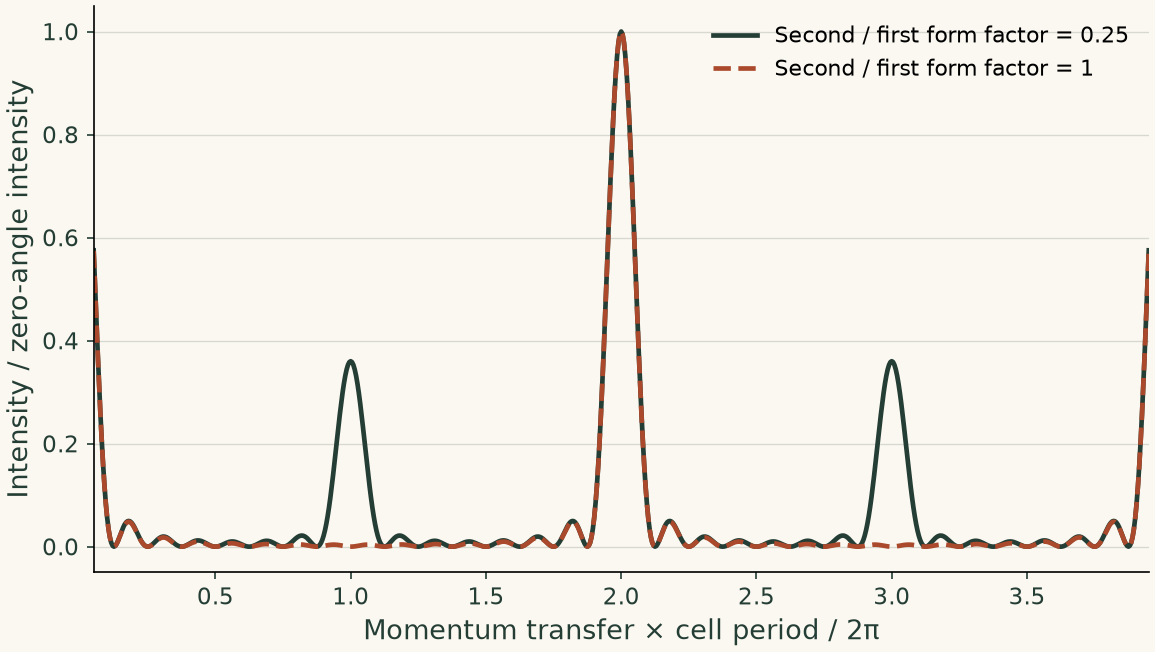
Try it · Diffraction chain
Change the inputs and compare the recalculated curves with the preceding derivation and baseline figure. The axes give the units; the numerical readout states the model assumptions and any limiting cases. Reset the inputs to return to the reference setting.
Read values from the plot
| Momentum transfer × cell period / 2π | Second / first form factor = 0.25 | Second / first form factor = 1 |
|---|---|---|
| 0.05 | 0.57525 | 0.57397 |
| 1.025 | 0.31656 | 0.0013517 |
| 2 | 1 | 1 |
| 2.975 | 0.31656 | 0.0013517 |
| 3.95 | 0.57525 | 0.57397 |
Study the full derivation
Which reciprocal-lattice points produce a diffraction spot? · Structure, excitations and probes of solids
A bright spot depends on the wavelength and orientation of an incident beam, on the periodic repeat of a crystal, and on the atoms inside one repeat. Separate these three conditions so that a missing reflection becomes an interpretable observation. Then use the relative strength of two spots to estimate chemical order.