From first principles
Derive enclosure heat exchange from emission, reflection and absorption
Consider an opaque diffuse grey surface at uniform absolute temperature \(T\). Let \(G\) denote incoming radiant power per area and \(J\) total outgoing radiant power per area. The Stefan–Boltzmann law gives blackbody emission \(E_b=\sigma T^4\). Emissivity \(\epsilon\) scales actual emission; under the grey thermal model absorptivity equals \(\epsilon\), so the reflected fraction is \(1-\epsilon\). Add emitted and reflected contributions to obtain
In an enclosure each surface receives irradiation from the radiosities it sees. For two large parallel facing plates, \(G_1=J_2\) and \(G_2=J_1\). Solving the two linear radiosity equations for their net outward flux difference yields
The denominator incorporates repeated reflections. Equal temperatures give zero net exchange even though each surface radiates. Black plates reduce to the difference of their blackbody emissions. A small surface that sees itself or other walls requires the corresponding geometric view factors in its irradiation balance.
Derivation and applications
Determine a small surface temperature in a large radiating enclosure
A small opaque specimen suspended in a large enclosure receives radiation over its entire visible hemisphere. Under diffuse grey conditions Kirchhoff’s relation gives equal absorptivity and emissivity \(\epsilon\); a large isothermal black enclosure at \(T_w\) supplies irradiation \(G=\sigma T_w^4\). Assume the specimen is isothermal at \(T\), sees only the enclosure, and also exchanges heat with a gas at \(T_g\) through a known constant film coefficient \(h\). Neglect conduction through supports. Let \(p''\) be a uniform internal heat supply per unit radiating area.
Emission and absorption occur separately, so the net outward radiative heat flux is the emitted flux minus the absorbed irradiation. The steady balance becomes
To compare film and radiation effects without approximating a fourth power, factor the difference. Define a secant radiation coefficient between the two actual temperatures:
For perturbations about an operating point, hold \(T_w,T_g\) fixed and differentiate the balance. The slope governing a small additional input is different from the secant coefficient:
Both coefficients have units of W/(m² K); their numerical values coincide as \(T\to T_w\). Fourth powers require absolute temperatures. The balance is monotone for positive \(T\), giving one physically relevant operating temperature for a compatible specified input.
Worked example
Size a heater for a test coupon
Change the inputs and test this calculation.
Let \(T=350\) K, \(T_w=300\) K, \(T_g=310\) K, \(h=8.00\) W/(m² K) and \(\epsilon=0.800\). With \(\sigma=5.6704\times10^{-8}\) W/(m² K⁴), radiation loss is \(313\) W/m² and convection loss \(320\) W/m². A coupon with \(0.0100\) m² total exposed area requires \(6.33\) W. The corresponding secant radiation coefficient is \(313/50=6.26\) W/(m² K).
Second application
Predict a small calibration shift
Change the inputs and test this calculation.
At the same operating point the tangent radiation coefficient is \(4(0.800)\sigma(350)^3=7.78\) W/(m² K). Adding \(0.100\) W over the same area increases \(p''\) by \(10.0\) W/m². Linearization predicts a temperature rise of \(10/(8.00+7.78)=0.634\) K. The differential coefficient applies to this incremental measurement; the secant coefficient gave the original heat exchanged with the enclosure.
Try it · Radiation heater
Set the inputs to the values in the worked example, then vary one quantity while holding the others fixed. Compare the curve and numerical balance with the second application. The calculation uses the assumptions derived above; its readout identifies bounds such as choking, phase-region changes and inconsistent measurements.
Separate what a surface emits from what leaves it
A hot surface transfers energy across a vacuum through electromagnetic radiation. A black surface emits total hemispherical power \(E_b=\sigma T^4\) per unit area, using absolute temperature. A diffuse grey opaque surface emits a fraction \(\varepsilon E_b\) and reflects a fraction of incident irradiation \(G\). Under the grey equilibrium-property assumptions, absorptivity equals emissivity and reflectivity is \(1-\varepsilon\). The total radiation leaving the surface, called radiosity, is then
Net radiative heat flux is
Eliminate the unknown irradiation using the radiosity relation. For a surface of area \(A\) and \(0<\varepsilon<1\), this gives
The denominator behaves like a resistance between the blackbody emission potential and the surface radiosity. It vanishes for an ideal black surface, whose outgoing radiation is set solely by its temperature.
Couple two large facing plates
Consider two large parallel diffuse grey plates of equal area with negligible edge losses. Each plate sees only the other, so \(G_1=J_2\) and \(G_2=J_1\). The net rate from 1 to 2 is \(A(J_1-J_2)\). Combine that space resistance \(1/A\) with the surface resistances of the two plates in series. After cancellation the net flux is
The fourth powers cannot generally be evaluated using Celsius temperatures, even though a simple temperature difference has the same magnitude in kelvins and degrees Celsius. For finite or angled surfaces, a view factor describes how much of one surface’s outgoing radiation reaches the other. Equal area alone does not imply a view factor of one.
Add a freely floating radiation shield
Take \(T_1=500\,\mathrm K\), \(T_2=300\,\mathrm K\), both plate emissivities 0.80 and \(\sigma=5.670\times10^{-8}\,\mathrm{W/(m^2 K^4)}\). The blackbody difference is \(3084\,\mathrm{W/m^2}\). Division by \(1/0.8+1/0.8-1=1.5\) gives \(2056\,\mathrm{W/m^2}\). Insert an opaque thin shield with emissivity 0.10 on both faces and negligible temperature drop through its thickness. There are now two radiation gaps, each with denominator \(1/0.8+1/0.1-1=10.25\).
At steady state the shield exchanges equal heat flux with both plates and stores no energy. With equal gap denominators it follows that \(T_s^4=(T_1^4+T_2^4)/2\), so \(T_s\simeq433\,\mathrm K\). The total resistance denominator is 20.5 and heat flux drops to about 150 W/m². The floating shield temperature is higher than the arithmetic average of the plate temperatures. Solid supports connecting the shield to either plate would add conductive paths and change its temperature and the total heat leak. This explains why a low measured radiative load alone may not determine the performance of an insulated assembly.
Compare radiation with a convection coefficient
For black exchange, factor \(T_1^4-T_2^4=(T_1-T_2)(T_1+T_2)(T_1^2+T_2^2)\). For the original grey plates the corresponding effective coefficient is
It can be compared directly with a convective coefficient for the same temperature difference, but its value changes when either absolute temperature changes.
Combine view-factor reciprocity with grey-surface resistances
Two large parallel plates have equal area and see one another completely. For opposite-sized diffuse grey surfaces in a two-surface enclosure, exchange through the intervening space depends on view factor \(F_{12}\), the fraction of energy leaving surface 1 that directly reaches surface 2. Reciprocity requires
A convex inner body entirely surrounded by a shell has \(F_{12}=1\); radiation leaving the larger concave shell need not all reach the inner body because some hits the shell again.
Net transfer through the space is \(Q=A_1F_{12}(J_1-J_2)\), with radiosities \(J_1,J_2\). Combine this relation with both surface resistance expressions and eliminate the radiosities. For uniform isothermal surfaces that can each be represented by one radiosity, the result is
For concentric long cylinders with negligible ends \(F_{12}=1\) and \(A_1/A_2=r_1/r_2\). The rate per inner area simplifies to \(\sigma(T_1^4-T_2^4)/[1/\varepsilon_1+(A_1/A_2)(1/\varepsilon_2-1)]\). As the outer area becomes very large its surface resistance has little effect on transfer per unit inner area. When the two areas approach equality the familiar parallel-surface denominator is recovered. This area weighting matters when a shiny outer enclosure surrounds a relatively small part.
Separate radiation and support conduction in a vacuum vessel
A long heated cylinder has outer radius 10 mm and active length 0.50 m, concentric with a cylindrical vacuum jacket of inner radius 40 mm. Take \(T_1=400\,\mathrm K,\ T_2=300\,\mathrm K,\ \varepsilon_1=0.70,\ \varepsilon_2=0.20\), and ignore end exchange. Areas satisfy \(A_1/A_2=0.25\), and \(A_1=2\pi(0.010)(0.50)=0.03142\,\mathrm{m^2}\). The effective denominator is
The blackbody flux difference is \(5.670\times10^{-8}(400^4-300^4)=992.3\,\mathrm{W/m^2}\), giving radiative loss \(992.3(0.03142)/2.429=12.8\,\mathrm W\).
Two solid supports each have area 4.0 mm², length 20 mm and mean conductivity 15 W/(m K). Conduction through both is \(2(15)(4.0\times10^{-6})(100)/0.020=0.60\,\mathrm W\), so holding the inner cylinder at its stated temperature requires approximately 13.4 W. A measured heater power of 15 W would leave about 1.6 W unaccounted for, potentially from end radiation, electrical leads, residual gas or emissivity uncertainty. If the jacket is blackened to \(\varepsilon_2=1\), the radiation rises to \(992.3(0.03142)(0.70)=21.8\,\mathrm W\). Improving absorption of the outer wall increases the heat loss from the inner component even though neither temperature changes.
An intercept test can distinguish temperature-dependent pathways more effectively than a single operating point. At a small excess \(\Delta T\) around 300 K, radiative loss varies approximately as \(4\sigma T^3 A_1\Delta T/[1/\varepsilon_1+(A_1/A_2)(1/\varepsilon_2-1)]\). The original cylinder has linearised radiative conductance about \(4(5.67\times10^{-8})(300)^3(0.03142)/2.429=0.0792\,\mathrm{W/K}\), compared with 0.0060 W/K for its two supports. At large temperature differences the effective radiation conductance rises with absolute temperature while ideal support conduction stays linear. Recording heater power at several balanced temperatures lets those trends be tested, provided the surface emissivities and support conductivity do not themselves vary significantly over the range.
A measurement with electrical power off also establishes any background sensor offset before estimating these comparatively small near-ambient conductances from a temperature difference.
Which surface treatment changes net radiation most?
Two large diffuse-grey opaque plates at 400 K and 300 K face each other across a nonparticipating gap. For unit view factor the net radiation resistance is proportional to \(1/\epsilon_h+1/\epsilon_c-1\). Vary the hot coating and keep the cold one fixed.
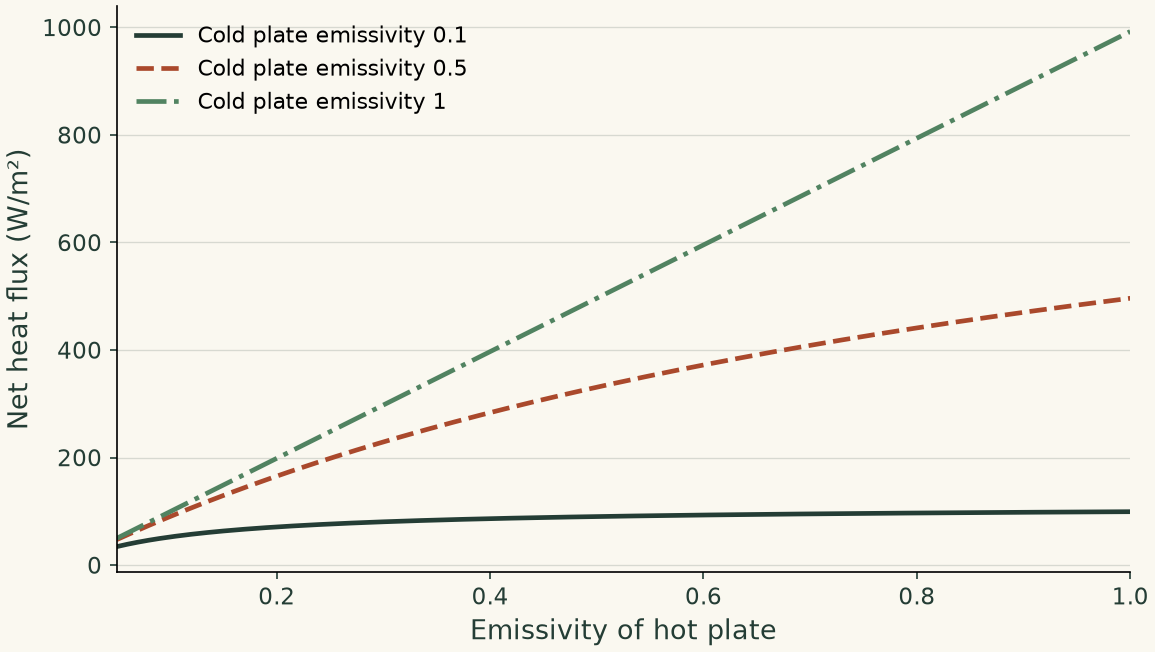
Read values from the plot
| Emissivity of hot plate | Cold plate emissivity 0.1 | Cold plate emissivity 0.5 | Cold plate emissivity 1 |
|---|---|---|---|
| 0.05 | 34.218 | 47.253 | 49.616 |
| 0.29 | 79.715 | 223.08 | 287.77 |
| 0.525 | 90.998 | 341.62 | 520.97 |
| 0.76 | 96.194 | 428.5 | 754.16 |
| 1 | 99.232 | 496.16 | 992.32 |
Interactive calculation · change the inputs of this example
Change the cold coating and compare its effect with changing the hot coating. Temperature enters as an absolute fourth power.
The curves below are recalculated from this section’s equations in your browser. The fixed reference plot above remains available for comparison.
Study the full derivation
Radiative exchange in a grey enclosure · Thermal processes and transport in engineering
A thin radiation shield does not need to absorb all incoming radiation to reduce heat transfer. Multiple reflections connect every surface to every other visible surface. Build the radiosity equations, recover the two-plate result and infer what can be learned from a measured shield temperature.