From first principles
Derive the low-temperature heat capacity from acoustic modes
In a large three-dimensional crystal, long-wavelength acoustic vibrations have approximately linear dispersion \(\omega=vk\). Count allowed wavevectors inside a sphere of radius \(k\). Its volume grows as \(k^3\), so the number of modes below \(\omega\) grows as \(\omega^3\). The frequency density is its derivative. In a single-speed model normalized to the \(3N\) displacements of \(N\) atoms,
Each mode stores mean thermal energy \(\hbar\omega/[e^{\hbar\omega/(k_BT)}-1]\). Multiply by the mode count and substitute \(x=\hbar\omega/(k_BT)\) to expose the temperature dependence,
When \(T\ll\hbar\omega_D/k_B\), the omitted tail above the upper limit is exponentially small. The integral approaches a constant, giving \(U_{\rm th}\propto T^4\) and \(C_V=(\partial U/\partial T)_V\propto T^3\). The cube law relies on both three-dimensional mode counting and linear low-frequency dispersion.
Derivation and applications
Recover the Debye velocity from distinct sound branches
A three-dimensional solid usually carries one longitudinal and two transverse acoustic polarizations. Their speeds can differ substantially. Consider a large elastically isotropic crystal of volume \(V\), with linear dispersion \(\omega=v_s k\) for each polarization \(s\) in the thermally populated range. Impose periodic boundaries; one wavevector state occupies reciprocal volume \((2\pi)^3/V\). For each polarization count all points in a sphere of radius \(\omega/v_s\), which includes opposite propagation directions. Differentiating gives the total density of modes,
A slower sound branch has more low-frequency states because the same frequency reaches a larger wavevector sphere. Define one effective velocity \(v_D\) to preserve this acoustic density of states. Requiring an isotropic monatomic Debye model to contain \(3N\) vibrations, with number density \(n=N/V\), fixes its frequency cutoff and temperature scale,
At low temperature the cutoff can be moved to infinity in the thermal energy integral. Changing variables to \(x=\hbar\omega/(k_BT)\) uses \(\int_0^\infty x^3/(e^x-1)\,dx=\pi^4/15\). A temperature derivative yields the directly measurable coefficient
The inverse cubes explain why replacing the three velocities by their arithmetic mean can noticeably underestimate the heat capacity. Optical or electronic contributions must be identified separately in specimens where they are thermally active.
Worked example
Predict the acoustic temperature scale
Change the inputs and investigate this derivation.
For \(v_L=6000\,\mathrm{m/s}\), \(v_T=3000\,\mathrm{m/s}\), the longitudinal branch contributes only \(1/17\) of the low-temperature coefficient. The effective velocity is
With \(n=5.00\times10^{28}\,\mathrm{m^{-3}}\), the cutoff wavevector is \(1.44\times10^{10}\,\mathrm{m^{-1}}\), giving \(\Theta_D\simeq369\,\mathrm K\). The long-wave estimates apply well below that scale.
Second application
Extract the transverse speed from calorimetry
Change the inputs and investigate this derivation.
Suppose a separate specimen gives \(v_D=2500\,\mathrm{m/s}\) from its low-temperature heat capacity and \(v_L=5000\,\mathrm{m/s}\) from a longitudinal pulse. Solving for the missing speed gives
A shear-wave transit across \(10.0\,\mathrm{mm}\) should consequently take \(4.51\,\mathrm{\mu s}\). This timing test uses a distinct mechanical measurement of the same states counted by calorimetry.
Try it · Debye speed
Vary the physical parameters in the derived relation. Use the units and assumptions in the readout to connect the curves to the two worked examples. A parameter study can test the forward prediction; the same relation can then be inverted to infer a parameter from a measurement.
What a solid can store
Consider an electrically insulating three-dimensional crystal of \(N\) atoms, volume \(V\), sufficiently cold that its structure remains fixed and normal-mode frequencies vary weakly with temperature. In a harmonic approximation displacements about equilibrium separate into \(3N\) independent oscillators. Their excitations are called phonons. Phonon number is not conserved when the solid exchanges heat, so each mode has a Bose mean occupation with zero chemical potential. The modes exist because the crystal can deform, including at very long wavelengths.
A model assigning the same frequency to every oscillator predicts an exponentially small low-temperature heat capacity, since exciting any mode would require a fixed nonzero energy. Acoustic vibrations instead approach zero frequency as their wavenumber approaches zero. Even in a cold macroscopic crystal, long-wavelength modes can remain thermally accessible. The key quantity is how many have energies of order \(k_BT\) or less.
Test the single-frequency model before introducing a spectrum
The premise of the Einstein solid is deliberately restrictive. All \(3N\) vibrational coordinates of a crystal are independent harmonic oscillators with one frequency \(\omega_E\). For one coordinate the levels are \(E_n=\hbar\omega_E(n+1/2)\). Write \(x=\hbar\omega_E/(k_BT)=\Theta_E/T\). Summing the geometric series gives
The partition function of the crystal is \(Z_1^{3N}\), because each normal coordinate can be occupied independently and phonon number is free to change.
Apply \(-\partial\ln Z/\partial\beta\), with \(\beta=1/(k_BT)\), to obtain
The zero-point energy contributes no heat capacity at fixed volume. Differentiating the occupation term and using \(dx/dT=-x/T\) gives
At high temperature \(1-e^{-x}\simeq x\), so the heat capacity per mole of atoms approaches \(3R\). At low temperature the denominator tends to one, and the surviving factor \(x^2e^{-x}\) measures the cost of the lowest available excitation. For \(\Theta_E=240\) K the same mole would have \(C_V=18.06\) J/(mol K) at 120 K, \(7.585\) at 60 K and \(0.536\) at 30 K. Halving temperature does not give a fixed ratio. The curve crosses from a classical plateau to thermally rare excitations.
A real three-dimensional macroscopic crystal supports collective vibrations whose frequencies approach zero with wavelength increasing. Replacing the single frequency by a distribution puts modes below any fixed nonzero thermal scale. The next calculation finds the density of those modes, and therefore a low-temperature power law. High-temperature agreement alone cannot distinguish the two models since both count the same total number of coordinates.
Practise on sheet 5 · Discriminate two low-temperature laws with a ratio. Further reading · University of Oxford · S. Simon, Lecture Notes for Solid State Physics · Chapter 2 · Specific Heat of Solids: Boltzmann, Einstein, and Debye · TUM / Walther-Meißner-Institut · R. Groß, Physik der kondensierten Materie I · §6.1.5 · Debye- und Einstein-Modell.
Count to a cutoff
Use a continuum approximation with three acoustic polarizations and a common sound speed \(v\). The modes in a shell of wavevectors grow as \(k^2dk\), as for photons. Real crystals generally have distinct longitudinal and transverse speeds. An effective Debye speed averages their inverse cubes. Converting via \(\omega=vk\) gives density \(g(\omega)=3V\omega^2/(2\pi^2v^3)\). The continuum would supply infinitely many modes, whereas a crystal with \(N\) atoms has exactly \(3N\). Choose an upper cutoff \(\omega_D\) to match that count,
This cutoff is an approximate representation of the lattice at high wavenumber. The low-temperature prediction depends on the long-wave acoustic spectrum and is insensitive to precise details near the cutoff. In a multi-atom cell additional optical branches change the intermediate-temperature behaviour, which cannot generally be reconstructed with a single effective speed.
Two limits and a measurement
The thermal energy is the integral of \(g(\omega)\hbar\omega/[\exp(\hbar\omega/k_BT)-1]\) over the band. Define \(\Theta_D=\hbar\omega_D/k_B\). When \(T\ll\Theta_D\), extend the upper limit of the dimensionless integral to infinity. The resulting energy scales as \(T^4\) and differentiation yields
At high temperature each mode instead approaches \(k_BT\) of thermal energy and the heat capacity tends to \(3Nk_B\). The acoustic model has the correct count by construction. The constant zero-point energy never enters either heat capacity because it disappears upon differentiation.
For one mole of atoms with \(\Theta_D=300\) K, the low-temperature prediction at 10.0 K is \(0.0720\) J mol⁻¹ K⁻¹, far below the classical \(3R=24.9\) J mol⁻¹ K⁻¹. At 20.0 K the cubic asymptote predicts \(0.576\) J mol⁻¹ K⁻¹. Measuring several temperatures and plotting \(C/T^3\) tests the constant coefficient directly. In a conducting solid an electronic term proportional to \(T\) can dominate at low temperatures. Separating that term through a plot of \(C/T\) against \(T^2\) allows the intercept and slope to reveal the two physically distinct energy stores.
Finite size eventually supplies a lower frequency cutoff related to the crystal dimensions, so the continuum counting argument presupposes a specimen large enough to have many wavelengths populated throughout the temperature interval.
Connect vibrations to thermal expansion
A purely harmonic crystal with force constants independent of volume can store vibrational energy yet has no vibrational mechanism for thermal expansion. Real vibrational frequencies usually vary as the lattice spacing changes. The quasiharmonic approximation treats each mode as harmonic at each volume while allowing its angular frequency \(\omega_j(V)\) to change smoothly. Define the mode Grüneisen parameter \(\gamma_j=-\partial\ln\omega_j/\partial\ln V\). A positive value means expansion softens that mode.
For one oscillator the Helmholtz free energy is
Differentiation at fixed \(T\) gives
where \(U_j\) includes the zero-point energy and the mean thermal excitation. Since vibrational pressure is \(-\partial F/\partial V\), the chain rule gives
A temperature derivative at fixed volume suppresses the constant zero-point contribution. The mechanical relation \((\partial p/\partial T)_V=\alpha_V B_T\) finally yields
Here \(B_T\) is the isothermal bulk modulus and \(\alpha_V\) the volume expansion coefficient. The mode sum weights each Grüneisen parameter by its thermally active heat capacity. A low-frequency mode that softens under compression can contribute negatively and can dominate in a cold crystal while high-frequency modes remain frozen. A single positive average parameter is therefore a material model rather than a thermodynamic necessity.
Infer a mode average from dilatometry
For a cubic crystal take measured molar heat capacity \(C_{V,m}=12.0\) J/(mol K), molar volume \(V_m=1.20\times10^{-5}\) m³/mol and bulk modulus \(B_T=100\) GPa. A measured linear expansion coefficient \(6.00\times10^{-6}\) K⁻¹ corresponds to \(\alpha_V\simeq3\alpha_L=1.80\times10^{-5}\) K⁻¹. The effective heat-capacity-weighted parameter is then
The factor of three comes from differentiating the cube of a length, not from counting acoustic polarizations again.
If the same positive average and bulk modulus remain approximately constant down to a regime where phonons give \(C_V\propto T^3\), the volume expansion coefficient should also fall as \(T^3\). Doubling temperature there increases the coefficient by about eight, although the accumulated length change requires integrating it over temperature. A comparison of \(\alpha_V/C_V\) at several temperatures can test whether the active modes really share a common volume sensitivity. Molar heat capacity and molar volume must be taken on the same chemical counting basis before inferring any dimensionless Grüneisen parameter.
Hydrostatic pressure spectroscopy gives an independent way to measure a mode parameter. By the chain rule, the definition yields \(\gamma_j=B_T(\partial\ln\omega_j/\partial p)_T\) within the quasiharmonic description. For the numerical bulk modulus, a mode with parameter 1.80 would increase its frequency by approximately 1.8 percent under a 1.00 GPa hydrostatic pressure increment. Agreement between this slope and the value inferred from expansion requires that the probed mode be representative of the thermally populated spectrum. A strong optical mode visible to a spectrometer need not dominate low-temperature heat capacity or expansion.
Quoted pressure derivatives must therefore specify the mode, the temperature and whether hydrostatic or directional stress was applied in the measurement.
Which lattice heat capacities survive at low temperature?
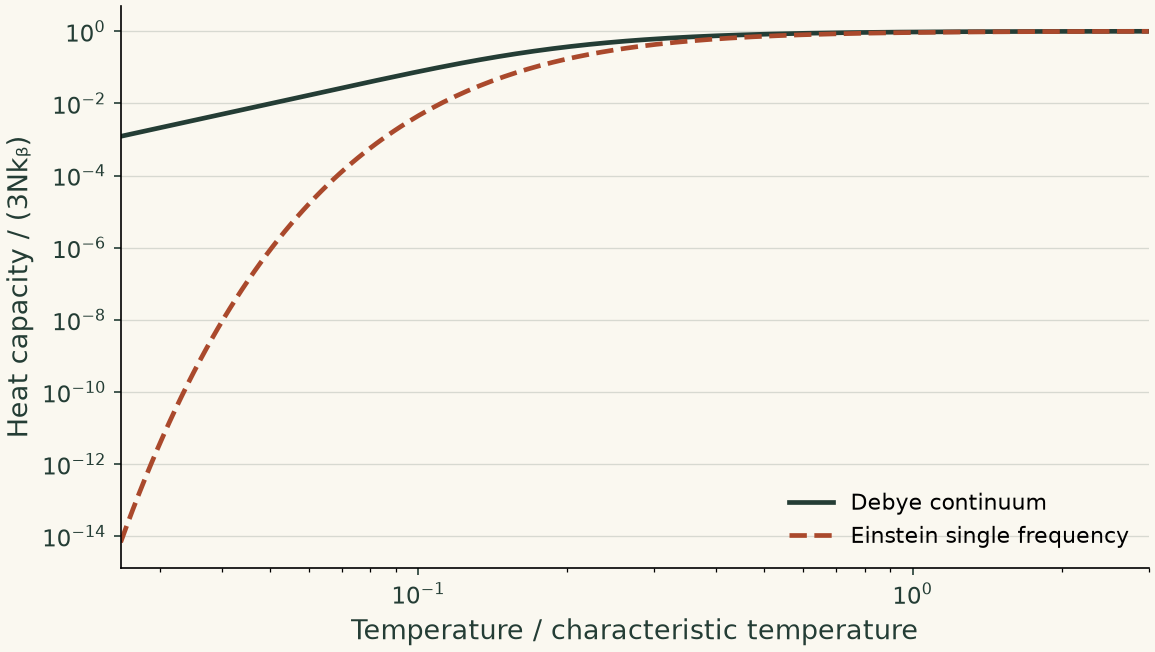
Compare a linear acoustic spectrum with a single oscillator frequency. Scale each temperature by its model’s characteristic temperature. The Debye prediction uses numerical quadrature of \(3t^3\int_0^{1/t}x^4e^x/(e^x-1)^2\,dx\); both expressions approach unity at high temperature.
Try it · Einstein debye
Change the inputs and compare the recalculated curves with the preceding derivation and baseline figure. The axes give the units; the numerical readout states the model assumptions and any limiting cases. Reset the inputs to return to the reference setting.
Read values from the plot
| Temperature / characteristic temperature | Debye continuum | Einstein single frequency |
|---|---|---|
| 0.025 | 0.0012176 | 6.7974e−15 |
| 0.08216 | 0.042949 | 0.00076686 |
| 0.27001 | 0.54841 | 0.35519 |
| 0.91285 | 0.94248 | 0.90572 |
| 3 | 0.99447 | 0.99079 |
Study the full derivation
Rotational and vibrational populations in a molecular gas · Statistical mechanics from microscopic counting to material response
A pressure thermometer and a calorimeter do not count molecular degrees of freedom in the same way. A dilute diatomic gas can retain nearly ideal pressure while its heat capacity changes appreciably as discrete internal levels become populated. Build the molecular partition function, derive the rotor and oscillator contributions, and infer temperatures from line populations without treating spectral intensity as a direct state count.