Displace an electron fluid against its background
Consider a wide slab with carrier number density \(n\), band mass \(m^*\) and immobile neutralising positive background. Displace the electron cloud uniformly through a small distance \(u\) normal to the faces. The opposite surface charges have magnitude \(ne u\) per area and generate a restoring field \(E=ne u/(\epsilon_0\epsilon_\infty)\) inside. The factor \(\epsilon_\infty\) accounts for faster electronic degrees of freedom excluded from the carrier model.
In a homogeneous bulk the same long-wavelength mode follows from continuity, carrier momentum and Gauss's law for a longitudinal density fluctuation. A longitudinal self-sustaining oscillation occurs at a zero of the dielectric function. With damping time \(\tau\) the relative permittivity in this model is \(\epsilon(\omega)=\epsilon_\infty[1-\omega_p^2/(\omega(\omega+i/\tau))]\) for \(e^{-i\omega t}\). Electron energy loss is sensitive to \(-\mathrm{Im}(1/\epsilon)\), while transmission also depends on interfaces.
For \(n=10^{24}\) m⁻³, \(m^*=0.20m_e\) and \(\epsilon_\infty=12\), the model gives \(\omega_p\simeq3.64\times10^{13}\) rad/s, or 5.80 THz. Four times the density doubles this frequency if mass and background screening are unchanged.
Solve an effective electron–hole relative-coordinate problem
In a three-dimensional direct-gap semiconductor a photon can create a conduction electron and a valence hole. Separate their centre of mass from their relative coordinate. Near parabolic band edges the relative mass obeys \(\mu^{-1}=1/m_e^*+1/m_h^*\). Approximate screening by a constant \(\epsilon_r\) over the length and time scales of the pair. The relative Hamiltonian is then hydrogenic.
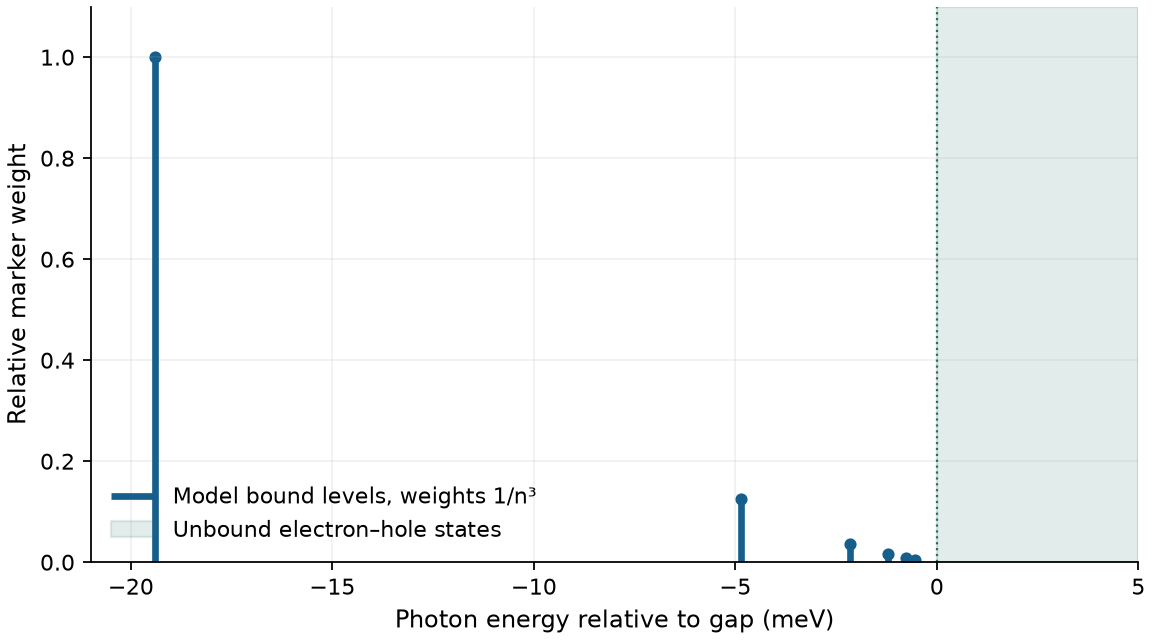
Minimising the expectation for an exponential radius \(a\) gives kinetic energy \(\hbar^2/(2\mu a^2)\) and potential \(-e^2/(4\pi\epsilon_0\epsilon_r a)\). The minimum yields \(a^*=(\epsilon_r m_e/\mu)a_0\) and \(R^*=(\mu/m_e)13.606\,{\rm eV}/\epsilon_r^2\). With \(m_e^*=0.20m_e\), \(m_h^*=0.50m_e\), \(\epsilon_r=10\), these give \(\mu=0.1429m_e\), \(a^*=3.70\) nm and \(R^*=19.4\) meV. The most strongly bound line lies this distance below the unbound continuum. A large radius relative to the unit cell supports the effective-mass model. A sub-gap peak alone can also come from a defect.
Try it · Exciton
Change the inputs and compare the recalculated curves with the preceding derivation and baseline figure. The axes give the units; the numerical readout states the model assumptions and any limiting cases. Reset the inputs to return to the reference setting.
Let a single carrier relax a lattice coordinate
Take a local displacement \(Q_i\), stiffness \(K\), and local occupation \(n_i\). Each site's lattice energy and coupling are \(KQ_i^2/2-g Q_i n_i\). At a fixed occupation distribution minimise over each displacement. In the adiabatic classical distortion model,
A carrier with all its weight on one site gains \(g^2/(2K)\). With uniform weight across \(N\) sites the gain is smaller by \(N\). Hopping competes with this localisation energy. For \(g=2.0\) eV/nm and \(K=20\) eV/nm² the one-site relaxation is 0.10 eV and the optimum displacement 0.10 nm. Compare with the bandwidth before concluding that a small polaron will form. Quantised phonons, tunnelling of the distortion and long-range polar coupling are additional physics.
Recall · Screening has a frequency scale
A bound pair and a fast plasma oscillation need not see the same dielectric constant. Identify which lattice and electronic modes can follow each perturbation before importing a tabulated static permittivity.
Tutorial on assigning a measured feature
1 · Extract an exciton binding scale from two lines
Work through the solution
In the hydrogenic series \(E_2-E_1=3R^*/4\). A splitting of 12 meV gives \(R^*=16\) meV and continuum \(E_g=E_1+16\) meV. Check another member or the absorption onset to distinguish an accidental pair of defect peaks.
2 · Separate two density dependencies
Work through the solution
A mode increasing from 5.8 to 8.2 THz as the carrier density doubles follows the plasmon square-root trend. The simple isolated exciton model has no such density law. At high density screening or many-body effects can also modify the exciton spectrum.
3 · Test the localisation argument
Work through the solution
For equal occupation of two sites the distortion energy gain is half the one-site gain. A two-site bonding state can lower the electronic kinetic energy by a hopping energy \(t\). If \(t\) is large compared with the difference in relaxation energies, localisation cannot be inferred from the static distortion gain alone.
For further study see Kittel, Introduction to Solid State Physics, 8th edition, chapters 14–15 on collective excitations, polarons and optical response.