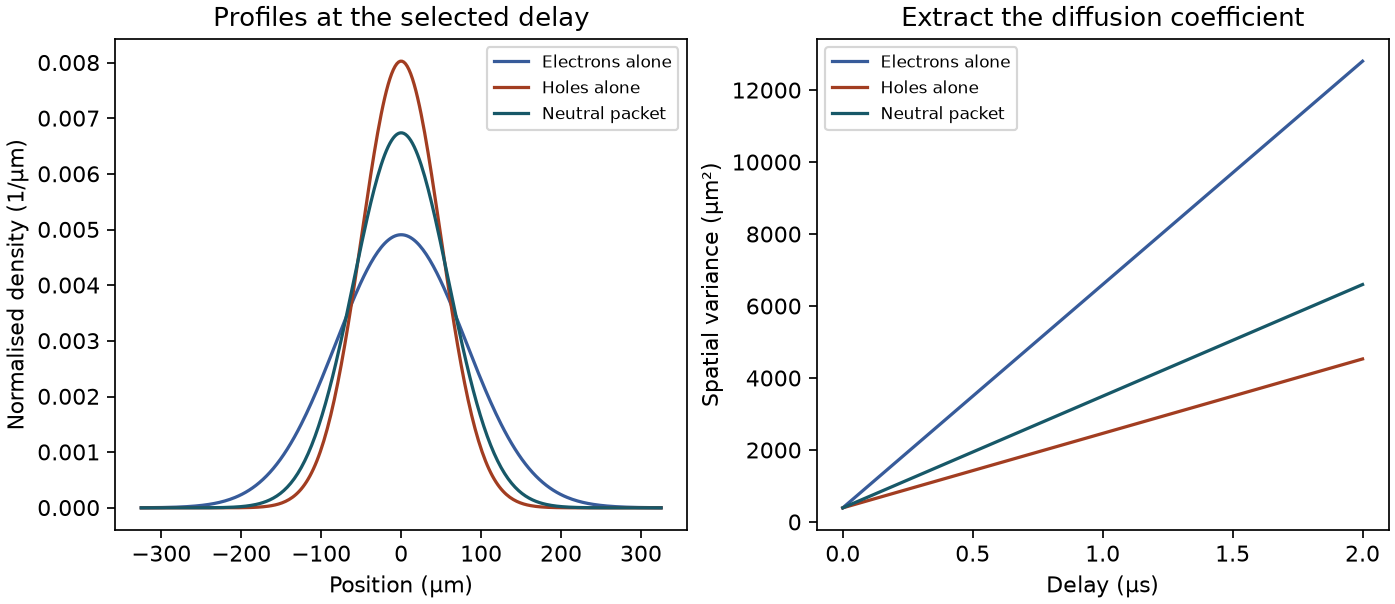
Why an optically injected electron–hole packet spreads at one rate
A light pulse makes equal excess electron and hole densities. A small internal electric field can make their particle fluxes agree even when their mobilities are very different. Compare this coupled motion with two independent Gaussian packets.
Open editable notebook · Download .ipynb · Chapter 5 · Carriers, neutrality and transport in semiconductors
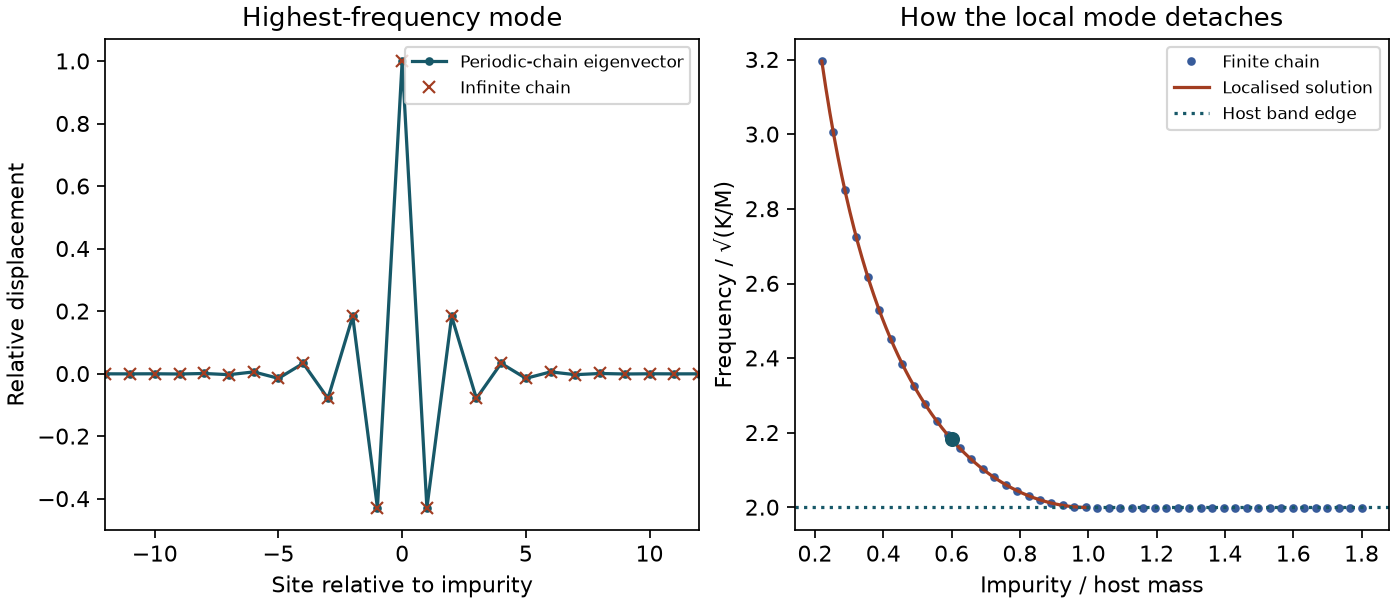
How one light isotope traps a lattice vibration
A perfect chain supports travelling lattice vibrations. Replace one atom by a lighter isotope while keeping every spring unchanged. Determine whether a vibration can now be confined to a few sites, calculate its frequency and decay length, and find out from a finite simulation when the word localised is justified.
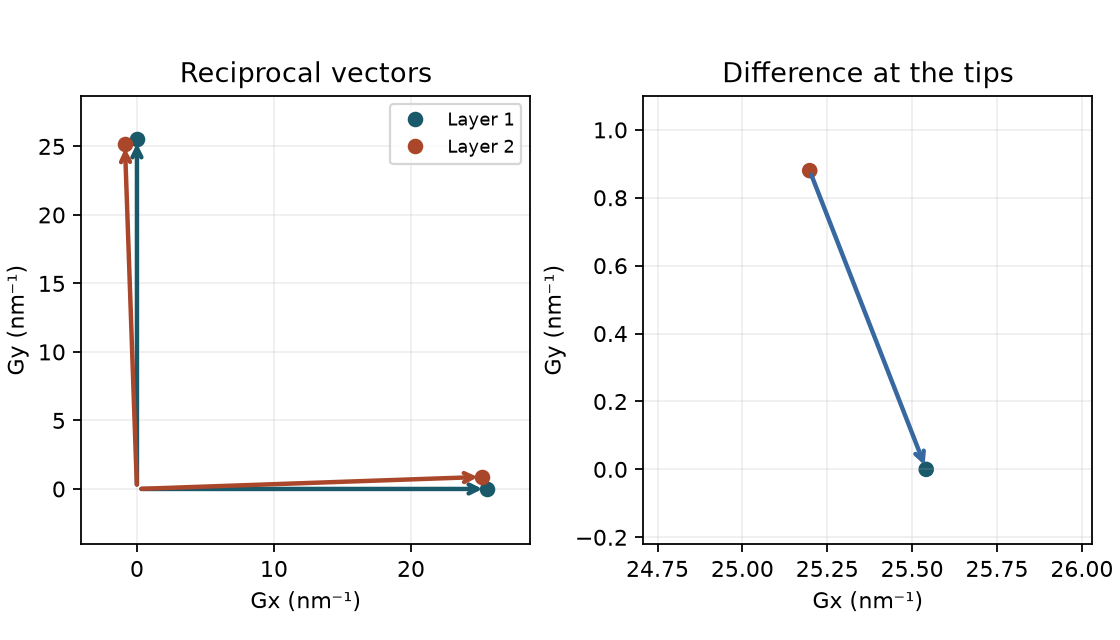
Read twist and mismatch from the moiré of two lattices
Stack two square grids that differ slightly in orientation or pitch. The slowly varying registry map is visible over many unit cells. Derive its scale and direction in reciprocal space, and find which combinations of layer parameters a single period measurement can resolve.
Open editable notebook · Download .ipynb · Structure, excitations and probes of solids
Fundamentals / Physics / Condensed matter and band theory
Condensed matter and band theory · Computational notebooks
Change an input, run the Python cells and compare the result with the derivation. You can also download each notebook for Jupyter.