What is permitted in the unperturbed crystal?
Let each atom of an infinite one-dimensional monatomic chain have mass \(M\), nearest-neighbour spring constant \(K\) and equilibrium spacing \(a\). A small longitudinal displacement \(u_j\) stretches the spring on the right by \(u_{j+1}-u_j\) and that on the left by \(u_j-u_{j-1}\). The restoring force is their difference multiplied by \(K\). Newton's equation conserves total momentum in the absence of external forces and makes uniform translation an exact zero-frequency motion.
For a travelling wave \(u_j(t)=Ue^{i(kja-\omega t)}\), the spatial difference contributes \(e^{ika}+e^{-ika}-2\). Thus
This defines a continuous band from zero to \(\omega_{\max}=2\sqrt{K/M}\). At the upper edge adjacent sites move oppositely; for a fixed amplitude the springs experience their largest extension. A measured peak above that bound could not be a propagating plane wave in this model. It might indicate an incorrect force constant, another branch, an anharmonic response or a local structural change. We shall test one specific explanation using a spatial prediction as well as a spectral one.
The second difference still permits an evanescent displacement
Replace the centre atom by mass \(m=qM\). All equations except that at \(j=0\) remain the same. A vibration spatially confined to the defect should decay in both directions without any boundary driver replenishing it. The upper-band-edge sign pattern suggests \(u_j=U(-r)^{|j|}\), with \(0<r<1\). The sign alternation is crucial: using a positive decaying exponential in a monatomic acoustic branch would give a negative \(\omega^2\) for a freely oscillating stable chain. The ideal symmetric mass defect couples to an even displacement about the origin. An antisymmetric displacement would vanish there and would not feel a change of its inertia.
For \(j\ne0\), substitute the ratio \(u_{j+1}/u_j=-r\) on the right half chain into the equation of motion at frequency \(\omega\). At the centre the neighbours on either side both equal \(-rU\). These two equations must determine the same frequency:
Eliminating \(\omega\) gives \(q(1+r)^2=2r(1+r)\), or \(r=q/(2-q)\) when the decaying solution exists. The physical restriction \(0<r<1\) then requires \(0<q<1\). The complete result is
The second expression measures the decay length of displacement amplitude. The envelope of intensity or squared amplitude decays twice as fast and has half that length. A group velocity evaluated by inserting a real wave number into the ordinary band cannot describe energy transport away from this mode. Its spatial decay replaces a real propagation phase by a complex lattice wave number with real part \(\pi/a\).
Look at what happens when the defect barely differs from its host
Write \(q=1-\eta\) with a small positive mass reduction \(\eta\). The frequency ratio to the band edge is \(1/\sqrt{1-\eta^2}\simeq1+\eta^2/2\). The displacement ratio is \((1-\eta)/(1+\eta)\), giving \(\ell/a\simeq1/(2\eta)\). Two consequences go in opposite directions. A small mass mismatch always gives a mathematical above-band solution in this infinite one-dimensional model, but its frequency is hard to separate from the band and its spatial extent becomes large. An instrument with finite spectral width or a simulation with few atoms may therefore see little evidence of confinement.
Take \(q=0.60\). Here \(r=3/7\simeq0.429\); after three sites the signed amplitude relative to the centre is about \(-0.0787\). The decay length is about \(1.18a\). In frequency units \(\sqrt{K/M}\), the mode sits at 2.18218, clearly above the edge at 2. For \(q=0.98\), by contrast, the excess frequency is only about 0.020 per cent and the decay length is approximately \(25a\). An 80-site ring in the latter case lets the two tails meet at a distance comparable to their decay length. Interpreting the finite eigenvalue as an isolated impurity in an infinite crystal requires a size check.
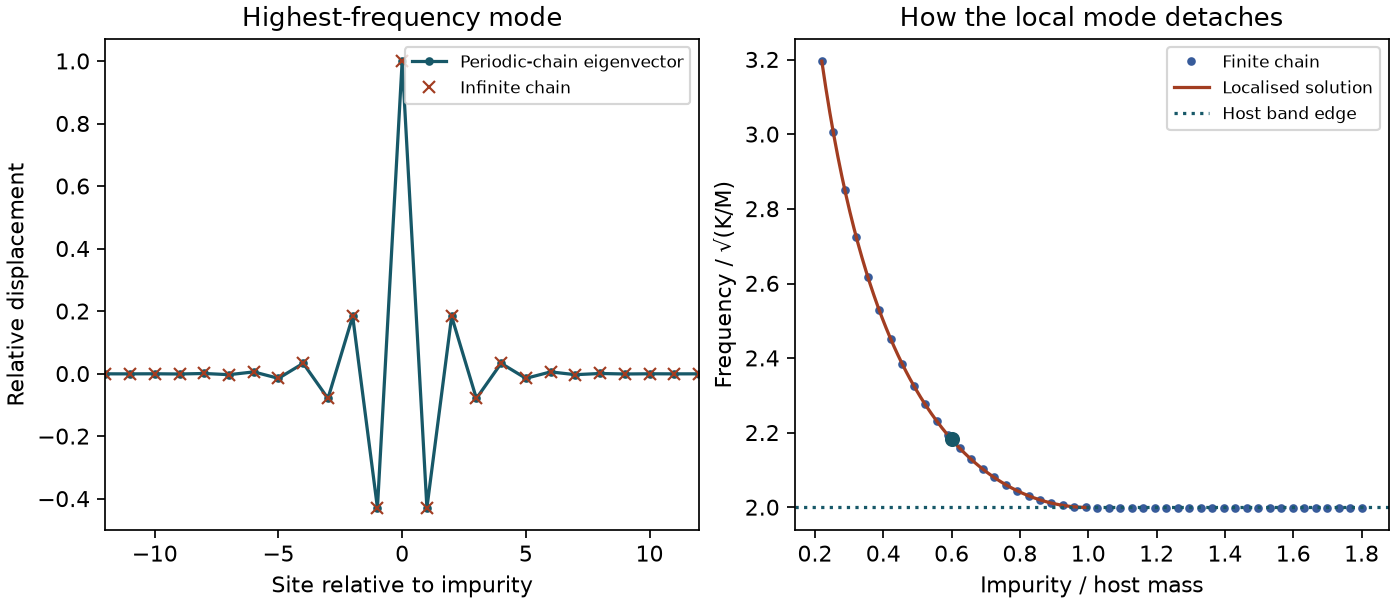 Open full-size diagram
Try it · Impurity
Change the inputs and compare the recalculated curves with the preceding derivation and baseline figure. The axes give the units; the numerical readout states the model assumptions and any limiting cases. Reset the inputs to return to the reference setting.
Download the corresponding editable notebook. The browser recalculates the reduced equations directly; the notebook exposes the full calculation and its checks.
For an ideal isotope change the force constants are held fixed. A chemical substitution can change a bond's stiffness along with its mass, and a crystal with more than one atom per unit cell has additional bands. A heavy impurity can have other local or resonant behaviour in more general systems. The result here concerns an above-band normalisable mode of one mass defect in this harmonic acoustic chain. Simply plugging a value \(q>1\) into the algebraic frequency expression discards the decay condition and can give a spurious interpretation.
Construct the finite eigenproblem from kinetic and elastic energies
For a periodic ring write \(\mathcal M\) for the positive diagonal matrix of masses and \(\mathcal K\) for the cyclic second-difference stiffness. Elastic energy is \(u^\mathsf T\mathcal K u/2\), the sum of positive spring energies. Kinetic energy is \(\dot u^\mathsf T\mathcal M\dot u/2\). The variational equations give
Directly forming \(\mathcal M^{-1}\mathcal K\) yields a nonsymmetric matrix in ordinary Euclidean coordinates. It has the right eigenvalues mathematically, but feeding it to a symmetric eigensolver without transforming it would ask the solver to process a different matrix.
Set \(w=\mathcal M^{1/2}u\). The equivalent symmetric eigenproblem has operator \(\mathcal M^{-1/2}\mathcal K\mathcal M^{-1/2}\). An orthonormal eigenvector \(w\) corresponds to a physical displacement \(u=\mathcal M^{-1/2}w\). Consequently a detector measuring displacement at one site and a map of kinetic participation do not plot the same quantity. At fixed mode frequency the mean kinetic-energy weight at site \(j\) is proportional to \(m_j|u_j|^2\). The notch in the mass at the centre matters even after the spatial shape of displacement has been found.
The notebook forms the ring stiffness from two shifted identity matrices and uses an even site count so that the unperturbed zone edge is an allowed wave number. It reports both the frequency and the impurity's kinetic weight. Validate the result by substituting the recovered displacement into the original force balance at every site, including the two periodic endpoints. Check also the zero-frequency translation mode. A small defect residual and a correct band edge test different aspects of the assembly. The optional OneSimulation cell independently invokes its symmetric eigenproblem interface on the mass-weighted matrix and checks the residual of the highest mode.
Which experiment distinguishes localisation from a stiff crystal?
Suppose spectroscopy resolves an extra high-frequency line. Increasing every spring constant would shift the entire host band by the same square-root scaling. Changing a small set of isotopic masses makes an extra feature with large amplitude near those sites and leaves much of a large sample nearly unperturbed. A local displacement measurement moving away from the known defect therefore discriminates between two explanations that can be adjusted to match one peak frequency. The sign reversal is accessible to a phase-sensitive measurement; an intensity-only experiment determines the envelope but cannot directly establish that successive displacements are out of phase.
One can estimate the weight concentrated at the impurity analytically. With central displacement one, the mass-weighted norm divided by \(M\) is \(q+2\sum_{j\ge1}r^{2j}=q+2r^2/(1-r^2)\). The centre fraction is its first term divided by this sum. Even a pronounced peak need not contain all the energy, and changing the arbitrary normalisation of an eigenvector cannot change such a fraction. This gives a second scalar check more sensitive to errors in the eigenvector than the frequency alone.
Tutorial on localisation and finite rings
A measured displacement envelope falls by a factor of four over two lattice spacings. Within the one-defect model, infer the impurity mass and the frequency relative to the band edge.
Work through the solution
Two spacings multiply amplitude by \(r^2=1/4\), hence \(r=1/2\). The inverse formula gives
The frequency ratio is
If the reported quantity were intensity rather than amplitude the inference would change, so the physical meaning of the recorded ordinate belongs with the number.
For a mass ratio of 0.6, compute the fraction of time-averaged kinetic energy at the impurity. Why is it different from a simple count of squared displacement?
Work through the solution
With \(r=3/7\), the sum over both sides is
The denominator of the mass-weighted norm is \(0.6+0.45=1.05\), giving a centre fraction of \(0.6/1.05=4/7\). Counting squared displacements alone would give \(1/1.45\), which overestimates the central kinetic contribution because that atom carries less mass.
The measured light defect has \(q=0.98\). Estimate a ring size for which the amplitude of one infinite-chain tail at the antipodal site is below one per cent of its central value.
Work through the solution
Require \(\exp[-Na/(2\ell)]<0.01\), hence \(N>2(\ell/a)\ln100\). With about 25 spacings per decay length this gives a little over 230 sites. This is a geometric tail criterion, not an error bound on every eigenvalue. For higher accuracy compare two larger rings and test the residual against the infinite-chain formula.
Further reading · Qiang Luo · Local vibrational mode of an impurity in a monatomic chain with free and periodic boundaries