Subtract two spatial phases
One family of planes in layer one carries a density modulation proportional to \(\cos(\mathbf G_1\cdot\mathbf r)\), with \(|\mathbf G_1|=2\pi/a\). Layer two has spacing \(a(1+\delta)\) and is rotated by \(\theta\). Multiplying their modulations, as in a local registry correlation, produces half the sum of two cosines. The rapidly varying term contains \(\mathbf G_1+\mathbf G_2\); averaging over several original cells leaves the term with \(\Delta\mathbf G=\mathbf G_1-\mathbf G_2\). A distance parallel to \(\Delta\mathbf G\) that advances the resulting phase by \(2\pi\) spans one full registry period.
Taking the dot product of the rotated reciprocal vectors gives the exact geometric scale
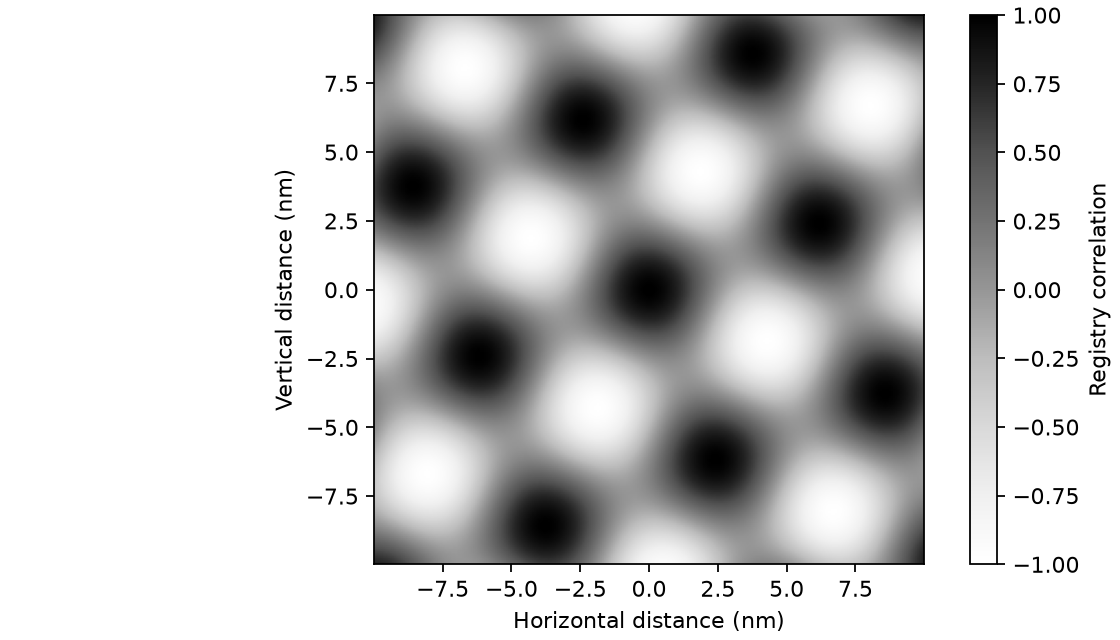
The second perpendicular family of a square lattice rotates and rescales the same way. Its difference vector is perpendicular to the first and has the same magnitude. Their two slow cosines generate a square registry pattern. For small mismatch and small twist measured in radians the period is approximately \(a/\sqrt{\delta^2+\theta^2}\). The interference construction specifies a local continuum period. An exact common atomistic supercell would require additional commensurability conditions.
Interpret a long measured period
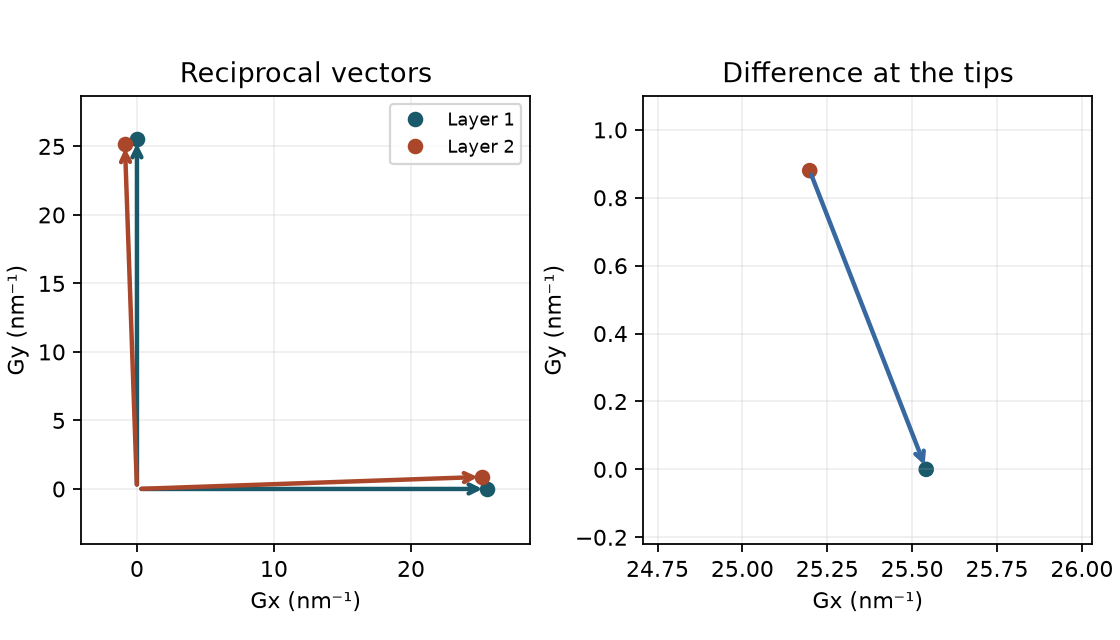
Take \(a=0.246\) nm, mismatch 1.3 percent and twist two degrees. In units of \(2\pi/a\) the horizontal family's difference vector is \((1-\cos\theta/(1+\delta),-\sin\theta/(1+\delta))\), approximately \((0.0134,-0.0345)\). Its length is about 0.0370, so the registry period reaches about 6.65 nm. Each layer still has a spacing near a quarter nanometre. The larger scale is the distance over which small phase differences accumulate.
If an image measures only this period and the first layer spacing, it supplies a single scalar for the two unknowns \(\delta\) and \(\theta\). A reciprocal-space measurement referenced to the first lattice supplies direction as well. In the simple isotropic model this resolves the rotated and rescaled vector by \(\mathbf G_2=\mathbf G_1-\Delta\mathbf G\). Additional distortions or strain require more directions before an inversion is possible.
 Open full-size diagram
 Open full-size diagram
Exercise · determine a twist from pure rotation
The lattice spacings have been verified equal at 0.246 nm. What is the magnitude of the twist if the registry spacing is 10.0 nm?
Work through the solution
With \(\delta=0\), the reciprocal vectors form an isosceles triangle and \(\Lambda=a/[2|\sin(\theta/2)|]\). The small positive solution is \(2\arcsin(0.246/20.0)=0.02460\) rad or 1.41 degrees. Changing the twist sign reflects the pattern without changing its period.
Exercise · make the same spacing with no twist
Use the same first-layer spacing and measured 10.0 nm period. What positive mismatch would explain the observation for aligned layers?
Work through the solution
At \(\theta=0\) and positive mismatch,
Solving gives \(\delta=a/(\Lambda-a)=0.02522\), about 2.52 percent. Comparing this result with the previous exercise shows explicitly why period alone cannot identify a twist.
Try it · Moire
Change the inputs and compare the recalculated curves with the preceding derivation and baseline figure. The axes give the units; the numerical readout states the model assumptions and any limiting cases. Reset the inputs to return to the reference setting.
Download the corresponding editable notebook. The browser recalculates the reduced equations directly; the notebook exposes the full calculation and its checks.