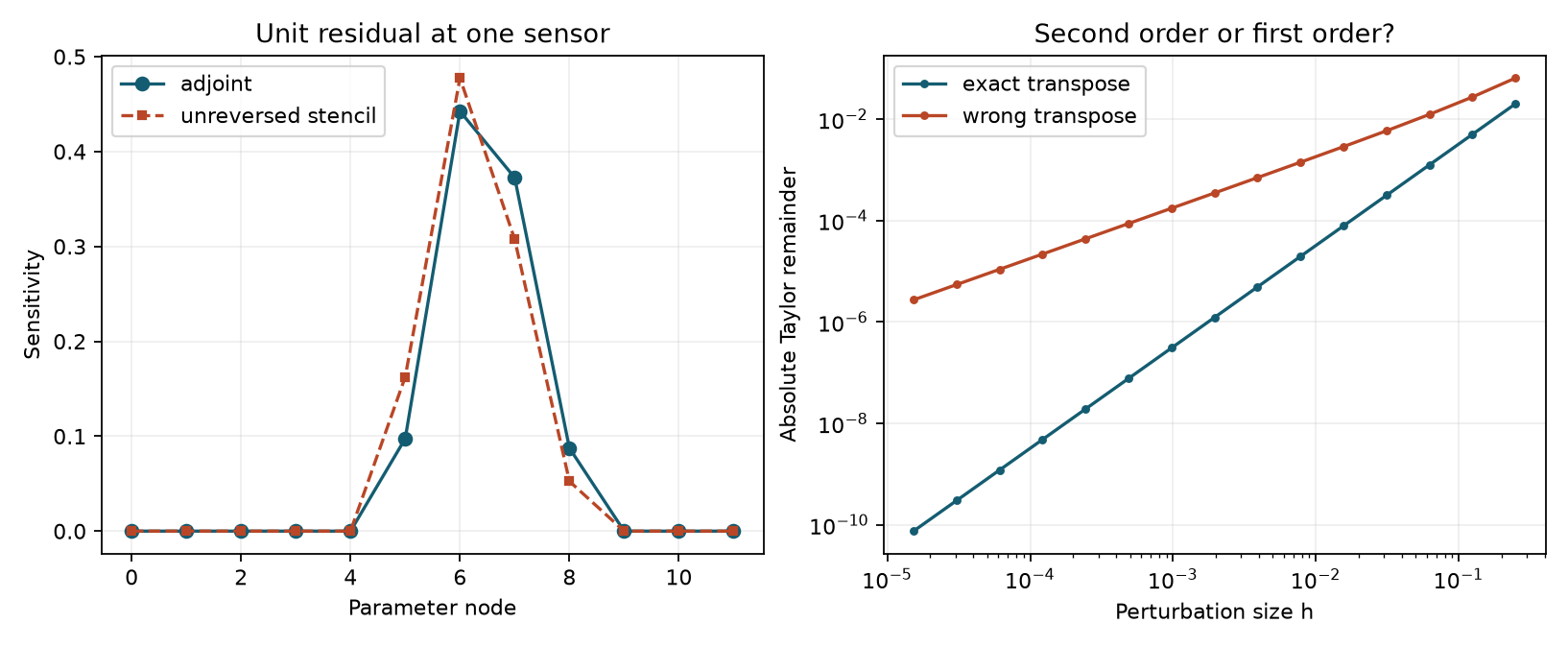
Does the gradient see where the instruments were actually placed?
Build a forward instrument response from smoothing and interpolation. Derive its transpose by reversing the operations and by scattering a residual to both neighbouring grid nodes. The notebook catches a plausible wrong adjoint using inner products and a Taylor test.
Open editable notebook · Download .ipynb · Chapter 9 · Adjoint gradients through a forward solver
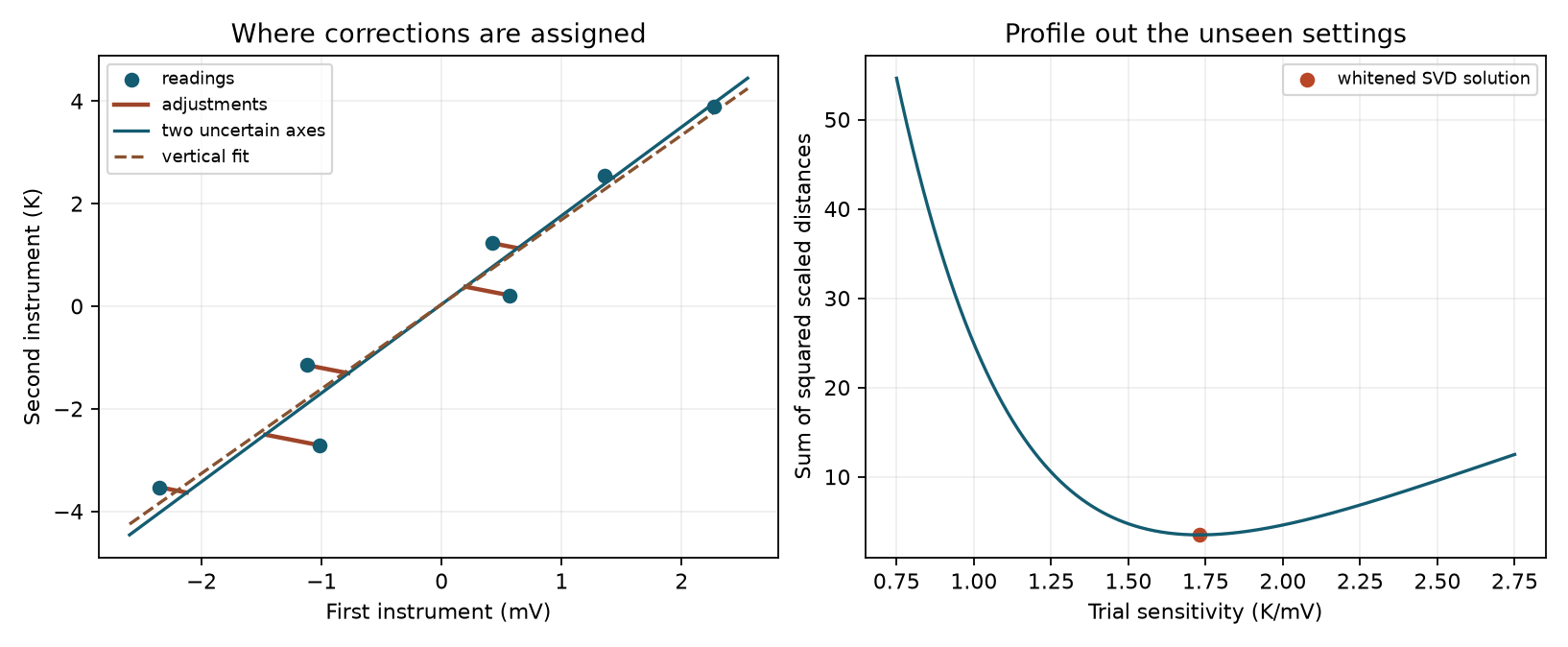
Calibrating two instruments when both axes fluctuate
The horizontal axis of a calibration plot is often described as an input. In this experiment it is itself a reading from a second noisy instrument. Infer a straight calibration relation from paired data, derive the metric in which the fit should be performed, and use a change of units to reveal an easily overlooked modelling error.
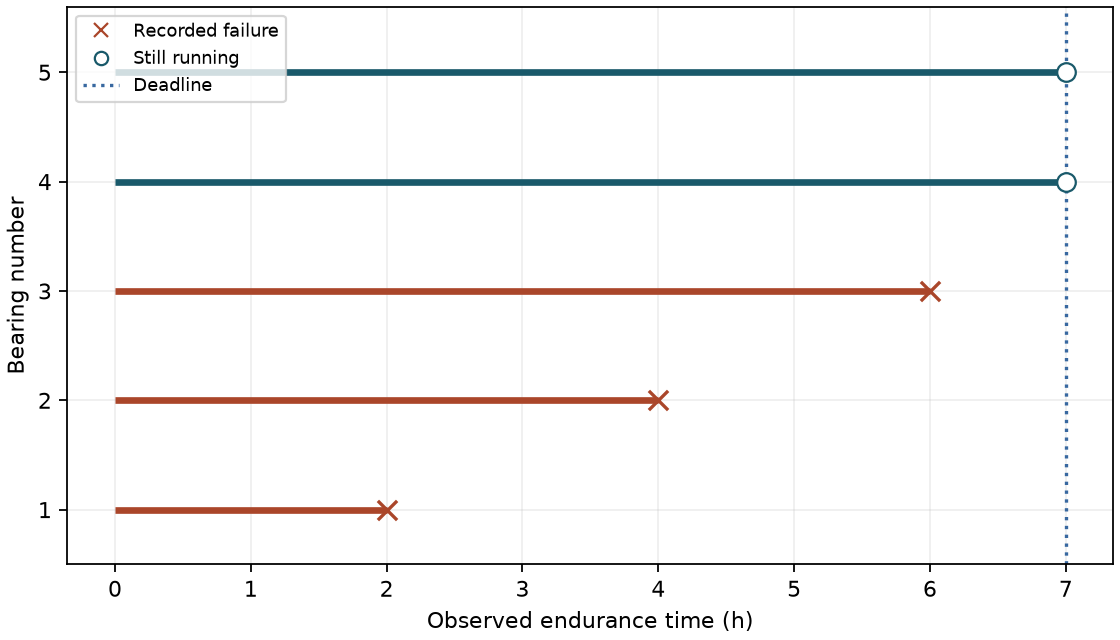
What can unfinished endurance tests reveal about lifetime?
When a test stops, a surviving bearing has supplied information. Derive the likelihood from first principles and examine how changing the observation deadline moves the rate inferred from a small batch.
Open editable notebook · Download .ipynb · Inferring parameters and fields from observations
Fundamentals / Numerical mathematics / Inverse problems and least squares
Inverse problems and least squares · Computational notebooks
Change an input, run the Python cells and compare the result with the derivation. You can also download each notebook for Jupyter.