Count failures and add the time spent on test
Assume identical bearings fail independently at a constant rate \(\lambda\) per hour. Over a short interval \(dt\), the conditional probability of failure for an operating bearing is \(\lambda\,dt+o(dt)\). This gives the differential equation \(S'(t)=-\lambda S(t)\) with \(S(0)=1\) for the fraction surviving beyond \(t\). Its solution is \(S(t)=e^{-\lambda t}\) and the failure-time density is
Choose a fixed administrative deadline \(c\) in advance. Each observed duration is the earlier of the failure time and \(c\). Write \(\delta_i=1\) for a recorded failure, zero for an unfinished run. A failure contributes its density. An unfinished run contributes the probability of lasting at least its recorded duration. Multiplying these quantities over the bearings gives
For positive \(d\), differentiating \(d\log\lambda-\lambda T\) gives a score \(d/\lambda-T\). It vanishes at \(\hat\lambda=d/T\). The curvature \(-d/\lambda^2\) is negative. With zero failures the likelihood falls immediately to the right of zero, making zero the boundary maximum. A survivor contributes no failure to \(d\) and still adds positive exposure to \(T\). Removal triggered by a bearing's imminent failure would require a model for that mechanism. A predeclared deadline avoids this selection issue.
Audit a batch stopped after seven hours
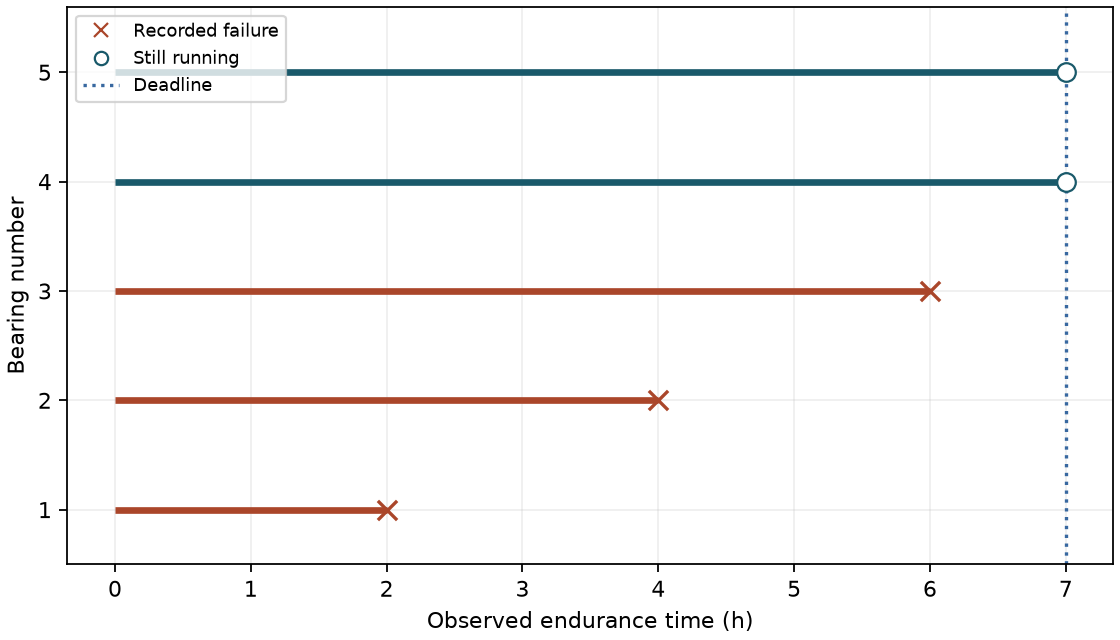
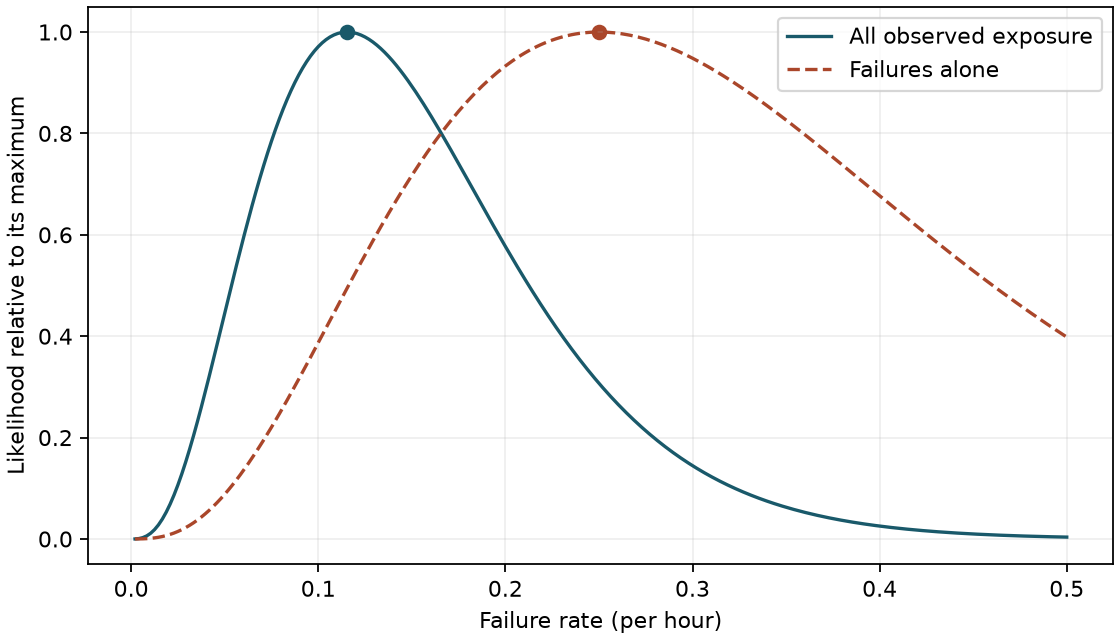
Suppose the simulated complete lifetimes are 2, 4, 6, 9 and 14 hours. At seven hours the actual records are three failures and two unfinished tests. Their total exposure is \(2+4+6+7+7=26\) bearing-hours. The rate estimate is \(3/26=0.11538\) per hour and the fitted mean lifetime is \(26/3=8.667\) hours. Discarding the two survivors leaves 12 bearing-hours and inflates the apparent rate to \(3/12=0.25\) per hour.
For a candidate rate of 0.20 per hour the log likelihood relative to the full-data maximum is
This is a relative likelihood near 0.58. The absolute density changes when time units change, while this likelihood ratio is invariant. In the notebook change the deadline to five hours. Each failure that now occurs after the deadline becomes an unfinished observation. Inspect the time lines before interpreting the new estimate.
 Open full-size diagram
 Open full-size diagram
Exercise · change the stopping time
What does a five-hour deadline yield for the same five bearings? Can extending the deadline without any additional failure increase the estimated rate?
Work through the solution
The durations are 2, 4, 5, 5 and 5 hours with two observed failures. The new estimate is \(2/21=0.09524\) per hour. While additional operating time accumulates with the same failure count, the ratio \(d/T\) falls for positive \(d\). The estimate can jump upward at an actual failure event. A generally increasing or decreasing trend with a moving deadline is therefore not guaranteed.
Exercise · infer an upper rate after zero failures
Five fresh bearings all survive ten hours. Find the rate for which observing no failures would have probability 0.05 under the model.
Work through the solution
All five must survive ten hours. Independence gives probability \(e^{-50\lambda}\). Setting this equal to 0.05 gives \(\lambda=-\log(0.05)/50\approx0.05991\) per hour. Inverting this zero-failure event gives a one-sided 95% upper confidence bound for the rate in this experiment. The likelihood maximum itself remains at zero.
Change parameters · Explore this notebook model
Change one input at a time and compare the recalculated curves with the argument above. The browser evaluates this small model locally; the accompanying numerical values state its assumptions and reference checks. Reset restores the reference inputs, and the data can be downloaded as CSV.