From first principles
Derive maximum useful work relative to an environment
For a closed body changing toward equilibrium with surroundings at \(T_0,p_0\), consider the reversible path that gives the largest possible useful work. Neglect bulk kinetic and gravitational energy. With heat \(Q_0\) positive into the body and total boundary plus shaft work \(W\) positive out, the first law gives
Reversible heat exchange with this environment requires
Part of total work simply displaces ambient pressure, so
Choose the final state as the dead state, denoted by subscript zero. Grouping the available initial differences defines nonflow physical exergy:
If the process generates entropy, the same first and second law combination lowers the useful work by \(T_0S_{\rm gen}\). The expression depends on the specified surrounding state and assumes no other heat reservoirs or chemical changes. A stream crossing a control volume carries its pressure flow work as well, giving a distinct enthalpy-based expression for flow exergy.
Background · Exergy destruction
The environmental reference temperature enters in kelvin. Irreversibility destroys useful-work potential even when the total energy balance closes.
Derivation and applications
Derive the work potential of a compressed flowing gas
A stream can deliver useful work by cooling or by expanding, even when no fuel or chemical reaction is involved. Choose a steady reference environment at \(T_0,p_0\) with the same gas composition. Consider one kilogram taken reversibly from its inlet state to the environmental state. Neglect kinetic and potential energy. Let \(q_0\) be heat supplied from the environment, positive into the device, and \(w\) shaft work delivered. The steady energy balance includes flow work in enthalpy:
The only external heat exchange occurs with the environment. Reversibility then gives \(s_0-s=q_0/T_0\), eliminating the unmeasured heat transfer. The maximum work is the specific physical flow exergy
For an ideal gas with constant \(c_p\) and \(R\), insert \(dh=c_p\,dT\) and \(ds=c_p\,dT/T-R\,dp/p\). Integrate relative to \(T_0,p_0\):
The pressure term survives at ambient temperature. Near \(T=T_0\) the thermal term is quadratic in the temperature difference because energy and the ambient heat contribution cancel to first order. The formula describes work relative to a specified reference and assumes the inlet and outlet composition is the same. An actual dissipative path destroys part of the reversible work potential.
Worked example
Estimate the work available from warm compressed air
Change the inputs and test this calculation.
Take air at \(T=360\) K, \(p=300\) kPa entering an environment at \(T_0=300\) K and \(p_0=100\) kPa. With \(c_p=1.005\) and \(R=0.287\) kJ/(kg K), the thermal contribution is \(1.005[60-300\ln1.2]=5.33\) kJ/kg. The pressure contribution is \(0.287(300)\ln3=94.6\) kJ/kg. Total available work is approximately \(99.9\) kJ/kg, mostly associated with pressure.
Second application
Account for loss in an ambient-temperature throttle
Change the inputs and test this calculation.
Let \(0.100\) kg/s of ideal air throttle adiabatically from \(300\) to \(100\) kPa, both at \(300\) K. Enthalpy stays constant, no shaft work is extracted, and the exergy destruction is \(0.100(94.6)=9.46\) kW. Independent entropy accounting gives \(\dot S_{\rm gen}=\dot mR\ln3=0.0315\) kW/K. Its product with the ambient \(300\) K recovers the same \(9.46\) kW. A device balancing energy perfectly can therefore expend substantial work potential.
Try it · Flow exergy
Set the inputs to the values in the worked example, then vary one quantity while holding the others fixed. Compare the curve and numerical balance with the second application. The calculation uses the assumptions derived above; its readout identifies bounds such as choking, phase-region changes and inconsistent measurements.
How much work is lost when two finite bodies touch?
Two insulated metal blocks start at different temperatures. A small cyclic heat engine could transfer heat from one to the other and deliver shaft work until the temperatures equalise. Simply bringing the blocks into thermal contact also gives a common final temperature, but it conserves a different quantity. Calculate the two end states before estimating how much work the initial temperature difference made available.
Assume constant positive heat capacities \(C_h,C_c\), no phase change, no external heat exchange and no mechanical work by either block. In direct passive contact no outside work is produced. The total energy change is therefore zero, giving \(T_{\rm mix}=(C_hT_h+C_cT_c)/(C_h+C_c)\). If the intervening engine instead operates reversibly, each small entropy transfer leaving the hot block equals the entropy entering the cold one. At the final common temperature \(T_f\),
Here all temperatures are absolute. More formally the logarithms can be taken of ratios to the same reference temperature; that reference cancels. The weighted geometric mean lies below the weighted arithmetic mean. The reversible final state thus contains less internal energy than the passive final state. The difference has emerged as work,
An irreversible engine generates entropy and ends at a higher common temperature with smaller available work.
Take two blocks with capacities of 1.2 kJ/K, initially at 360 K and 280 K. Passive contact ends at 320.0 K; the reversible engine ends at \(\sqrt{360\times280}=317.49\) K and delivers 6.02 kJ. Passive contact generates 0.01890 kJ/K of entropy. To visualise the reversible path, let \(s\) be the entropy transferred from one block into the other. The instantaneous temperatures are \(T_h(s)=T_h(0)e^{-s/C_h}\) and \(T_c(s)=T_c(0)e^{s/C_c}\). The next increment of work is \((T_h-T_c)ds\), so the signed area between the two temperature curves reproduces the total work.
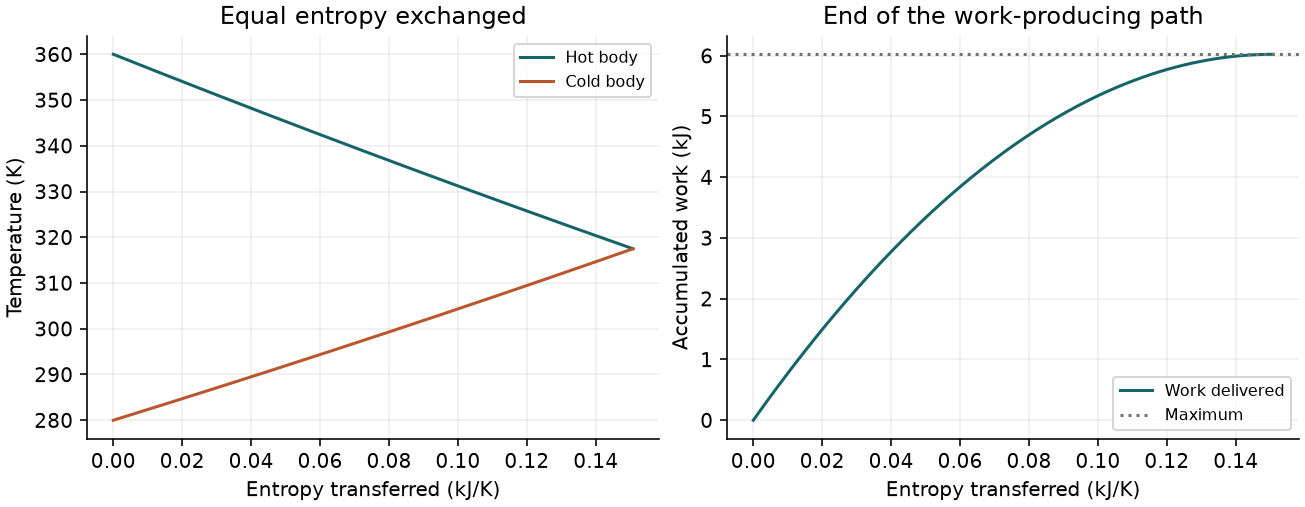
The scaling becomes particularly clear for equal capacities \(C\) when the starting temperatures are \(T_m+\Delta\) and \(T_m-\Delta\). The mixed temperature is \(T_m\), while the reversible final temperature is \(T_m\sqrt{1-(\Delta/T_m)^2}\). Expanding the square root for small temperature gaps gives
For \(T_m=320\) K and \(\Delta=40\) K this is 6.0 kJ, close to the exact 6.02 kJ. Halving the temperature gap at the same mean temperature gives roughly a quarter of the work. The energy initially contained in the warmer block above the mean temperature scales only linearly with the gap, so that energy alone is a poor measure of usable work.
If the surroundings never exchange heat with either block, should their temperature appear in this maximum-work calculation?
Work through the solution
The reversible engine can use only the two specified bodies. Their initial states and conservation of their total entropy determine how far the work extraction goes. A different problem allows ultimate equilibration with an external reservoir at \(T_0\). In that enlarged problem the standard exergy destruction associated with the irreversible contact is \(T_0 S_{\rm gen}\). These work comparisons have different permitted end states. The notebook keeps the enclosure insulated and checks the work using the energy balance on both bodies throughout the exchange.
Interactive calculation · Finite source temperatures
Vary the notebook inputs and compare both plotted observables. The same equations generate the browser curves and the notebook reference; fixed material, geometry and model assumptions are stated in the readout.
Interactive calculation · Finite source work
Vary the notebook inputs and compare both plotted observables. The same equations generate the browser curves and the notebook reference; fixed material, geometry and model assumptions are stated in the readout.
Specify the surroundings before rating a resource
A warm stream contains energy relative to a chosen reference. The amount that could become useful work depends on the surroundings available to receive heat. If stream and environment reach mutual thermal and mechanical equilibrium, there is no further physical work potential associated with their difference. This equilibrium is the physical dead state at \(T_0,p_0\). Exclude chemical reactions here and consider a steady flow with constant composition.
Imagine a reversible device that takes a stream from its current state to the dead state while interacting thermally only with the environment. The steady first law relates delivered work to changes in stream enthalpy, kinetic and potential energy, and heat. The reversible entropy balance gives heat received from the environment \(q_0=T_0(s_0-s)\). Eliminating that heat gives the specific flow exergy
Use consistent units for the kinetic and potential terms. The entropy contribution reduces the fraction of enthalpy that a reversible device can turn into useful work. At the dead state, with the same velocity and elevation as the reference, that work potential vanishes.
Cool a liquid to the environment
Take a stream of liquid water at approximately ambient pressure, 360 K, with negligible motion and elevation change. It flows at 0.20 kg/s towards a large environment at 300 K. Assume \(c_p=4.18\,\mathrm{kJ/(kg\,K)}\) constant. Integration gives
The stream’s specific physical exergy is therefore
Its enthalpy difference is much larger, 250.8 kJ/kg.
Cooling all the way to 300 K makes at most \(0.20(22.2)=4.44\,\mathrm{kW}\) of useful work available, even though the stream releases 50.16 kW of heat. Direct heat exchange with the environment delivers no shaft work. The environment entropy gain is \(50.16/300=0.1672\,\mathrm{kW/K}\), while the stream loses \(0.20(4.18)\ln(360/300)=0.1524\,\mathrm{kW/K}\). The difference, about 0.0148 kW/K, is the entropy production rate. Multiplication by \(T_0\) gives the lost 4.44 kW of work potential.
Include heat crossing another temperature boundary
Heat \(Q\) supplied reversibly by a reservoir at a uniform boundary temperature \(T_b\) carries exergy \(Q(1-T_0/T_b)\). This follows by comparing its energy with the environmental heat required to discharge the associated entropy \(Q/T_b\). A heat input of 10 kW from a 600 K reservoir in a 300 K environment carries 5 kW of exergy. A transfer from a finite cooling stream has changing source temperature and requires integration, as in the water example. Irreversibility in the device destroys exergy at rate \(T_0\dot S_{\rm gen}\); directing heat to a useful secondary process can retain part of the exergy that direct cooling would destroy.
Include the work potential of pressure
For an ideal gas already at \(T_0\), an elevated pressure still gives physical flow exergy \(RT_0\ln(p/p_0)\). Air at 300 K and twice environmental pressure has about \(0.287(300)\ln2=59.7\,\mathrm{kJ/kg}\) of pressure-related work potential although its ideal-gas enthalpy equals that at the dead state.
Derive the least work needed to heat a finite stream
Heat pumps are commonly compared by heat delivered per unit of electrical work. A second-law comparison additionally accounts for the temperature at which heat is delivered. Consider a steady stream heated from \(T_i\) to \(T_o\) at nearly environmental pressure, with constant heat capacity rate \(C=\dot m c_p\). A reversible heat pump extracts heat from surroundings at \(T_0\) and delivers it through a temperature-matched sequence of infinitesimal condensers. For one increment \(dQ=C\,dT\) at stream temperature \(T\), the reversed Carnot relation gives
Integrating over the stream yields
This is the increase of its physical flow exergy, and is smaller than evaluating the Carnot work factor at the final high temperature for the whole heat duty. A device that condenses at a single temperature above the warmest outlet generates entropy during delivery to the colder portions. The result assumes that the source of heat is the environment at \(T_0\); a colder source would introduce an additional resource requirement.
For steady equipment receiving only electricity and environmental heat, with negligible parasitic flows, a meaningful second-law efficiency is the stream’s exergy increase divided by actual electrical input. Electric power is entirely work potential, whereas a kilowatt of heat near room temperature carries only a small fraction of a kilowatt of exergy.
Compare a heat pump with a resistance heater
Water flows at 0.10 kg/s from 293 K to 333 K in a 293 K environment. With \(c_p=4.18\,\mathrm{kJ/(kg\,K)}\), heat duty is \(0.418(40)=16.72\,\mathrm{kW}\). The exergy increase is \(0.418[40-293\ln(333/293)]=1.05\,\mathrm{kW}\) approximately. This relatively small figure reflects the modest average temperature lift. A well-insulated heat pump drawing 4.20 kW from the electrical supply has heating COP \(16.72/4.20=3.98\) and exergy efficiency about 25%. Its surroundings provide 12.52 kW of heat under the stated energy balance.
A resistance heater supplying the identical water service draws 16.72 kW when its losses to the room are negligible. It is nearly 100% efficient on the simple electrical-energy-to-heat basis, yet its exergy efficiency is only about 6.3%. For the heat pump the implied destruction of work potential is \(4.20-1.05=3.15\,\mathrm{kW}\); for resistance heating it is about 15.67 kW. Electricity used by a circulating pump, external heat leaks or a source below environmental temperature belongs in the appropriate device boundary before drawing a practical comparison. The heat-duty equality ensures that the machines are judged against the same delivered temperature service.
For the resistance case the entropy balance can be checked without using the exergy formula. Electrical work carries no entropy across the control surface, and assume no heat leakage. The stream increases its entropy at \(0.418\ln(333/293)=0.0535\,\mathrm{kW/K}\). Multiplying by the 293 K environment gives 15.7 kW destroyed, consistent with the difference between input work and stream exergy gain. This agreement depends on keeping the heater and heated stream in the same chosen boundary.