From first principles
Obtain cycle efficiency and refrigerator performance from two balances
A working fluid completing a cycle returns to its original thermodynamic state, so its internal energy and entropy have zero net changes. Denote positive magnitudes of heat received from the hot reservoir and given to the cold reservoir by \(Q_h,Q_c\), with absolute temperatures \(T_h>T_c\). For a heat engine the first law then gives work delivered as their difference, and the cycle entropy balance relates both heat amounts:
Since generated entropy is nonnegative, \(Q_c/Q_h\ge T_c/T_h\). Thus the maximum fraction of the absorbed heat available as work occurs for a reversible cycle:
For a refrigerator run in the opposite direction the useful output is extracted cold heat and the input is compressor work. Applying the same balances with heat directions reversed gives
These limits assume exactly two thermal reservoirs. The actual cycle depends on how its individual compression, heat exchange and expansion processes are carried out.
Derivation and applications
Combine two refrigeration stages without counting intermediate heat twice
A cascade refrigerator can move heat across a large temperature interval using two separate loops. For an ideal limit, assume each stage is reversible, works steadily, and exchanges heat with constant-temperature reservoirs. The lower stage extracts \(Q_c\) per cycle at \(T_c\) and rejects \(Q_i\) at intermediate temperature \(T_i\). The upper stage takes precisely this \(Q_i\) and rejects \(Q_h\) at \(T_h\). All temperatures are absolute; ignore other heat leaks, pressure drops and energy storage at the intermediate exchanger.
For a reversible cycle the working fluid returns to its initial entropy, so its incoming and outgoing heat-to-temperature ratios match. Apply this statement independently to both stages:
Energy conservation gives the work delivered to each compressor. In the sum the intermediate heat cancels because it leaves the first loop and enters the second:
Combine the two ratios to remove \(T_i\). The minimum work and highest possible overall cooling coefficient of performance are
The ideal intermediate temperature controls how work is split but cannot change the reversible overall limit. A real cascade can benefit from smaller pressure ratios in its components. Heat exchanged across a finite temperature difference at the interstage exchanger produces entropy and raises work above the reversible value.
Worked example
Allocate heat and work in a laboratory freezer
Change the inputs and test this calculation.
Take \(T_c=240\) K, \(T_i=270\) K, \(T_h=300\) K and cooling duty \(2.00\) kW. The lower stage rejects \(2.25\) kW, consuming \(0.250\) kW. The upper rejects \(2.50\) kW and also consumes \(0.250\) kW. The overall COP is
The upper loop has to process all the heat extracted from the cold space plus the lower compressor work.
Second application
Quantify the cost of a finite interstage temperature difference
Change the inputs and test this calculation.
Keep the end temperatures and cooling duty, but let the lower stage reject heat at \(275\) K while the upper stage takes it at \(265\) K. Treat each separate stage as internally reversible. The shared heat rate is now \(2(275/240)=2.292\) kW. Upper rejection is
The total work rises to \(0.594\) kW and COP falls to \(3.37\). The exchanger generates \(2.292(1/265-1/275)=0.000315\) kW/K; multiplied by \(300\) K this accounts for the extra compressor work.
Try it · Cascade
Set the inputs to the values in the worked example, then vary one quantity while holding the others fixed. Compare the curve and numerical balance with the second application. The calculation uses the assumptions derived above; its readout identifies bounds such as choking, phase-region changes and inconsistent measurements.
Account for transfers over a complete cycle
A cyclic machine returns a working fluid to its initial state. Its internal energy and entropy changes over one complete cycle are zero. Heat and shaft work can nevertheless have nonzero net values. For an engine receiving \(Q_h\), rejecting positive magnitude \(Q_c\) and delivering work \(W_{\rm out}\), the first law gives
Thermal efficiency is \(W_{\rm out}/Q_h\). A refrigerator instead consumes work to remove heat from a cold space. Its useful effect is cooling, so its performance measure is \(\mathrm{COP}_R=Q_c/W_{\rm in}\).
Between reservoirs at absolute temperatures \(T_h,T_c\) a reversible cycle transports equal entropy \(Q_h/T_h=Q_c/T_c\). Combining this condition with the first law gives \(\eta_{\rm rev}=1-T_c/T_h\) for an engine and \(\mathrm{COP}_{R,\rm rev}=T_c/(T_h-T_c)\) for a refrigerator. The latter can exceed one because cooling duty includes transported heat. A heat pump uses \(Q_h\) as useful output and has \(\mathrm{COP}_{HP}=\mathrm{COP}_R+1\) for the same cycle.
Follow the refrigerant once around the loop
Label the compressor inlet 1, discharge 2, condenser outlet 3 and expansion-valve outlet 4. Assume steady operation, negligible kinetic and elevation changes and insulated compressor and valve. The evaporator absorbs \(q_c=h_1-h_4\) per kilogram, the compressor consumes \(w=h_2-h_1\), the condenser rejects \(q_h=h_2-h_3\) and throttling preserves enthalpy \(h_4=h_3\). Enter enthalpies from a consistent refrigerant table or supplied state data. A constant ideal-gas heat capacity cannot represent latent heat across a two-phase region.
At saturation a mixture at quality \(x\) has \(h=(1-x)h_f+xh_g\), where \(x\) is vapour mass fraction and \(h_f,h_g\) are saturated liquid and vapour enthalpies at the same pressure. A throttle can create vapour as the pressure falls even though no external heat enters the valve. The mixture redistributes its enthalpy between phases at the new saturation temperature.
Determine cooling, power and flash fraction
For an illustrative refrigerant take enthalpies \(h_1=390\), \(h_2=430\), \(h_3=h_4=250\) kJ/kg. At evaporator pressure the saturated values are \(h_f=200,\ h_g=390\) kJ/kg. With mass flow 0.060 kg/s, the evaporator removes \(0.060(390-250)=8.40\) kW, the compressor needs 2.40 kW and the condenser rejects 10.80 kW. The powers satisfy \(8.40+2.40=10.80\) kW, and cooling COP is 3.50. The valve outlet quality is \((250-200)/(390-200)=0.263\): just over a quarter of the mass is already vapour when it enters the evaporator.
Suppose that at the actual discharge pressure an isentropic compression would give \(h_{2s}=420\) kJ/kg. The compressor isentropic efficiency is
Losses raise the required shaft power and increase condenser duty at unchanged evaporator inlet and outlet conditions.
Distinguish a property assumption from a bound
If heat is removed from a 268 K reservoir and rejected to a 308 K reservoir, the reversible refrigeration COP is
A measured COP of 3.50 lies below that limit. Real heat exchangers need finite temperature differences, compressors generate entropy and valves destroy expansion work. Reducing the required temperature lift improves the reversible limit. The working fluid’s actual pressures and enthalpies must be redetermined to estimate a real COP change. A cycle sketch and a numbered state table prevent accidentally using a compressor outlet temperature as the external hot-reservoir temperature in the bound.
Follow the energy after the compressor stops
Consider a cold cabinet held at constant temperature by a refrigerator. If it receives a 100 W heat leak and a 25 W electric fan dissipates power inside it, the evaporator must remove 125 W in steady operation. At cooling COP 2.5 the compressor draws 50 W, and the condenser releases \(125+50=175\) W into the room. If both the condenser and the cabinet exterior exchange heat with that room, its net thermal gain from the refrigerator system is
This equals the total electrical input to fan and compressor. Boundary selection explains why the condenser duty and the net heating of the entire room have different values.
Derive a gas-turbine efficiency from pressure ratio
A gas turbine running on a closed idealised Brayton cycle provides a useful counterpart to a refrigerating cycle. Model compression and expansion as isentropic ideal-gas processes with constant heat capacities. Heat is supplied and rejected at constant pressure. Let \(T_1\) be compressor inlet, \(T_2\) compressor outlet, \(T_3\) turbine inlet and \(T_4\) exhaust, and set \(r_p=p_2/p_1=p_3/p_4\). For \(a=(\gamma-1)/\gamma\), the isentropic relations give
The heat quantities per kilogram are \(q_{\rm in}=c_p(T_3-T_2)\) and \(q_{\rm out}=c_p(T_4-T_1)\).
Rewriting the latter difference as \((T_3-T_2)/r_p^a\) yields the ideal thermal efficiency \(1-r_p^{-a}\). This simple rise with pressure ratio does not mean that available shaft work rises indefinitely for a fixed permissible turbine inlet temperature. Net specific work divided by \(c_p\) is \(T_3(1-1/y)-T_1(y-1)\) with \(y=r_p^a\). Differentiating gives \(T_3/y^2-T_1=0\), so maximum work at fixed end temperatures occurs at \(y=\sqrt{T_3/T_1}\). When compression heats the gas all the way to \(T_3\), external heat input and net output both vanish in the ideal model.
Calculate the fraction of turbine output consumed by compression
Let \(T_1=300\,\mathrm K,\ T_3=1200\,\mathrm K,\ r_p=8,\ \gamma=1.4\), and \(c_p=1.005\,\mathrm{kJ/(kg\,K)}\). Then \(y=1.811\),
Compressor work is 244.7 kJ/kg, turbine work is 540.2 kJ/kg and net output is about 295.6 kJ/kg. The back-work ratio is \(244.7/540.2=0.453\), and the thermal efficiency is 44.8%. The ideal maximum-work pressure ratio would be \(2^{1/a}=11.31\) for these temperature limits.
Now specify compressor isentropic efficiency 0.82 and turbine efficiency 0.87 at the same pressure ratio and inlet temperatures. Actual compressor outlet is \(300+(543.4-300)/0.82=596.9\,\mathrm K\) and actual turbine outlet is
The net work becomes
Heat supplied is \(1.005(1200-596.9)=606.1\,\mathrm{kJ/kg}\), giving efficiency 28.3%. A relatively small fractional degradation in each machine causes a larger fractional drop in net power because compression consumes a large portion of gross turbine work. If a recuperator is considered, the actual exhaust being hotter than the compressor discharge offers a possible heat-recovery driving temperature difference.
The actual exhaust and compressor temperatures also quantify the limit of regeneration. If both streams have the same heat capacity rate and an idealised recuperator has effectiveness 0.70, the compressed stream can gain \(0.70(732.3-596.9)=94.8\) K before entering the external heater. Its required heat input falls by \(1.005(94.8)=95.3\,\mathrm{kJ/kg}\), to about 511 kJ/kg. If turbine and compressor pressure ratios, inlet temperatures and work remain unchanged, thermal efficiency rises to
Check both exchanger terminal temperatures to ensure heat still flows in the intended direction. Pressure drop in an actual recuperator can reduce net work, while the lower fuel requirement might still justify the component. A recuperator cannot improve the ideal cycle at an operating condition where turbine exhaust is already colder than compressor delivery.
Counterflow heat exchange here transfers energy internally, so the cycle energy account includes the reduced external heating requirement and leaves the recuperator transfer out of its net external balance.
How does piston compression ratio set the ideal cycle efficiency?
Consider a fixed mass of air in a piston cylinder. Represent heat exchange by two constant-volume processes and represent rapid compression and expansion by reversible adiabatic paths. This air-standard Otto cycle is a closed reference cycle. With constant specific heats, \(c_v\) determines the change in internal energy and \(\gamma=c_p/c_v\) determines the adiabatic temperature change. Let \(r=V_1/V_2\), with state 1 just before compression and state 2 just after. Heat is supplied from 2 to 3 at the smaller volume and rejected from 4 to 1 at the larger.
The isentropic law \(TV^{\gamma-1}=\mathrm{constant}\) gives \(T_2=r^{\gamma-1}T_1\) for compression and \(T_3=r^{\gamma-1}T_4\) for expansion. The constant-volume heat transfers have magnitudes \(q_\mathrm{in}=c_v(T_3-T_2)\) and \(q_\mathrm{out}=c_v(T_4-T_1)\), since the boundary work vanishes on each of those legs. Subtract the two temperature relations to obtain
The complete cycle returns to the same internal energy, giving
For \(T_1=300\,\mathrm K\), \(T_3=1500\,\mathrm K\), \(r=8\), \(\gamma=1.40\), and \(c_v=0.718\,\mathrm{kJ\,kg^{-1}K^{-1}}\), compression ends at \(689.2\,\mathrm K\) and expansion at \(652.9\,\mathrm K\). The supplied heat is \(582.1\,\mathrm{kJ\,kg^{-1}}\) and rejected heat \(253.4\,\mathrm{kJ\,kg^{-1}}\). The difference gives \(328.7\,\mathrm{kJ\,kg^{-1}}\) of net work and \(\eta=56.5\%\). Raising \(r\) to 10 while retaining both temperature limits yields \(\eta=60.2\%\), but only \(535.9\,\mathrm{kJ\,kg^{-1}}\) can now be supplied. Net work falls to \(322.6\,\mathrm{kJ\,kg^{-1}}\). Thus a larger fraction of the available heat becomes work, although the specified cycle does less work per kilogram. The temperature constraint matters when comparing design alternatives. Varying specific heats would change these numerical estimates.
Practise on sheet 2 · Test a heat input against a peak-temperature limit. Further reading · MIT · 16.Unified Thermodynamics and Propulsion · §3.5.1 Efficiency of an ideal Otto cycle.
Where does raising compression stop increasing work?
Set the cold state to 300 K and keep each upper temperature fixed. With constant \(\gamma=1.4\) and \(c_v=0.718\) kJ/(kg K), the isentropic legs give
Subtract the rejected heat from the supplied heat.
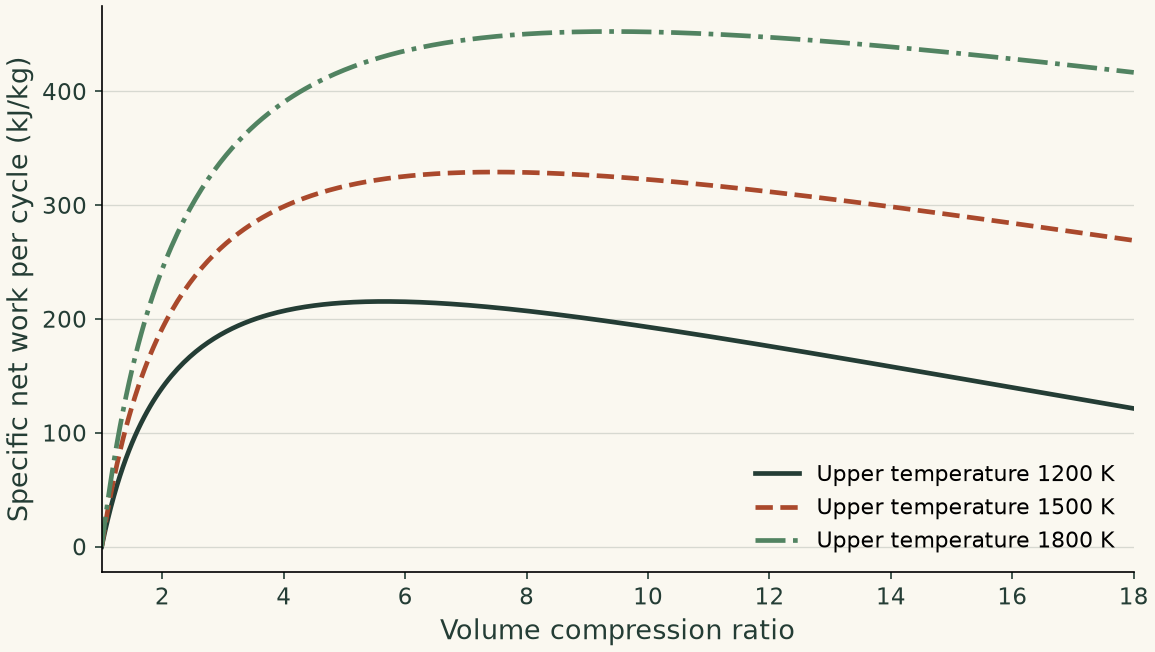
Read values from the plot
| Volume compression ratio | Upper temperature 1200 K | Upper temperature 1500 K | Upper temperature 1800 K |
|---|---|---|---|
| 1 | 0 | 0 | 0 |
| 5.25 | 215.02 | 319.45 | 423.89 |
| 9.5 | 196.81 | 324.68 | 452.55 |
| 13.75 | 160.45 | 300.36 | 440.26 |
| 18 | 121.39 | 269 | 416.62 |
Interactive calculation · change the inputs of this example
Vary the upper temperature at fixed lower temperature and locate the maximum-work compression ratio.
The curves below are recalculated from this section’s equations in your browser. The fixed reference plot above remains available for comparison.