Spend a phase budget at the gain crossover
In a scalar negative-feedback loop let \(L=PC\), \(S=1/(1+L)\) and \(T=L/(1+L)\). At \(|L(i\omega_c)|=1\), a required margin \(\phi_m\) imposes \(\arg L(i\omega_c)\geq-\pi+\phi_m\) on the continuously unwrapped phase at the crossing relevant to stability. Factor a right-half-plane zero at \(z>0\) into a minimum-phase zero and the unit-gain all-pass factor \((z-s)/(z+s)\). Its phase is \(-2\arctan(\omega/z)\). Pure delay contributes \(-\omega\tau\). Magnitude data alone cannot reveal these phase costs.
For a nominal minimum-phase design contributing \(-90°\) at crossover, the available phase budget gives the following exact condition under that assumption. An attainable gain crossover with multiple crossings still requires the full Nyquist stability test.
If \(z=40\) rad/s, \(\tau=0\) and \(\phi_m=45°\), then \(\omega_c\leq40\tan(\pi/8)=16.57\) rad/s. A proposed 25 rad/s crossover would leave only \(90°-2\arctan(25/40)=25.99°\). A changed controller may buy lead with noise amplification or a steeper high-frequency roll-off. Reevaluate the complete minimum-phase contribution rather than treating this particular 16.57 as universal.
Use the maximum-modulus principle for a controller-independent test
Now suppose the plant has a simple real unstable pole \(p>0\) and a right-half-plane zero \(z>0\) with \(p\ne z\). Assume rational proper internally stabilizing feedback without unstable cancellations. \(S\) and \(T\) are bounded and analytic in the open right half plane. Internal stability of \(PS\) requires \(S(p)=0\), hence \(T(p)=1\). At the plant zero \(T(z)=0\). Divide \(T\) by the stable all-pass factor \(B_z(s)=(s-z)/(s+z)\). The apparent singularity at \(z\) is removable. On the imaginary axis \(|B_z|=1\), so \(F=T/B_z\) and \(T\) have identical boundary magnitudes.
The maximum-modulus principle bounds the interior value \(|F(p)|\) by the largest boundary magnitude (including the limit at infinity). Substituting the interpolation values gives
For \(p=2\) and \(z=3\) s⁻¹ the peak is at least 5, approximately 14.0 dB. A claimed peak below 2 is infeasible for every controller obeying the stated assumptions, even if the measured range missed the peak. When the pole and zero approach each other the bound diverges. Trying to cancel them inside the controller sacrifices internal stability.
Why the sensitivity integral and this test say different things
The Bode integral constrains the area of log sensitivity across frequency. The maximum-modulus argument uses exact internal interpolation at two specific plant singularities to bound a peak of complementary sensitivity. Which result is sharper depends on the requirement and measured plant.
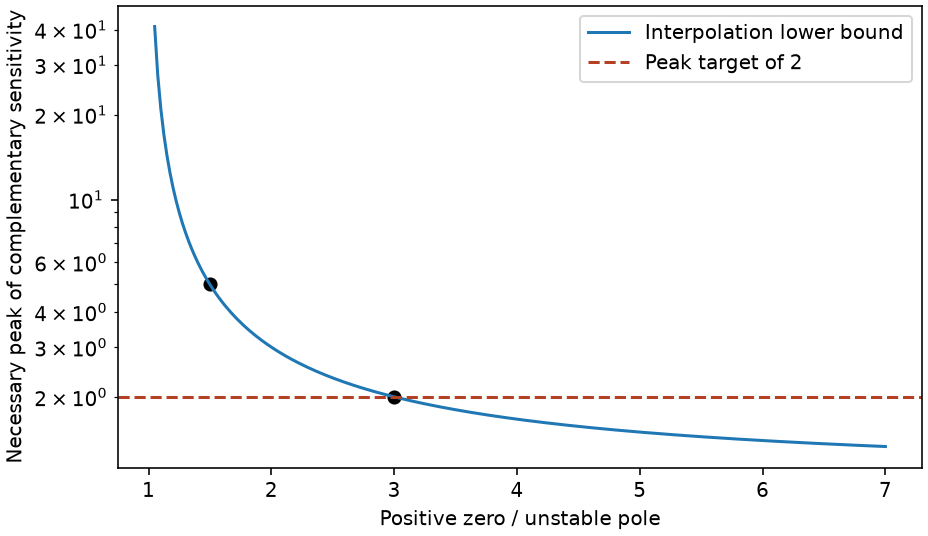
Interactive calculation · Move a positive zero toward an unstable pole
Compare the necessary peak-gain bound with the specified target. The delay affects the separate45° phase budget, not the interpolation inequality.
Exercises on impossible requirements
A measured minimum-phase loop has −110° phase at its proposed crossover of 30 rad/s. How much additional pure delay permits a 45° margin?
Worked solution
The spare phase is \(180-110-45=25°=0.4363\) rad. At the stated unchanged crossover this permits at most \(0.4363/30=14.5\) ms.
How far must a positive zero \(z>p\) lie above an unstable pole \(p=2\) to avoid ruling out a peak target of 2 by the interpolation bound alone?
Worked solution
Require \((z+2)/(z-2)\leq2\), giving \(z\geq6\) s⁻¹. This removes one necessary-condition violation. It does not construct a controller satisfying every constraint.
Further reading · Åström and Murray, Feedback Systems, 2nd ed., Chapters 13–14, especially sections 14.3–14.4.