From first principles
Match displacement and force at a string joint
Join two long strings under the same tension \(T\), with linear densities \(\mu_1,\mu_2\). Assume small transverse displacements and a massless joint with no external force. A sinusoidal wave arrives from string one. Write \(A,B,C\) for complex incident, reflected and transmitted displacement amplitudes at the join. Because the strings remain attached, their endpoint positions agree at each instant.
The transverse components of the two tensions must balance. A right-going wave has slope amplitude \(ikA\), whereas reversing its direction changes the sign of that slope. With \(k_j=\omega/c_j\), the force equality becomes
Eliminate \(C\) using continuity and solve for the two wave amplitudes. The sign of the reflection records a possible reversal of displacement.
A matched joint gives zero reflection. Equal-frequency incident and reflected waves overlap to produce fixed interference minima and maxima. Two reflecting endpoints select a standing pattern when the round trip reproduces the original phase.
Derivation and applications
Scatter a string wave from a small bead
Two strings with identical impedance can reflect a wave at their joint if the joint has inertia. Attach a bead of mass \(M\) between two long uniform portions of a string under tension \(T\). Assume a pointlike bead, small transverse motion and negligible damping. Write displacements proportional to \(e^{-i\omega t}\), with incident, reflected and transmitted amplitudes \(A\), \(B\) and \(C\). Continuity of the string displacement gives \(C=A+B\). Newton's law for the bead requires the difference in transverse tension components to accelerate this common displacement.
The reflected wave has the opposite spatial phase gradient, which produces the second copy of \(B\) in the tension jump. Introduce the travelling-wave impedance \(Z=T/c\) and dimensionless mass parameter \(s=\omega M/(2Z)\). Using \(k=\omega/c\), the junction equation gives \(B=isC\). Eliminate \(C\) through displacement continuity to obtain
For identical strings the mean incident and outgoing powers carry the same impedance and frequency factors. Squaring the amplitude ratios gives the energy fractions and explicitly accounts for the entire incident power.
For slowly oscillating signals the bead follows the string and becomes almost transparent. At high frequency the transmitted amplitude tends to zero and \(r\) approaches \(-1\), the displacement reversal of a fixed endpoint.
Worked example
Predict the power passing a marker bead
Change the inputs and investigate this derivation.
With \(Z=0.500\) kg/s, \(M=5.00\) g and \(\omega=200\) rad/s, the junction has \(s=1.00\). Each outgoing string carries half of the incident power. The transmitted displacement magnitude is \(1/\sqrt{2}=0.707\) of the incident value, and \(t=(1+i)/2\) in the selected phase convention. An incident 12.0 mW wave therefore delivers 6.00 mW beyond the bead.
Second application
Weigh an attached marker by reflection
Change the inputs and investigate this derivation.
Another string has \(Z=0.300\) kg/s. At 30.0 Hz its reflected power fraction is 0.200. The inversion \(s=\sqrt{\mathcal R/(1-\mathcal R)}\) gives 0.500. Its inferred bead mass is
Doubling the frequency should bring \(s\) to unity and the reflected power to 50.0 percent, a check independent of the calibrated incident displacement.
Try it · Bead scattering
Vary the physical parameters in the derived relation. Use the units and assumptions in the readout to connect the curves to the two worked examples. A parameter study can test the forward prediction; the same relation can then be inverted to infer a parameter from a measurement.
Make the joint part of the model
A travelling disturbance reaches the junction between a light string and a heavy one held at the same tension. The animation of the junction might show an inverted reflected crest. To tell which sign and amplitude are physically possible, isolate the joint. We assume it has negligible mass, that the strings are tied without slip and that it experiences no externally applied transverse force. The displacement must be continuous and the transverse components of tension must balance.
Place the junction at \(x=0\) and let positive \(x\) point into the transmitted string. Use a harmonic time convention \(e^{-i\omega t}\). In the first string write the complex displacement as \(A_i e^{ik_1x}+A_r e^{-ik_1x}\), and in the second as \(A_t e^{ik_2x}\). Since the joint experiences one oscillation frequency, wavelength changes with the respective speed. A change of wavelength alone says nothing about the reflected power.
Match motion and transverse force
At the joint the displacement condition gives
The force condition gives
Defining the string impedance as \(Z_j=F_{Tj}/c_j=\sqrt{F_{Tj}\mu_j}\) converts the second equation into \(Z_1(A_i-A_r)=Z_2 A_t\). Under the equal static tensions assumed here, different impedances arise from different linear mass densities. Eliminating the transmitted amplitude gives
The sign of \(r\) describes displacement relative to the incident displacement at the junction. For \(Z_2\gg Z_1\) the junction approaches a fixed end, \(r\to-1\). For \(Z_2\ll Z_1\) it approaches a free end, \(r\to+1\). These limiting experiments check the force signs independently.
Background · Which sign changes at a free end?
A free end of an ideal stretched string carries zero transverse force, hence zero slope. For harmonic displacement \(y=(A e^{ikx}+B e^{-ikx})e^{-i\omega t}\), differentiating reverses the sign of the reflected term. If the end lies at \(x=0\), zero slope requires \(B=A\). Holding the same end at zero displacement instead gives \(B=-A\).
Either end returns all incident power. A sensor measuring string displacement sees an antinode at the free end and a node at the fixed end. A force sensor responds to slope and gives the opposite pattern. State the measured quantity when assigning a phase reversal to a reflected wave.
Compare amplitude and power
The mean power of a sinusoidal travelling wave is \(Z\omega^2|A|^2/2\). Thus the reflected power fraction is \(|r|^2\) and the transmitted power fraction is \((Z_2/Z_1)|t|^2\). Adding the two fractions gives one for the ideal lossless junction. A transmitted displacement larger than the incoming displacement is consistent with energy conservation when the second medium has sufficiently small impedance.
Suppose both strings have tension 80 N, while \(\mu_1=0.0050\) and \(\mu_2=0.020\) kg/m. The ratio of impedances is two, so \(r=-1/3\) and \(t=2/3\). Of 0.90 W entering, 0.10 W is reflected and 0.80 W travels onwards. Reversing the incident direction makes \(r=+1/3\) and \(t=4/3\) while leaving the reflected fraction at one ninth. A sensor that records only displacement peaks could wrongly interpret the reverse experiment as amplification.
Build a resonator using two reflections
Put reflecting ends a distance \(L\) apart. After a round trip a monochromatic wave acquires propagation phase \(2kL\) and the phases of both reflection coefficients. A repeated wave pattern requires their sum to be an integer multiple of \(2\pi\). With two fixed ends, the two sign reversals add a complete cycle and \(k_n=n\pi/L\), \(n=1,2,\ldots\). With one fixed and one free end there is only one reversal, giving \(k_n=(2n-1)\pi/(2L)\). The boundary conditions, rather than the length alone, determine whether an antinode or a node sits at an end.
For a 0.60 m string with speed 120 m/s the fixed–fixed fundamental is 100 Hz. The fixed–free fundamental is 50 Hz. Replacing one ideal end by a partially transmitting attachment also leaks energy each round trip. One then observes a finite resonance width and a decaying signal after switching off the drive. A resonance frequency tests phase closure, whereas the decay time tests energy escape and internal loss.
A pulse experiment can also distinguish a fixed end from a free end without measuring force. At a fixed end the incoming and reflected displacements must cancel, so an upward pulse returns downward. At a free end the transverse force is zero, requiring slopes to cancel; the displacement returns with the original sign. In both cases ideal reflection conserves energy. A negative displacement reflection coefficient records a phase reversal, even though the reflected energy remains positive.
Terminate a string with a spring and a damper
A fixed or free termination gives only two extreme reflection phases. Connect the end of a uniform string to a linear spring of stiffness \(k_s\) and a viscous damper \(b\) acting in parallel against ground. The endpoint is massless, and the incoming transverse displacement is harmonic. Use temporal phasors \(e^{i\omega t}\) and let the string extend from negative \(x\) to its terminal at zero. Define the positive load force as the force the string supplies to the termination. The load force divided by endpoint velocity is \(Z_L=b+k_s/(i\omega)\). A travelling string wave has characteristic force-to-velocity ratio \(Z_0=\sqrt{T\mu}\).
The incident and reflected endpoint velocities add, but their forces enter with opposite signs because their directions of transport differ. If \(r\) is the reflected-to-incident velocity or displacement amplitude, the boundary equation is
Thus
For a pure spring the reflected power fraction is one, although its phase varies continuously with frequency. The spring temporarily stores energy and returns it. A matched pure damper \(b=Z_0\) with no spring absorbs an incident wave completely. In the low-frequency limit a nonzero spring has a large impedance magnitude and its end approximates a fixed boundary. As frequency increases the spring contributes less force for the same velocity, and the damper determines the response.
Infer the absorbed power from an endpoint motion
Choose \(T=100\) N and \(\mu=0.0100\) kg/m, giving \(Z_0=1.00\) N s/m. Fit \(b=1.00\) N s/m and \(k_s=20.0\) N/m, and drive at \(\omega=20.0\) rad/s. The load is \(Z_L=1.00-i1.00\) N s/m, hence
Its magnitude squared is \(0.200\). Of 10.0 mW incident power, 2.00 mW returns and 8.00 mW is dissipated.
The incident velocity amplitude is
Total endpoint velocity amplitude is \(|1+r|\) times this, or \(0.126\) m/s. Independent damper heating is \(b|v_{\rm end}|^2/2=8.00\) mW as required. The endpoint displacement amplitude is
At a much higher frequency the same termination approaches the matched damper limit. A complex reflection measurement therefore separates reactive force from dissipative force even when an amplitude-only measurement happens to give the same reflected fraction for two different fixtures.
One can invert the experiment to estimate the fixture properties from reflected phase. Algebraically the boundary equation gives
The real part estimates the damper coefficient, and multiplying the negative imaginary part by angular frequency estimates spring stiffness. Near a fixed boundary the measured reflection is close to minus one. The small denominator then makes the stiffness estimate sensitive to phase errors even when reflected power is measured accurately. Repeating the experiment near the fixture's spring–damper crossover gives a better-conditioned comparison between the two independently inferred components.
Repeating the inversion at two frequencies also tests whether the assumed spring and damper coefficients remain constant.
Infer a reflection from a standing-wave scan
Superpose an incident harmonic wave of unit amplitude and a returned wave of real amplitude \(r\). A probe that measures the oscillation amplitude at each point reports the modulus of their complex sum. Squaring first and adding intensities would erase the interference.
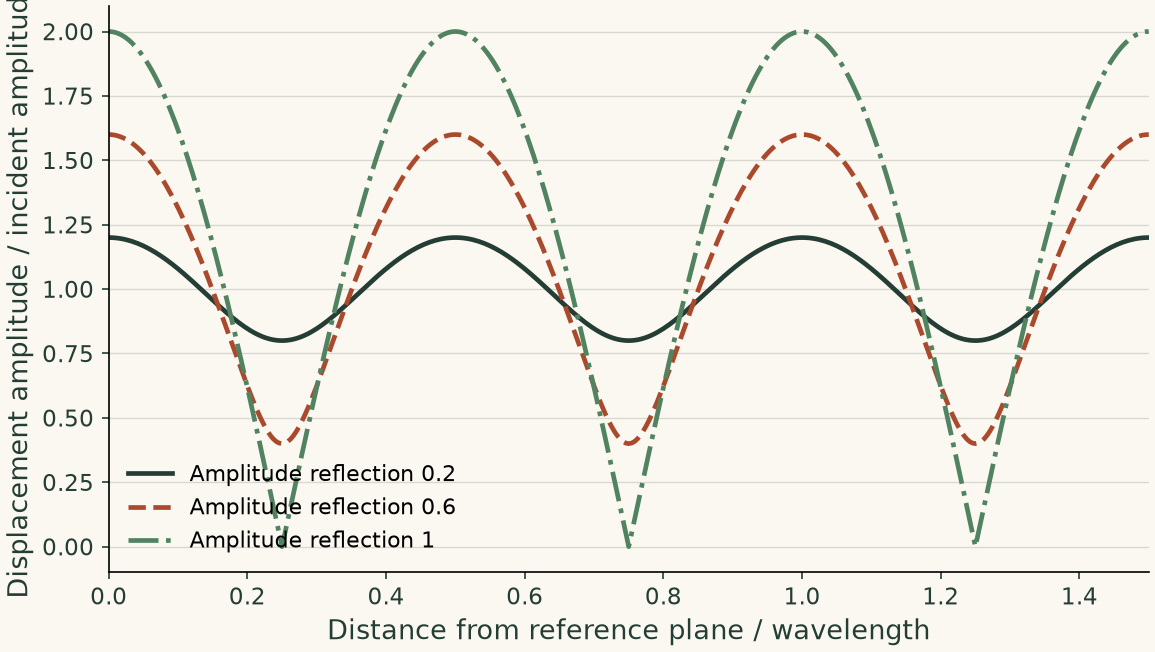
Try it · Standing wave
Change the inputs and compare the recalculated curves with the preceding derivation and baseline figure. The axes give the units; the numerical readout states the model assumptions and any limiting cases. Reset the inputs to return to the reference setting.
Read values from the plot
| Distance from reference plane / wavelength | Amplitude reflection 0.2 | Amplitude reflection 0.6 | Amplitude reflection 1 |
|---|---|---|---|
| 0 | 1.2 | 1.6 | 2 |
| 0.375 | 1.0198 | 1.1662 | 1.4142 |
| 0.75 | 0.8 | 0.4 | 3.6739e−16 |
| 1.125 | 1.0198 | 1.1662 | 1.4142 |
| 1.5 | 1.2 | 1.6 | 2 |