Identify which thermodynamic potential controls useful work
Consider an isothermal, isobaric cell releasing reactants into products according to stoichiometric numbers \(\nu_i\) with products positive. For an extent change \(d\xi\), \(dn_i=\nu_i\,d\xi\). The chemical contribution to the change in Gibbs free energy is \(\Delta_rG\,d\xi\) where \(\Delta_rG=\sum_i\nu_i\mu_i\). The maximum non-expansion work delivered reversibly to an external circuit is \(-dG\) for the reaction step. If it sends \(n\) moles of electrons through the external circuit per mole of reaction, the charge magnitude is \(nF\,d\xi\).
Here \(F=N_Ae\) and the activities are dimensionless relative to standard states. Substituting directly yields the Nernst equation. Reversing the written chemical reaction reverses the signed cell voltage and reciprocates \(Q\).
Make voltage from the same material in two environments
Take two identical reversible monovalent metal electrodes in ideal solutions with different ion activities and negligible liquid-junction potential. Combining oxidation in the dilute compartment with reduction in the concentrated one transfers an ion effectively from high to low activity. The standard contributions cancel.
At 298.15 K a tenfold ratio gives 59.16 mV. Doubling both activities leaves the voltage unchanged for ideal activities. In a nonideal solution measure activity coefficients or use a calibrated reference. A voltmeter that draws significant current changes the surface concentrations and thus the very chemical potentials under study.
Distinguish reversible work from power delivered under load
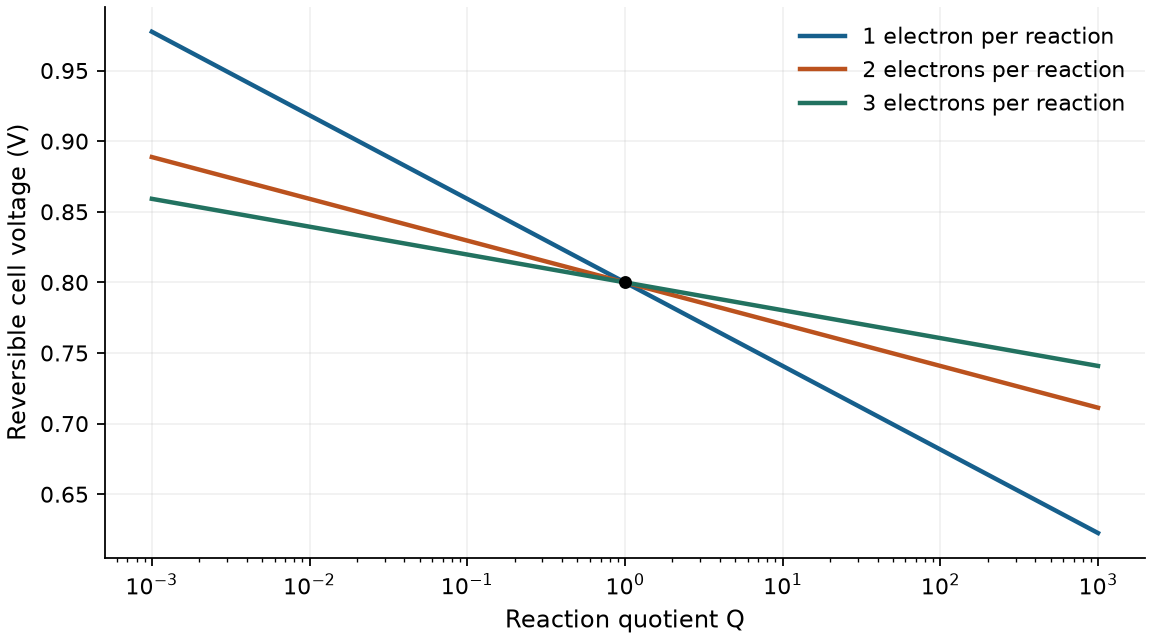
For a model cell with \(n=2\) and \(E^\circ=0.80\) V at 298 K, a reaction quotient of 100 lowers the voltage by 59.2 mV. The reversible work at this composition is \(2F(0.7408)\simeq143\) kJ/mol. Under an external load suppose a 10 mA current flows with measured terminal voltage 0.68 V. The electrical output is then 6.8 mW, with about 0.61 mW less output than the reversible power at that instant. Ohmic resistance, interfacial kinetics and transport all contribute. A single operating point cannot distinguish them.
Recall · Why can equilibrium electrodes show a voltage?
Individual electrode reactions can be in local equilibrium at open circuit while the bulk reactants and products remain separated. An external path would allow the overall chemical reaction to move toward equilibrium, where the full-cell reversible voltage for that reaction vanishes.
Try it · Nernst
Change the inputs and compare the recalculated curves with the preceding derivation and baseline figure. The axes give the units; the numerical readout states the model assumptions and any limiting cases. Reset the inputs to return to the reference setting.
Tutorial on activities and polarity
1 · Find an activity ratio from a voltage
Work through the solution
A monovalent concentration cell gives 35.0 mV at 298.15 K. Inverting gives \(a_{\rm high}/a_{\rm low}=\exp(0.0350/0.02569)=3.91\). Reversing the leads changes the sign while the inferred larger-to-smaller ratio remains above one.
2 · Which reaction transfers more charge per released joule?
Work through the solution
If two reactions at the same temperature each deliver 80 kJ/mol reversibly but carry respectively one and two moles of electrons, their voltages are 0.829 V and 0.415 V. Adding a stoichiometric multiple of an entire reaction multiplies both \(n\) and \(\Delta_rG\), leaving voltage invariant.
3 · Use a temperature sweep for calorimetry
Work through the solution
Since \((\partial\Delta_rG/\partial T)_p=-\Delta_rS\), reversible voltage at fixed pressure and consistently specified composition gives \(\Delta_r S=nF(\partial E/\partial T)\). A two-electron cell with slope \(-0.20\) mV/K has \(\Delta_rS\simeq-38.6\) J/(mol K). Compare at the same reaction extent and control changes in activity coefficients.
For further study see Schroeder, An Introduction to Thermal Physics, chapters 3 and 5 on chemical potential, free energy and electrochemical work.