From first principles
Count the particles that can reach a small opening
A small hole in a vessel of dilute equilibrium gas samples molecules moving toward its plane. Let \(n\) be number density, let \(v_x>0\) point outward, and let \(f_x(v_x)\) be the normalized distribution of this velocity component. In a short time \(dt\), only molecules starting within a layer of thickness \(v_xdt\) can cross. Its volume is hole area \(A\) times that thickness. Summing over positive velocities gives the one-way number flux,
At classical thermal equilibrium the component distribution is Gaussian with variance \(k_BT/m\). Substitution and integration using the derivative of the exponential give
This is the outgoing flux for an opening small compared with a mean free path and thin enough to avoid significant internal passage effects. Any gas outside can generate a reverse flux. The velocity factor in the integral explains why faster molecules are overrepresented among those leaving.
Derivation and applications
Predict how an effusing gas mixture changes composition
A particle's contribution to the number flux through a small hole increases with its velocity normal to the opening. In a mixture at a common temperature this biases the escaping gas toward lighter species. Consider a rigid vessel of volume \(V\), with hole area \(A\) much smaller than the wall area and hole diameter smaller than the molecular mean free path. Take the exterior pressure to be negligible. The walls maintain temperature \(T\), and the reservoir re-equilibrates much faster than it empties. Thus the remaining species \(i\) has spatially uniform density \(N_i/V\) and a Maxwellian velocity distribution.
The minus sign assigns positive outgoing flux to a decreasing inventory. Each species therefore has a constant decay rate in time under the isothermal assumption. Its time constant and its abundance ratio relative to another species are
At any instant the outgoing number ratio has a further velocity weighting compared with the gas left in the vessel,
The ratio of molar masses may be used in this square root since the conversion to mass per particle cancels. A sample collected over a long time mixes successively different outlet compositions. A thick tube or a hole large enough for collective flow requires a different flow model.
Worked example
Compare the outlet and reservoir compositions
Change the inputs and investigate this derivation.
Start with equal numbers of helium and neon atoms, taking molar masses 4.00 and \(20.0\,\mathrm{g/mol}\). Initially the outlet helium-to-neon number ratio is \(\sqrt5=2.24\), giving a helium fraction \(2.24/(1+2.24)=0.691\). The initial reservoir helium fraction is \(0.500\). A detector reporting mass flow instead of particle count would multiply each contribution by its corresponding particle mass.
Second application
Recover a heavy-gas residence time from a light tracer
Change the inputs and investigate this derivation.
In a separate chamber a helium tracer signal halves in \(120\,\mathrm s\). For argon of molar mass \(40.0\,\mathrm{g/mol}\) the predicted half-life is
After \(240\,\mathrm s\), helium retains \(0.250\) of its initial number and argon retains \(2^{-240/379}=0.645\). With equal starting numbers the residual helium fraction is \(0.250/(0.250+0.645)=0.279\), showing the preferential depletion accumulated over time.
Why a leaking binary mixture changes its composition
A vessel containing two ideal gases is coupled to an empty chamber through a tiny hole. Both gases have the same temperature. Their mean speeds differ, so the gas remaining in the vessel, the gas passing through the hole now and the gas accumulated downstream have different compositions.
Count the molecules that reach the opening
For a Maxwellian species \(i\), the one-sided flux to a plane is \(n_i\int_0^\infty v_z f_i(v_z)\,dv_z=n_i\sqrt{k_BT/(2\pi m_i)}\). Particles with larger positive normal velocity reach the opening from a thicker upstream slab in a fixed time. A raw count of half the particles would miss this velocity weighting. Assume the aperture is small compared with a mean free path locally, the vessel rethermalises rapidly compared with its depletion time, the temperature is maintained, and particles do not return from the collection chamber. For area \(A\) and reservoir volume \(V\) the number balance becomes
At any instant the light fraction in the vessel is \(N_l/(N_l+N_h)\); the light fraction in the escaping beam is \(k_lN_l/(k_lN_l+k_hN_h)\). Equal populations yield a larger instantaneous light fraction because \(k_l/k_h=\sqrt{m_h/m_l}\). The amount collected over a long interval requires the integral of each flux. Starting from an empty collection chamber, that amount is \(N_i(0)-N_i(t)\). Averaging the instantaneous fractions with equal time weights would over-represent the late, very weak beam.
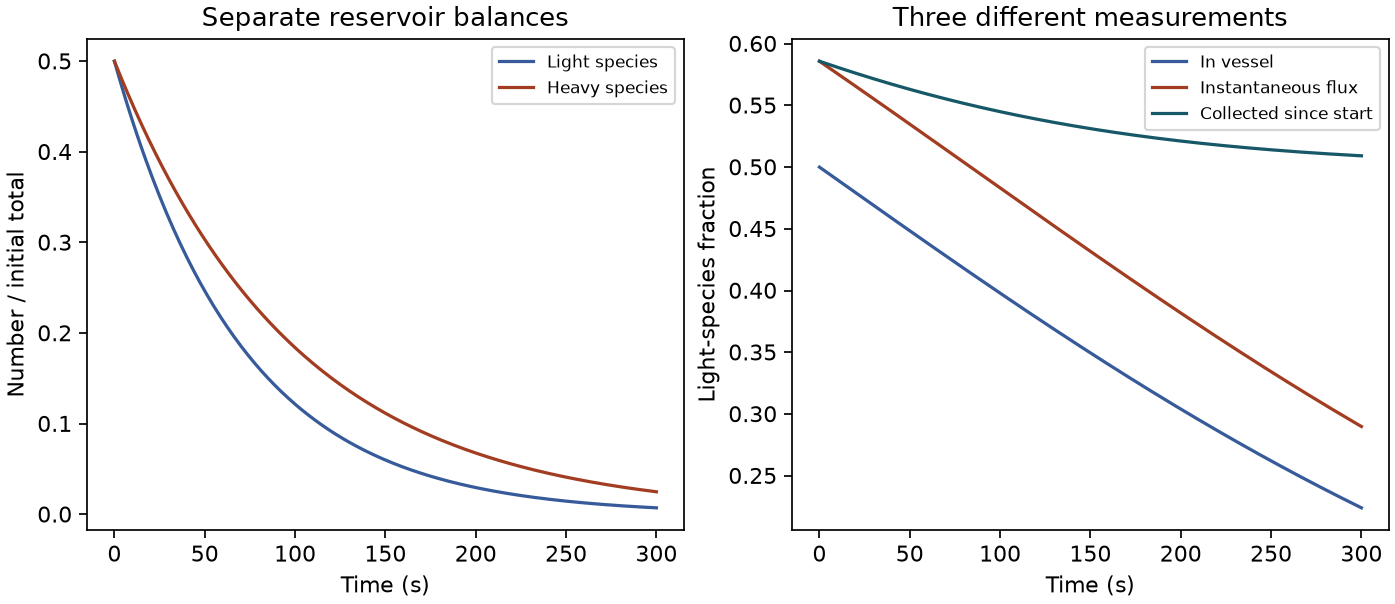 Open full-size diagram
Try it · Effusion mixture
Change the inputs and compare the recalculated curves with the preceding derivation and baseline figure. The axes give the units; the numerical readout states the model assumptions and any limiting cases. Reset the inputs to return to the reference setting.
Download the corresponding editable notebook. The browser recalculates the reduced equations directly; the notebook exposes the full calculation and its checks.
Take equal starting populations, masses of 20 and 40 atomic mass units and a heavy-species depletion time of 100 s. Initially the outgoing light fraction is
At 100 s, the reservoir contains fractions \(0.5e^{-\sqrt2}\) and \(0.5e^{-1}\) of its original total in the light and heavy species. Its light fraction is therefore about 0.398, the instantaneous beam is about 0.483 light, and the collection since startup is about 0.545 light. These three compatible numbers describe different measurements at the same clock time.
Change the mass ratio in the notebook, then state what happens if the two masses approach equality. All three composition curves approach the initial fraction even though the total gas still leaks out. If the downstream chamber is closed and pressure builds up, molecules can return; the purely outward rate law then fails. Similarly, a sufficiently large aperture supporting collisions and collective flow no longer provides this species-by-species effusive selection.
When does the escaping beam contain equal numbers of the two components in the default experiment? Does the gas remaining in the vessel also consist of equal numbers then?
Work through the solution
Equate \(k_lN_l(0)e^{-k_lt}\) and \(k_hN_h(0)e^{-k_ht}\). For equal starting numbers, \(t=\ln(k_l/k_h)/(k_l-k_h)\), about 83.7 s for the stated rates. The remaining ratio at that time is \(N_l/N_h=k_h/k_l=1/\sqrt2\), corresponding to a light fraction about 0.414. The faster rate compensates the light species' lower abundance in the outgoing beam.
Pressure counts momentum flux
Consider a dilute gas at equilibrium with number density \(n\), molecular mass \(m\) and no mean flow. Molecular diameters are small compared with intermolecular spacing. At a stationary wall an elastic specular collision reverses the normal component of velocity, transferring \(2mv_x\) to the wall when \(v_x>0\). In time \(dt\) only molecules within a slab of thickness \(v_xdt\) can reach it. Thus fast molecules strike the wall more frequently even at the same concentration.
With normalized velocity density \(f(\mathbf v)\) the pressure is \(2nm\int_{v_x>0}v_x^2 f\,d^3v\). Reflection symmetry converts this to \(nm\langle v_x^2\rangle\). Isotropy makes each Cartesian variance a third of total mean square speed, giving \(p=nm\langle v^2\rangle/3\). Combining with the ideal gas equation gives
Internal rotations and vibrations can store energy but do not directly carry translational momentum to the wall in this model.
Count particles crossing a hole
A small opening in a thin wall allows the crossing molecules to escape. Its diameter must be small compared with the mean free path, and the gas on the receiving side must be sufficiently dilute to neglect backflow. The outgoing flux per unit area is \(J=n\int_{v_x>0}v_x f\,d^3v\). The positive-half integral of the Maxwellian normal component is \(\sqrt{k_BT/(2\pi m)}\), equivalently
The factor of one quarter combines the half of velocity directions facing the hole with their angular projection. The emerging speed distribution is weighted by one extra power of speed relative to the equilibrium speed distribution, since faster particles cross the hole more often. For a Maxwell gas it is proportional to \(v^3e^{-mv^2/(2k_BT)}\). Dividing its energy-weighted integral by its normalization gives mean translational energy \(2k_BT\) per escaping molecule. A thermally isolated remaining gas can consequently cool as it leaks.
Estimate a molecular leak
Nitrogen of molecular mass \(4.65\times10^{-26}\) kg is at \(300\) K and pressure \(1.00\) Pa. The number density is \(p/(k_BT)=2.41\times10^{20}\) m⁻³ and mean speed is \(476\) m/s. A circular hole of diameter \(20.0\) μm has area \(3.14\times10^{-10}\) m². The emission rate \(JA\) is approximately \(9.0\times10^{12}\) molecules/s. This large count corresponds to only \(4.2\times10^{-13}\) kg/s. The small-hole condition must be checked independently using the collision mean free path.
At equal pressures and temperatures two pure gases have the same number density. Their effusion-rate ratio therefore depends only on inverse square root of molecular mass. If back pressure develops, apply the flux equation separately to both sides and subtract opposing fluxes. A pressure difference across a wide tube requires a flowing-gas model instead.
A pressure gauge attached to the receiving chamber reports a quantity affected by the pumping speed as well as by the leak. Weighing a collected condensate, measuring the source pressure decay in a known constant-temperature volume, or calibrating the pump independently can provide an absolute flux determination. Each method tests a different piece of the chain from measured pressure to inferred molecular rate.
A thermally isolated effusing gas cools as it loses particles
The speed distribution in an escaping beam differs from the distribution in its source. This selective loss can feed back on the source temperature. Consider a fixed, insulated vessel of volume \(V\) containing a dilute monatomic gas. A small aperture of area \(A\) lets molecules escape into vacuum. Assume collisions in the vessel establish a Maxwellian temperature much faster than particles leave, the aperture remains in the free-molecular regime, and thermal exchange with the vessel walls is negligible. These assumptions separate rapid internal equilibration from the slow evolution of temperature and particle number.
The gas stores \(U=3Nk_BT/2\), while the mean energy of each escaping molecule is \(2k_BT\). During a small change \(dN<0\), the internal energy change is therefore
Expanding the left side and collecting terms gives
The resulting temperature law is
It predicts cooling because the outgoing beam carries more energy per particle than the source average, despite the absence of externally extracted mechanical work.
The effusive rate is
Define \(\tau_0=V/[A\sqrt{k_BT_0/(2\pi m)}]\). Substitution of the temperature law and integration give
A fixed-temperature reservoir would instead exhibit a simple exponential decay in particle number. The initial logarithmic loss slopes agree, but cooling changes the later curve.
Predict pressure at half the initial gas inventory
Take argon of mass \(6.63\times10^{-26}\) kg initially at 300 K in a 1.00 litre vessel. A small hole of area \(1.00\times10^{-8}\) m² gives \(\sqrt{k_BT_0/(2\pi m)}=99.7\) m/s and \(\tau_0=1003\) s. To reach \(N/N_0=1/2\) requires
The gas temperature is then
Its pressure relative to the starting value is \((N/N_0)(T/T_0)=0.397\) at fixed volume.
If a wall heater maintained 300 K instead, pressure at half inventory would be one half of its original value, reached after \(\tau_0\ln2=695\) s. Monitoring both pressure and temperature can distinguish these cases. In practice chamber walls can have far greater heat capacity than a rarefied gas and reheat it rapidly. The isolated-gas prediction is therefore a limiting case that an experiment must establish, rather than something guaranteed merely by insulating the outer vessel.
The cooling law can be tested even if the absolute aperture area is uncertain. Plot \(\ln(T/T_0)\) against \(\ln(N/N_0)\) using simultaneous temperature and inventory records. The predicted slope is one third and does not contain the hole area, particle mass or vessel volume. The initial time derivative, by contrast, depends on all three. A correct logarithmic slope but an incorrect time constant therefore points toward an aperture calibration or transmission probability issue. A changing slope suggests thermal leakage, additional molecular energy stores or loss of internal equilibration during the measurement.
A seal or valve letting room-temperature gas enter the chamber also violates the assumed one-way balance and changes both logarithmic slopes.
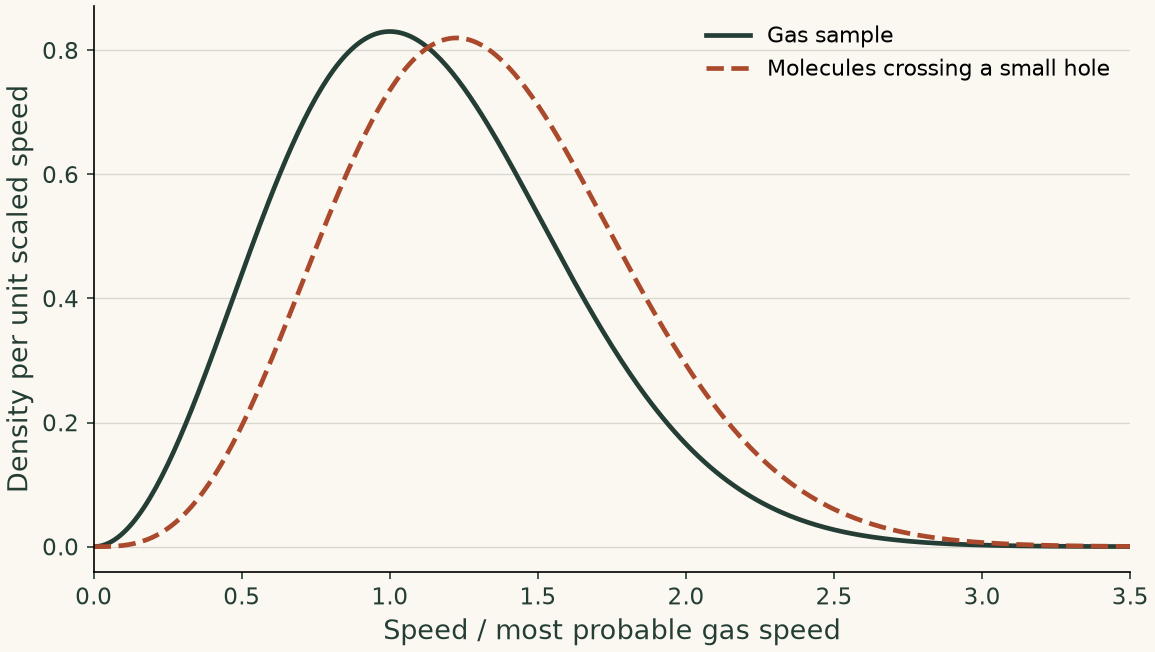
Why does an effusing beam contain faster molecules?
In a dilute equilibrium gas the speed density contains a velocity-space factor \(u^2\). Molecules crossing a small aperture are additionally weighted by their normal speed; the angular average leaves one extra power of speed. Normalise each distribution to unit area.
Try it · Speed law
Change the inputs and compare the recalculated curves with the preceding derivation and baseline figure. The axes give the units; the numerical readout states the model assumptions and any limiting cases. Reset the inputs to return to the reference setting.
Read values from the plot
| Speed / most probable gas speed | Gas sample | Molecules crossing a small hole |
|---|---|---|
| 0 | 0 | 0 |
| 0.88 | 0.80562 | 0.62829 |
| 1.75 | 0.32325 | 0.50132 |
| 2.62 | 0.016178 | 0.037563 |
| 3.5 | 0.00013229 | 0.00041032 |
Study the full derivation
From binary collisions to the Boltzmann equation · Statistical mechanics from microscopic counting to material response
An initially anisotropic velocity distribution can relax even though every individual collision conserves energy and momentum. Describe a dilute gas with a phase-space density, derive the structure of its collision term and prove which distribution can stop producing entropy. Then examine the assumptions behind that proof and the measurements most likely to reveal their failure.