Make the two postulates operational
Assume inertial experiments obey the same physical laws and that vacuum light signals have the same speed c in each inertial frame. A light clock consists of two parallel mirrors separated transversely by distance d in its rest frame. One round trip takes Δτ=2d/c. An observer seeing the clock move at speed v measures a longer diagonal light path. For half of the round trip, the right triangle gives (cΔt/2)²=d²+(vΔt/2)². Solving yields Δt=γΔτ.
Here proper time means the reading of a clock carried along the two events. For arbitrary smooth timelike motion, split the trajectory into short inertial pieces and integrate.
Recall · A reading at one place differs from comparing distant clocks
Proper time uses successive events at the same moving clock. Measuring the length of a moving rod instead requires its two endpoints at the same time in the observer's frame. Changing that simultaneity condition changes the pair of events used in the measurement.
Construct the Lorentz map and its diagram
Homogeneity makes the map between aligned inertial coordinates linear. The moving origin has x=vt, fixing x′=A(x−vt). Requiring each ray x=±ct also to satisfy x′=±ct′ fixes t′=A(t−vx/c²). Symmetry under reversing v determines A=γ. The y and z coordinates stay unchanged for this boost.
On a diagram with x horizontal and ct vertical, the moving time axis is x=βct. The moving simultaneity axis is ct=βx. A light ray always has slope ±1. For events separated by Δx=3 m and Δt=0, a frame with β=0.6 assigns Δt′=−7.505 ns. Their interval is spacelike, so their order can change without reversing the order of a causal signal. For timelike events, a subluminal boost preserves the temporal order.
A rod of rest length L₀ has endpoint separation Δx′=L₀. Its laboratory length uses Δt=0, giving Δx′=γΔx and L=L₀/γ. Requiring Δt′=0 instead would describe another pair of events. Differentiating the transformation gives the velocity composition rule.
Two speeds of 0.8c in the same direction compose to 1.6c/1.64=0.97561c. Light still gives c. Introducing rapidity η through β=tanhη turns successive collinear boosts into addition of η, which is convenient when several observer changes are chained.
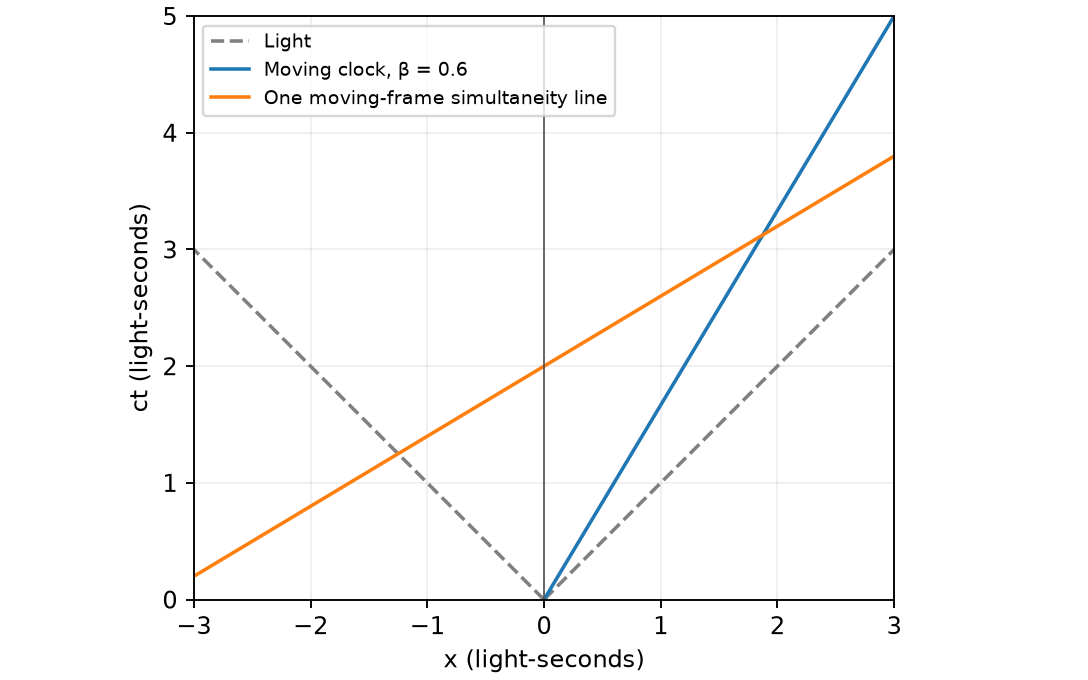
Try it · Spacetime
Change the inputs and compare the recalculated curves with the preceding derivation and baseline figure. The axes give the units; the numerical readout states the model assumptions and any limiting cases. Reset the inputs to return to the reference setting.
Compare clocks that meet again
In a chosen laboratory frame, let one clock remain at the origin while another travels out and back at speed 0.6c for a total laboratory duration of 10 years, with a short idealised turnaround. The stay-at-home clock records 10 years, and the travelling one records 8 years. Both readings can be compared at the same final event. The travelling clock uses two inertial frames separated by the turnaround. Its change of simultaneity prevents combining the outward and inward time-dilation arguments as if there were one travelling inertial frame.
Acceleration can be spread over a finite time and inserted into the proper-time integral. The measured age difference follows the whole path. Merely knowing a peak acceleration or a final relative speed does not determine it.
Derive the quantities that survive a collision
For a free particle use the invariant action S=−mc²∫dτ, giving L=−mc²√(1−v²/c²). Differentiate with respect to v to obtain p=γmv. The Legendre transform p·v−L gives E=γmc². Eliminate v to obtain the invariant mass relation.
For an isolated collision add the incoming four-momenta and equate them to the outgoing sum. The invariant of the total four-momentum defines the centre-of-momentum energy, including energy that becomes internal excitation. The velocity of that frame along the total momentum is V=c²P/E_total.
As an example, two identical particles of mass m approach with speeds ±0.6c and stick. Each has γ=1.25. The total momentum vanishes, and the final invariant mass is 2.5m. The difference from 2m is stored internal energy 0.5mc². In another inertial frame the composite moves, but its invariant mass is the same.
Find a production threshold with one stationary target
Let an incident particle with mass m and total energy E hit an identical stationary target. Squaring the total four-momentum gives s=2m²c⁴+2mc²E. Consider endothermic production with minimum final total rest mass Mf≥2m. At threshold it has no relative kinetic energy in its centre-of-momentum frame, so s=Mf²c⁴.
If Mf=3m, the required incident total energy is 3.5mc² and its kinetic energy is 2.5mc². The newly created rest energy is only mc², but momentum conservation forces part of the available laboratory energy into overall recoil. A collider with oppositely directed equal momenta uses the incoming kinetic energy differently.
Remember · Use total energy when constructing a four-vector
The time component is E/c with E=K+mc². Substituting K/c would fail the invariant relation even for a particle at rest. Kinetic energy is convenient for a calorimeter, while total energy is required in the Lorentz transformation and threshold invariant.
Exercises with events and four-momenta
1. A moving clock at 0.8c records 3 μs between two flashes. Find their laboratory time and displacement.
Work through the solution
γ=5/3 gives Δt=5 μs. The displacement is 0.8c times 5 μs≈1199.17 m. Direct substitution gives c²Δt²−Δx²=c²(3 μs)².
2. Two photons of energies 2 MeV and 1 MeV travel in opposite directions. Determine the invariant mass of their combined system and its centre-of-momentum velocity.
Work through the solution
Total energy is 3 MeV and cP=1 MeV. Hence Mc²=√8 MeV≈2.828 MeV and V=c/3 toward the more energetic photon. Each individual photon has zero rest mass.
3. At β=0.6 a rod has laboratory length 0.80 m. Determine its rest length, then find the laboratory time difference for endpoint events simultaneous in the rod frame.
Work through the solution
L₀=γL=1.00 m. For Δt′=0 and Δx′=L₀, the inverse transformation gives Δt=γvL₀/c²=2.502 ns. Those events cannot be used directly for the laboratory length measurement.