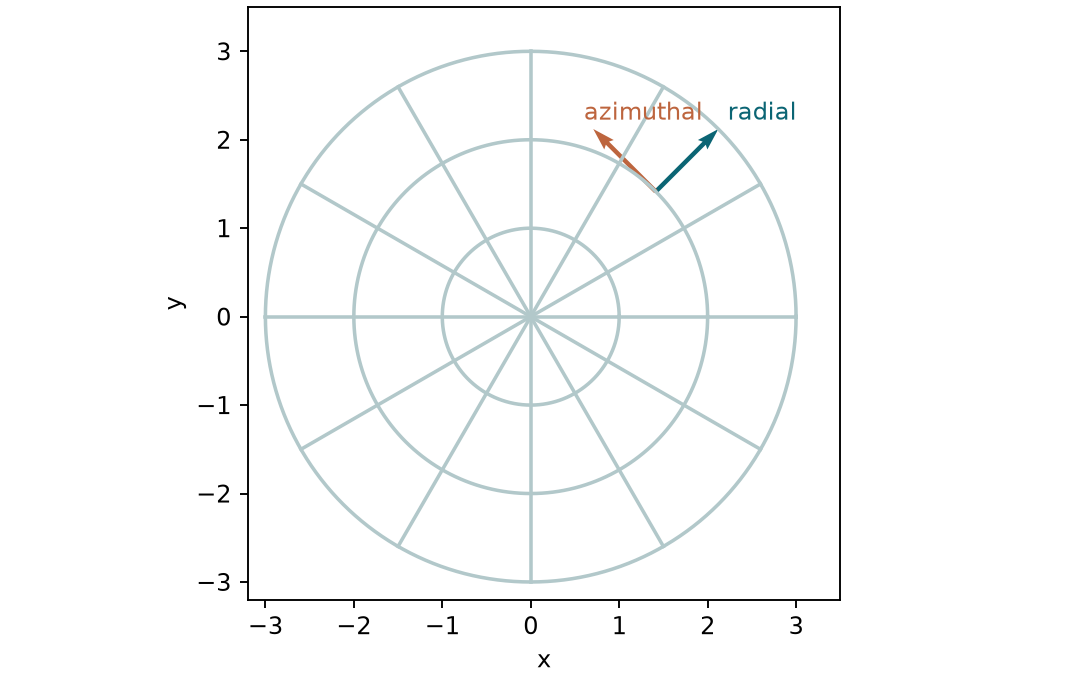
Try it · Cylindrical
Change the inputs and compare the recalculated curves with the preceding derivation and baseline figure. The axes give the units; the numerical readout states the model assumptions and any limiting cases. Reset the inputs to return to the reference setting.
Attach a length to a coordinate increment
Coordinates label points, while differential operators describe spatial change. In a right-handed orthogonal system q₁,q₂,q₃ write the position as r(q). The coordinate tangent vectors are mutually perpendicular. Define hᵢ=|∂r/∂qᵢ| and unit vectors eᵢ=(∂r/∂qᵢ)/hᵢ. A small displacement is Σeᵢhᵢdqᵢ. Matching dV=Σ(∂V/∂qᵢ)dqᵢ with dV=∇V·dr gives the gradient.
For cylindrical coordinates (s,φ,z), r=(s cosφ,s sinφ,z). Differentiation gives h=(1,s,1), e_s=(cosφ,sinφ,0) and e_φ=(−sinφ,cosφ,0). Thus ∂φ e_s=e_φ and ∂φ e_φ=−e_s. For spherical coordinates (r,θ,φ), direct differentiation gives h=(1,r,r sinθ). The coordinate basis changes direction even if the components of a field stay constant.
Recall · Angle increments are dimensionless
An angular change dφ corresponds to arc length s dφ in a cylinder. Accordingly the azimuthal derivative of potential has physical component (1/s)∂φV. This has the same units, volts per metre, as ∂sV. Omitting the geometric factor changes both dimensions and the electric field.
Derive divergence by subtracting opposite face fluxes
A small face normal to e₁ has area h₂h₃dq₂dq₃. The two opposite faces have different field and potentially different area. Subtract their outward fluxes using a first-order expansion, sum over the three coordinate directions and divide by cell volume.
The cylindrical radial term is (1/s)∂s(sA_s). The spherical radial term is (1/r²)∂r(r²A_r). These follow from circumference and surface area respectively. For A=Cr e_r in a sphere, the divergence is 3C. A sphere of radius R then encloses flux 4πCR³, matching the volume integral of 3C.
Derive curl from the oriented boundary of one face
Choose the q₂–q₃ face with positive normal e₁. Circulation along its four edges gives ∂₂(h₃A₃)−∂₃(h₂A₂), multiplied by dq₂dq₃. Divide by h₂h₃dq₂dq₃. Cyclic permutation supplies all three components.
In cylindrical symmetry A=Aφ(s)eφ yields (curl A)z=s⁻¹d(sAφ)/ds. Aφ=Bs/2 has curl B ez, the familiar vector potential for a uniform axial magnetic field. Aφ=C/s has zero local curl away from the axis but a nonzero circulation 2πC around it. The excluded axis supplies the topological or singular information.
Remember · Zero local curl needs a domain condition
Stokes' theorem requires a spanning surface inside the region where the field is regular. A loop encircling an excluded axis need not have such a surface. To infer a single-valued potential from zero curl, check the domain as well as the local differential equation.
Compose the two operators
Insert the gradient components into the divergence formula. The scalar Laplacian is therefore
In spherical coordinates this becomes r⁻²∂r(r²∂rV)+(r² sinθ)⁻¹∂θ(sinθ∂θV)+(r²sin²θ)⁻¹∂φ²V. For V=r²P₂(cosθ), the radial contribution is 6P₂ and the angular contribution is −6P₂. The potential is harmonic even though neither contribution vanishes separately. This cancellation underlies separation into radial powers and angular eigenfunctions.
Convert a physical experiment between conventions
In SI vacuum electrostatics the point-source law is E=q/(4πε₀r²), with force qE. Gaussian conventions write the corresponding laws E=q/r² and F=qE, while magnetic force contains v×B/c. The numerical values and dimensions of both charge and field change. To convert, equate a measurable force in the same physical experiment first. One statcoulomb is 3.335640952×10⁻¹⁰ C, one statvolt/cm is 29979.2458 V/m, and one gauss is 10⁻⁴ T.
Gaussian electric and magnetic fields share dimensions. Rationalised Heaviside–Lorentz conventions absorb the source factors 4π into the field and charge normalisation. A conversion must state whether c is retained or set to unity. The route from an equation to a voltage or force requires restoring that convention. A ratio E/B in SI is a velocity, whereas E_G/B_G for a plane vacuum wave equals one.
Exercises on geometry and conversion
1. Derive the cylindrical Laplacian and apply it to V=s²cos2φ. What Cartesian polynomial does this represent?
Work through the solution
The radial term is 4cos2φ and the angular term is −4cos2φ. Their sum vanishes. Since s²cos2φ=x²−y², the Cartesian Laplacian is 2−2=0.
2. A plane wave has E=300 V/m. Determine B in tesla and gauss, then check the Gaussian electric-field number.
Work through the solution
B=E/c≈1.00069 μT=0.0100069 G. Dividing 300 V/m by 29979.2458 V/m per statvolt/cm gives 0.0100069 statvolt/cm, the same Gaussian number.
3. Evaluate the outward flux of C e_s/s through a cylindrical shell and explain why local zero divergence does not remove an axial source.
Work through the solution
The curved outer face gives 2πCL for length L, independent of radius. A shell with both inner and outer faces has net zero flux. A solid cylinder includes the singular axis, where the distributional source supplies 2πC per unit length.