From first principles
Why translating a lattice state produces an energy band
In a perfect periodic chain the Hamiltonian is unchanged when the site labels are shifted by one. A wave may therefore have site amplitudes of the form \(c_j=C e^{ikja}\), with \(k\) defined up to \(2\pi/a\). To give that phase a physical energy, choose one localized orbital per cell of spacing \(a\). Assume an orthonormal basis, on-site energy \(\epsilon_0\), and a real hopping matrix element \(-t\) to either nearest neighbour. Projecting the stationary Schrödinger equation on orbital \(j\) gives
Successive amplitudes differ only by \(e^{\pm ika}\). Cancel \(c_j\), then combine these phases into a cosine:
For \(t>0\) the in-phase combination has the lowest energy. Comparing \(k=0\) and \(k=\pi/a\) gives bandwidth \(4t\). Form a narrow wave packet from neighbouring \(k\)'s. Its envelope speed is
Translation symmetry determines the allowed phase labels, while the coupling strength determines the numerical dispersion. A real crystal can require several orbitals and longer-range couplings.
Background · Band velocity
This is the group velocity of a band wave packet in the ordinary semiclassical approximation. The Fermi surface determines which states can respond at low temperature.
Derivation and applications
Use band curvature to predict acceleration off the force axis
Near a smooth, isolated band minimum the first derivative of energy vanishes. In a low-symmetry crystal its second derivatives can depend on direction. Choose principal axes \(x,y\) in the plane near the minimum \(\mathbf k_0\), and write \(\mathbf q=\mathbf k-\mathbf k_0\). Taylor expansion defines two positive effective masses through the curvatures,
Treat a narrow wave packet semiclassically in a uniform force \(\mathbf F\), over a time short enough for scattering to be negligible. Neglect interband transitions and any anomalous velocity. Differentiating energy component by component gives group velocity. Combining this with the crystal-momentum equation gives its acceleration,
Thus a force rotated through the principal axes traces an ellipse of accelerations. To describe a longitudinal measurement, project the full vector onto the applied force. If the force makes angle \(\theta\) to the \(x\) axis and \(\phi\) is the direction of the resulting acceleration in the same quadrant, then
The longitudinal inverse mass is a weighted average of inverse principal masses. The difference \(\phi-\theta\) vanishes along principal axes and for an isotropic band. The expansion requires the whole accelerated packet to stay inside the region of roughly constant curvature.
Worked example
Follow an oblique force pulse
Change the inputs and investigate this derivation.
Let \(m_x=0.20m_e\), \(m_y=0.80m_e\), where \(m_e\) is the free electron mass. A force pulse of magnitude \(1.00\times10^{-17}\,\mathrm N\) acts at \(45^\circ\) for \(50.0\,\mathrm{fs}\) on a packet initially at rest. Its velocity gains are \(F\Delta t/(\sqrt2m_i)\), or \(1.94\,\mathrm{m/s}\) along \(x\) and \(0.485\,\mathrm{m/s}\) along \(y\). The velocity points only \(14.0^\circ\) above the light-mass axis.
Second application
Recover an unseen principal curvature
Change the inputs and investigate this derivation.
A second band has longitudinal mass \(0.300m_e\) for a force at \(45^\circ\), and a measurement along its \(x\) axis gives
In units of \(1/m_e\), inversion yields \(m_e/m_y=2/0.300-1/0.200=1.667\), so \(m_y=0.600m_e\). A pulse along \(y\) should produce one third of the acceleration measured along \(x\) for the same force, providing an independent check of the principal-axis assignment.
Try it · Mass tensor
Vary the physical parameters in the derived relation. Use the units and assumptions in the readout to connect the curves to the two worked examples. A parameter study can test the forward prediction; the same relation can then be inverted to infer a parameter from a measurement.
OneSimulation laboratory
Open a band gap in a periodic dielectric
Start from this chapter. At a Brillouin-zone edge, periodic modulation mixes counter-propagating waves. Test this symmetry argument using optical modes. Their eigenvalues are electromagnetic frequencies and illustrate the analogous band splitting.
Compare recorded OneSimulation runs on this page. To test your own inputs, download the notebook and model files and run the model in an activated OneSimulation environment.
Use one periodic cell and keep its layer widths fixed. The finite-element calculation solves the electromagnetic eigenproblem for several Bloch wave numbers. Change the second relative permittivity in cases. Predict how the two lowest zone-edge frequencies separate as the index contrast increases.
| Layer permittivities | Lower edge | Upper edge | Relative gap |
|---|---|---|---|
| Uniform · 13 and 13 | 0.1387 | 0.1387 | 0.00% |
| Weak contrast · 13 and 12 | 0.1396 | 0.1433 | 2.55% |
| Strong contrast · 13 and 1 | 0.1509 | 0.2566 | 51.89% |
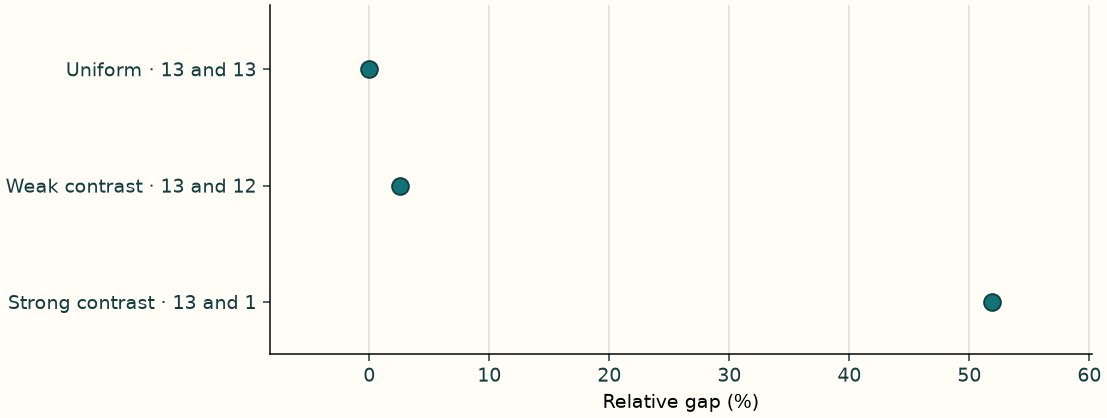
Replace the existing weak contrast pair with (13.0, 6.0) and rerun the notebook. Compare the FEM edges with the transfer-matrix calculation included in the file. Then set a = 2e-3 in the supplied geometry script, regenerate both STEP files and rerun with the same layer fractions. The reduced frequencies stay fixed, so the frequencies in Hz halve. Inspect the computed band diagrams.
Download experiment files (ZIP) Extract the files together and open one_dimensional_photonic_crystal_bands.ipynb in a local OneSimulation environment.
Try it · Opening the Bloch gap in equal-width layers
Both layers occupy half the physical period, exactly as in the OneSimulation cell. Keep the first permittivity at 13 and change the second from 13 to 12 and then 1 to compare the uniform, weak and strong contrasts in the table. The transfer matrix gives the reference band edges; doubling the period halves their physical frequencies.
Open the corresponding OneSimulation notebook, code and output
Problem sheet 3 · Reconstruct the edges of a photonic gap
Why label a state by crystal momentum?
A lattice translation by \(a\) commutes with the Hamiltonian when \(V(x+a)=V(x)\). Translation eigenvalues have modulus one because translation preserves norm. Write them \(e^{ika}\); then \(\psi_k(x)=e^{ikx}u_k(x)\) with \(u_k(x+a)=u_k(x)\). Since \(e^{i(k+G)a}=e^{ika}\) for \(G=2\pi h/a\), a single Brillouin zone suffices. The index distinguishing states at the same \(k\) is the band index. Crystal momentum labels translation symmetry and can change by a reciprocal vector in scattering.
A weak potential couples a degenerate pair
Near \(k=G/2\), free states \(|k\rangle\) and \(|k-G\rangle\) have nearly equal kinetic energies. The periodic potential has Fourier coefficients \(V_G\) that couple these waves. Absorbing the mean potential in both energies, the two-state characteristic equation is
with solutions
At equality the splitting is \(2|V_G|\). For a real coefficient the states are standing waves whose densities peak at different locations relative to the potential. Far from the degeneracy, the square root is dominated by the kinetic splitting and one obtains two nearly free waves again. A Fourier component that vanishes by symmetry cannot open a first-order gap at that crossing. Check other bands before interpreting a local splitting as a gap for the entire solid.
Build a band from a localised orbital
Start instead with one localised orbital \(|n\rangle\) per cell, all of energy \(\epsilon_0\), with overlap neglected in the basis and nearest-neighbour hopping matrix element \(-t\). A translation eigenstate has site amplitudes \(c_n=e^{ikna}/\sqrt N\). Acting with \(H\) on one site amplitude gives \(E c_n=\epsilon_0 c_n-t(c_{n-1}+c_{n+1})\), and hence \(E(k)=\epsilon_0-2t\cos ka\). The bandwidth \(4|t|\) measures the energy spread produced by hopping. In the limit of vanishing hopping the local energy repeats for every \(k\). More than one orbital per cell generates a matrix eigenproblem even in this simple construction.
The group velocity is \(v=\hbar^{-1}dE/dk\). Under a weak force with \(\hbar\dot k=F\), acceleration is \(F E''(k)/\hbar^2\). Define \(m^*=\hbar^2/E''(k)\), a local measure of curvature. Near the bottom of the cosine band with \(t>0\),
Near the top the curvature changes sign. Describing the missing electrons in a nearly full band as positively charged holes with positive mass simplifies transport calculations.
Use filling to decide whether current can flow
For a complete time-reversal-symmetric band, the contributions of \(k\) and \(-k\) to current cancel. More generally the integral of the derivative of a periodic band over a whole zone is zero. A weak field can redistribute carriers near a partially filled band edge, whereas a fully filled isolated band has no vacant neighbouring states. With one spin-degenerate orbital per primitive cell there are two states per cell. One electron per cell half fills this noninteracting band; two fill it. Symmetry breaking, interactions and additional bands can change the conclusion. A single measured zone-edge splitting therefore gives incomplete information about conduction.
For further work on three-dimensional bands, Fermi surfaces and electron motion, see David Tong’s Solid State Physics lectures at Cambridge.
Open a gap by doubling a chain’s period
A uniform one-dimensional chain with one spin-degenerate orbital and one electron per site has a half-filled band. A distortion can change both the spectrum and the periodicity used to count states. Let the sites be separated by \(a\) before the distortion. Group successive sites into \(A,B\) pairs and allow alternating hopping amplitudes \(t_1,t_2>0\). The distorted unit cell has length \(2a\). For equal on-site energies, chosen as zero, the amplitude on \(A\) couples to \(B\) inside its own cell and to \(B\) one cell away. Bloch translation supplies a phase \(e^{-2ika}\) for the latter coupling. The sublattice equations give a two-by-two matrix with zero diagonal and off-diagonal elements \(-(t_1+t_2 e^{\mp 2ika})\). Its characteristic equation yields
At the zone centre the hoppings add. At the new zone edge they subtract, opening a gap \(2|t_1-t_2|\). In the uniform limit the folded branches simply touch. Merely drawing a smaller zone did not change the crystal. It takes a physical alternation to split the states. With two electrons per doubled cell, the lower band is exactly filled when spin is counted. Its electronic energy falls on dimerization at fixed mean hopping: writing \(t_{1,2}=t\pm\delta\) gives
which is at most the undistorted lower energy. The lattice also pays an elastic cost. Quantitative distortion amplitudes require that competing energy.
For \(t_1=1.20\,\mathrm{eV}\) and \(t_2=0.80\,\mathrm{eV}\) the zone-centre energies remain \(\pm2.00\,\mathrm{eV}\), while the zone-edge energies become \(\pm0.40\,\mathrm{eV}\). The minimum direct excitation costs \(0.80\,\mathrm{eV}\), corresponding to a vacuum wavelength of about \(1.55\,\mathrm{\mu m}\) if the optical transition is allowed. The cause of this insulating filling is the pairing of bonds. Away from the commensurate filling the chemical potential can lie inside a band even if the same structural splitting remains visible.
Practise on sheet 2 · Recover alternating hoppings from spectroscopy. Further reading · University of Cambridge · David Tong, Solid State Physics · Chapter 4, Phonons, §4.1.3 Peierls Transition.
Follow a wave packet through the whole Brillouin zone
In a weak static field a band electron's crystal momentum changes even though its group velocity need not keep rising. Take one isolated tight-binding band \(E(k)=E_0-2t\cos(ka)\), positive hopping energy \(t\), lattice spacing \(a\) and electron charge \(-e\). Let the wave packet be narrow in \(k\) compared with the zone and neglect scattering and transitions to other bands. The semiclassical force equation is \(\hbar\dot k=-e\mathcal E\), while velocity follows from the band gradient:
Starting at \(k=0\) yields \(ka=-\omega_B t_{\rm lab}\) with Bloch angular frequency \(\omega_B=e\mathcal E a/\hbar\). Integrating velocity over laboratory time gives
Although the field never changes sign, velocity reverses when the packet samples regions of opposite band slope. Over a complete zone traversal there is no net displacement because the band energy is periodic. Energy conservation offers another derivation: the electrostatic potential-energy change of a negatively charged electron in a uniform field is \(+e\mathcal E\Delta x\), offsetting the change in band energy. The maximal excursion equals the band width \(4t\) divided by the force magnitude.
Estimate an observable oscillation in a superlattice
Use a one-dimensional superlattice with \(a=8.00\) nm, hopping \(t=5.00\) meV and field \(\mathcal E=2.00\times10^5\) V/m. The potential-energy change per lattice period is \(e\mathcal E a=1.60\) meV. Thus \(T_B=h/(1.60\,{\rm meV})=2.58\) ps and the peak-to-peak excursion is \(20.0\,{\rm meV}/(e\mathcal E)=100\) nm, about 12.5 lattice periods. The maximum speed from the band derivative is
At one quarter cycle velocity reaches its largest negative magnitude, while at half a cycle the electron reaches its furthest position and momentarily stops.
A momentum-relaxation time of 0.20 ps would interrupt most trajectories before a cycle completes, obscuring a Bloch oscillation despite the periodic dispersion. Conversely a scattering time several times longer than 2.58 ps would make coherent oscillatory transport plausible if the field does not tunnel carriers into other bands. In the weak-field limit the period and excursion both grow, so the mathematical limit of arbitrarily large excursions cannot be taken in a finite imperfect specimen. Recording the oscillation frequency as field is varied tests the predicted linear scaling separately from the much more sample-dependent amplitude.
The motion also clarifies the role of negative effective mass near a band top. The electron's crystal momentum continues to change in the direction of the applied force throughout the period. Its acceleration is proportional to the local band curvature, however, and can point in the opposite direction once that curvature changes sign. This reverses packet acceleration without a sudden elastic collision with a particular lattice plane. A spectrum measured along the direction of motion can predict the velocity through its local slope, giving a direct cross-check of the acceleration inferred from a time-domain trace.
The probe must resolve the oscillations before relaxation for that comparison to be meaningful.
Study the full derivation
Construct allowed bands from a cell transfer matrix · Structure, excitations and probes of solids
In a finite well a bound level follows from matching its wavefunction at the two walls. A periodic lattice replaces those two external walls by a matching condition on every cell. Derive a band criterion that works without guessing a wave inside the forbidden gap and use it to predict transmission through a finite sequence of cells.