Derive the relative acceleration in a falling frame
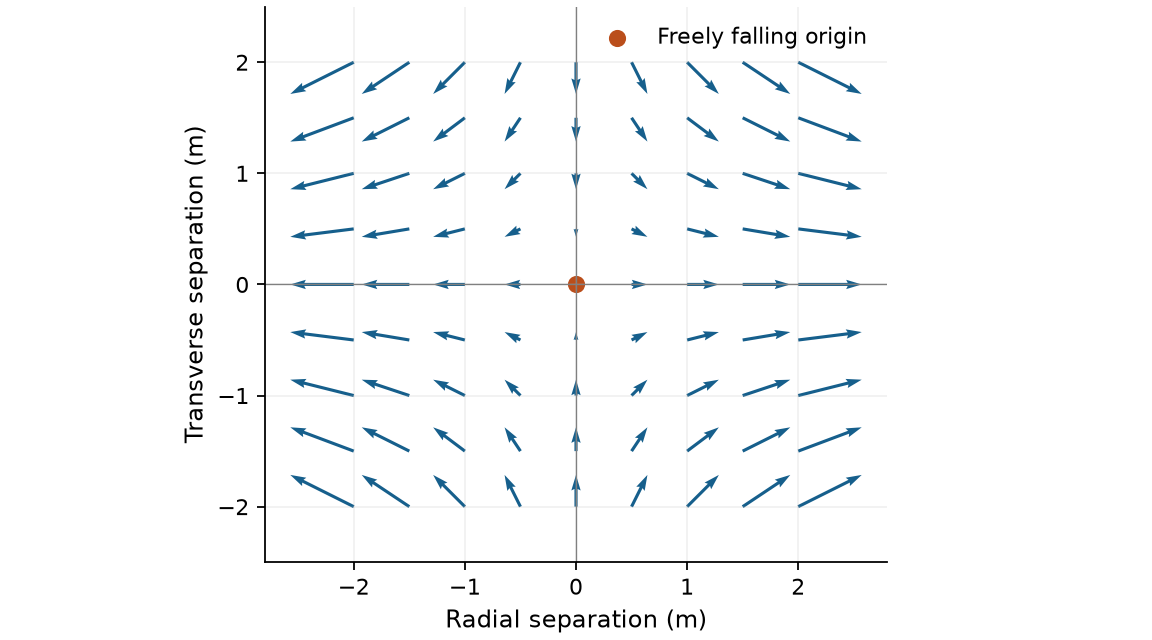
Let a laboratory origin fall freely at position \(\mathbf R\) in the field \(\mathbf g(\mathbf R)=-GM\mathbf R/R^3\) of a spherical source. Over a small separation \(\boldsymbol\xi\) choose parallel nonrotating axes. Subtract the origin's acceleration and expand to first order:
The radial eigenvalue is \(2GM/R^3\). Both transverse eigenvalues are \(-GM/R^3\). Outside the source the sum vanishes as required by \(\nabla\cdot\mathbf g=0\). Over a short time the fractional change of an initially stationary separation along an eigenvector is \(T_i t^2/2\). Near Earth's surface \(g/R\simeq1.54\times10^{-6}\) s⁻². Free masses initially separated by 2 m radially acquire a relative acceleration near \(6.2\) µm/s².
Recall · Which frame cancels gravity?
The origin's uniform acceleration cancels at all test masses when forming the difference. A rotating frame contributes centrifugal and Coriolis terms as well. For a small free-fall experiment state how axes are maintained and which relative velocities were initially present.
Try it · Tidal
Change the inputs and compare the recalculated curves with the preceding derivation and baseline figure. The axes give the units; the numerical readout states the model assumptions and any limiting cases. Reset the inputs to return to the reference setting.
Compare nearby material points before and after a displacement
Label a reference point by \(\mathbf X\) and let its displacement be \(\mathbf u(\mathbf X)\). An initial segment \(d\mathbf X\) becomes \((I+\nabla\mathbf u)d\mathbf X\). Expand its squared length, retaining the first-order terms. The antisymmetric part drops out of the quadratic form for length change.
The trace gives fractional volume change. A rigid translation has zero displacement gradient. An infinitesimal rotation has an antisymmetric gradient, so it has zero linear strain as well. For simple shear \(u_x=\gamma y\) the component \(\varepsilon_{xy}=\gamma/2\) explains the factor of two between tensor and engineering shear strain.
Build Hooke's law from symmetries and an energy
On a cut normal to \(\mathbf n\), force per area is the traction \(t_i=\sigma_{ij}n_j\). Balancing moments in a continuum without intrinsic body couples gives symmetric Cauchy stress. In an initially unstressed isotropic linear solid a quadratic elastic energy can depend only on the two independent rotationally invariant quadratic forms of the strain.
Under uniform dilation \(\varepsilon=\eta I\) the bulk modulus is \(K=\lambda+2\mu/3\). Pure shear isolates \(\mu\). Stability requires \(K>0\) and \(\mu>0\). The general anisotropic relation \(\sigma_{ij}=C_{ijkl}\varepsilon_{kl}\) need not reduce to two constants. Crystal symmetry decides which entries can be determined by rotating a sound measurement.
Recover both moduli from two arrival times
Balance of linear momentum gives \(\rho\ddot u_i=\partial_j\sigma_{ij}\) in a homogeneous body with no body force. A plane longitudinal displacement has nonzero divergence. A transverse displacement has zero divergence. Substitution gives their phase speeds:
For a solid of density 2500 kg/m³ with \(c_L=5000\) m/s and \(c_T=3000\) m/s the two moduli are \(\mu=22.5\) GPa and \(K=32.5\) GPa. One longitudinal speed would determine only their combination. Short wavelengths comparable with the lattice spacing, or waves in a thin guide, require dispersion or geometric corrections before using these bulk equations.
Tutorial on differential measurements
1 · Recover a missing tidal eigenvalue
Work through the solution
Two transverse values measured outside a spherical source are each \(-1.5\times10^{-6}\) s⁻². Zero trace implies a radial value \(+3.0\times10^{-6}\) s⁻². A positive radial gradient means the higher test mass falls slightly less quickly.
2 · A diagonal cut through a sheared specimen
Work through the solution
Let only \(\sigma_{xy}=\sigma_{yx}=4\) MPa be nonzero. With \(\mathbf n=(1,1,0)/\sqrt2\), traction is \(4\mathbf n\) MPa. The same stress state that is pure shear on coordinate planes becomes a purely normal traction on this cut.
3 · Test isotropic elasticity using an additional wave
Work through the solution
If \(c_T\) differs systematically for two orthogonal transverse polarisations at the same direction and frequency, a homogeneous isotropic bulk model predicts the wrong degeneracy. Check the sample dimensions and alignment first, then measure crystal orientation before assigning a distinct shear modulus.
For further study see Taylor, Classical Mechanics, chapters 9 and 16 on noninertial observers and elastic continua.