Use the common pitch-cone apex
For perpendicular intersecting shafts and straight bevel teeth, matching peripheral speeds at a common cone distance \(R\) implies \(d_1/d_2=z_1/z_2\). The two cones meet along a shared generator, so \(\delta_1+\delta_2=90°\) and \(\tan\delta_1=z_1/z_2\). Use the mean pitch diameter at the centre of the face to calculate forces. The transverse pressure-angle component \(F_t\tan\alpha\) acts normal to the pitch cone. Resolve that component parallel and perpendicular to the shaft:
For a 20-tooth pinion driving a 40-tooth wheel at 90°, \(\delta_1=26.57°\). At mean pinion diameter 64 mm and torque 80 N m, \(F_t=2500\) N. With a 20° pressure angle this gives radial and axial magnitudes of 814 N and 407 N. The wheel sees the equal and opposite contact force in space. Its own shaft axes exchange radial and axial roles. Use the direction of rotation and the identified tooth flank to assign signs.
Unroll one turn of the screw
A cylindrical worm with \(z_s\) starts advances the wheel \(z_s\) teeth each revolution. Consequently \(i=z_w/z_s\). Unwrap the mean worm cylinder into a plane. One turn advances axial lead \(L\) over distance \(\pi d_w\), so \(\tan\gamma=L/(\pi d_w)\). For sliding contact represented by an effective friction angle \(\phi=\arctan\mu_{eff}\), equilibrium along the inclined plane requires input effort proportional to \(\tan(\gamma+\phi)\) instead of \(\tan\gamma\) in the ideal case. The worm-driving efficiency and heat rejection estimate are
For \(\gamma=12°\), \(\mu_{eff}=0.08\) and 2 kW input, efficiency is about 0.714 and heat production about 0.57 kW before bearing and seal losses. A 40-tooth wheel with a two-start worm has ratio 20. Efficiency depends on lubricant and operating temperature. A ratio alone gives no thermal rating.
Can the load backdrive the worm?
Within this ideal Coulomb model, reversed sliding is possible when \(\gamma>\phi\). A static friction estimate alone is inadequate as a holding specification when vibration, lubrication, wear or operating direction change.
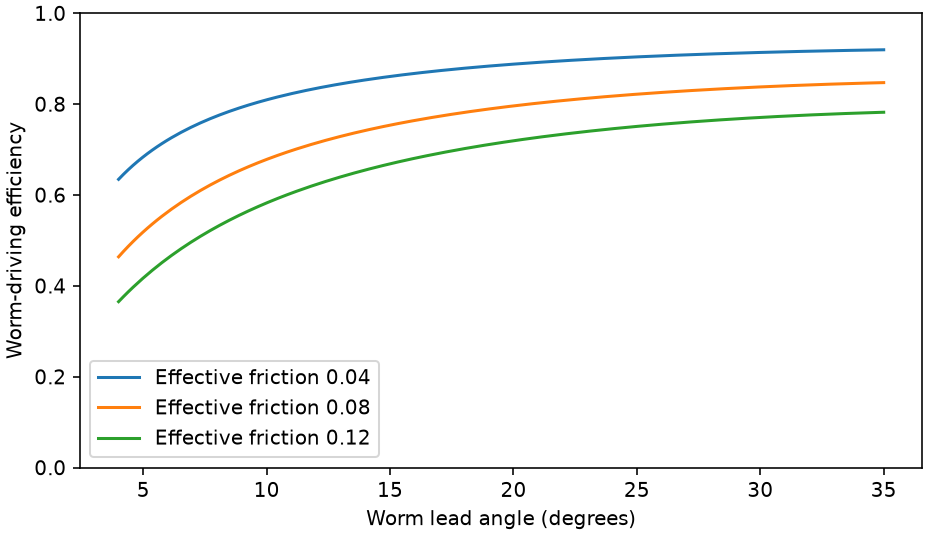
Interactive calculation · Change lead angle, friction and heat loss
Raise friction while holding transmitted geometry fixed. The input power changes thermal loss but not the dimensionless efficiency in this idealised model.
Exercises on geometry and heat
A bevel pair has equal numbers of teeth. Which separating components on either shaft become equal?
Worked solution
Both pitch cones have 45° half-angle, so the axial and radial components are each \(F_t\tan\alpha/\sqrt2\). The tangential component still carries all transmitted torque.
The worm housing can reject 0.40 kW at the allowable temperature. What continuous input power fits the example model?
Worked solution
Divide rejection by the loss fraction. With \(\eta\simeq0.714\), \(P_{in}\simeq1.40\) kW. An operating-temperature efficiency map and other losses are needed before specifying the drive.
Further reading · Budynas and Nisbett, Shigley’s Mechanical Engineering Design, 10th ed., Chapter 15.