Project the driven system onto measured modes
Use mass-normalized modes \(\Phi^TM\Phi=I\) from the preceding unit. Let a force history \(p(t)\) act through a fixed load vector \(b\) and measure \(y=c^Tq\). If modal damping ratios \(\zeta_j\) are an adequate damping model, projection with \(q\simeq\Phi_r z\) gives independent second-order oscillators. Their measured frequency response is
A mode appears only if the force excites it and the instrument sees it. In a collocated force/displacement pair the numerator is a square. At zero frequency the omitted contributions are then nonnegative and sum to a missing compliance. Test this with a static solve \(c^TK^{-1}b\). At a noncollocated sensor the residues can have either sign, especially near an antiresonance.
Treat excitation bandwidth as part of the experiment
A rectangular pulse of duration \(T\) has a transform proportional to \(T\,\mathrm{sinc}(\Omega T/2)\) with \(\mathrm{sinc}(u)=\sin(u)/u\). Its first zero is at \(f=1/T\), though higher-frequency lobes remain. A 5 ms pulse therefore has its main lobe up to 200 Hz, encompassing all three modes of the previous example. A first-mode fit can match the ring-down long after impact while missing the initial peak acceleration. Smoothing the pulse rise changes the high-frequency content of the physical loading.
Distinguish stability from phase fidelity
For an undamped mode \(\ddot z+\omega^2z=0\), trapezoidal integration of the two-component first-order system maps its continuous eigenvalue \(i\omega\) to the multiplier \((1+i\omega h/2)/(1-i\omega h/2)\). Its modulus is one for every step \(h\), but the numerical frequency is
For mode three at 147.08 Hz and \(h=1\) ms, \(\widetilde f\) is about 137.8 Hz. The signal can remain bounded indefinitely and still be badly out of phase. Halving the step brings it to about 144.5 Hz. At fixed \(h\), refining the mesh alone cannot remove this phase lag. Conversely, integrating the two-element third frequency with an extremely fine time grid merely reproduces the wrong spatial model more faithfully.
How to choose a diagnostic sequence
First converge spatial eigenfrequencies using a modal solver. Next compare the static compliance and measured frequency response when another mode is retained. Finally halve the time step with fixed spatial and modal spaces and a fixed, explicitly interpolated force signal. This keeps the three modeling decisions identifiable.
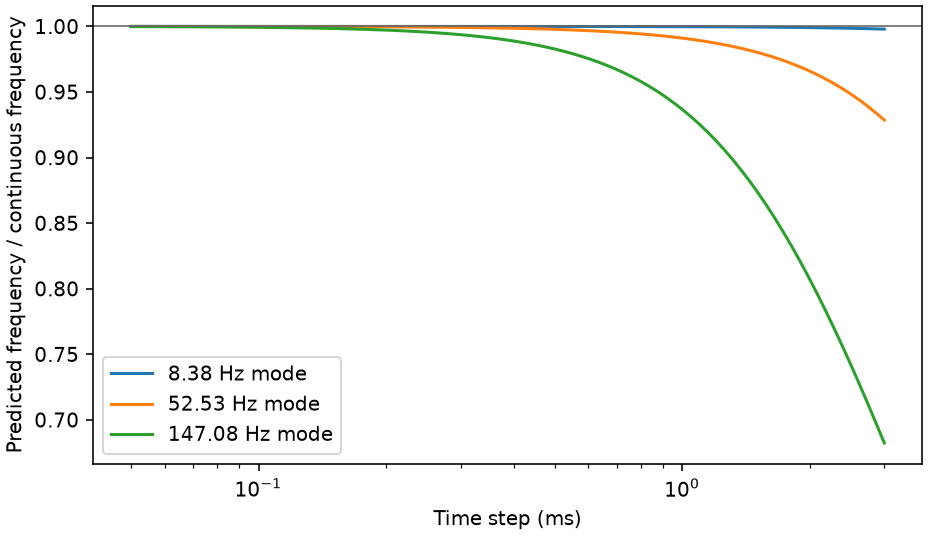
Interactive calculation · Resolve phase error over repeated oscillations
Increase time step at a fixed modal frequency, then compare a higher mode. Trapezoidal integration retains amplitude for this free undamped oscillator while slowing its phase.
Exercises on model discrimination
Two modes have frequencies 10 and 40 Hz and equal collocated modal residues. How much of their combined static compliance disappears when the second is omitted?
Worked solution
The ratio of second to first is \((10/40)^2=1/16\). The second contributes \(1/17=5.88\)% of the combined compliance, but it can dominate a narrowband force near 40 Hz.
A colleague matches the measured first frequency by adjusting Young’s modulus. Can the two-element third-frequency error also be fixed this way?
Worked solution
All frequencies scale with \(\sqrt E\). Matching the first applies one common scale near one. The third-to-first ratio remains wrong. Use spatial refinement or revise the beam assumptions before interpreting a fitted modulus.
Further reading · Rao, Mechanical Vibrations, 6th ed., Chapters 6–8 and 11–12.