From first principles
Close a short collision with impulse and restitution
During a short collision, contact force can be large while the position changes little. Let \(g^-=v_1^--v_2^->0\) be the relative approach speed along a fixed impact normal for two freely translating masses. Ignore tangential impulse and external impulses during contact. A compressive contact impulse of magnitude \(J\) slows the first mass and speeds the second. Integrating each momentum balance gives
Momentum conservation alone leaves the impulse undetermined. A measured normal coefficient of restitution \(e\) supplies the separation speed as a fraction of the approach speed. Substitution then determines the impulse.
For a rigid body struck away from its centre the impulse also changes angular momentum by \(\mathbf r\times\mathbf J\). The normal velocity used in restitution must then be evaluated at the contact point, combining centre translation and rotation. A restitution value is a contact model or measurement, whereas the impulse balances follow directly from mechanics.
Background · Force impulse
An impulse changes linear momentum over an event. A coefficient of restitution supplies a separate relative-velocity condition for an impact.
Derivation and applications
Locate the impact point that leaves a pivot without an impulse
A rapid blow on a hinged body can set it rotating while producing zero instantaneous horizontal impulse at the hinge. Model a rigid pendulum initially at rest, with mass \(m\), centre of mass distance \(a\) from its frictionless pivot, and moment of inertia \(I_O\) about the pivot. Apply a short tangential impulse \(J\) at distance \(b\) along the same radial line. Neglect the impulse from gravity during contact and take positive velocity along \(J\). Angular impulse about the pivot removes the unknown hinge reaction.
Linear impulse along the impact direction includes both \(J\) and the unknown hinge impulse \(H\). Substitution of angular speed therefore gives the signed hinge impulse as a function of the impact radius. A reaction in the opposite direction from \(J\) corresponds to \(H<0\).
Set \(H=0\) and use the parallel-axis theorem \(I_O=I_G+ma^2\). The resulting radius locates the centre of percussion; it lies beyond the centre of mass for any extended body with \(I_G>0\).
This result concerns the net hinge impulse during a short tangential event. Later hinge forces as the body swings need a separate force balance. A finite-duration or oblique impact also requires examining the other force components.
Worked example
Locate the point on a laboratory pendulum
A uniform slender bar of length 0.900 m and mass 1.50 kg is hinged at one end. Its \(a=0.450\) m and \(I_O=mL^2/3=0.405\) kg m², giving \(b_{\rm cp}=0.600\) m. A tangential impulse of 0.300 N s there produces
Its centre momentum is \(1.50(0.450)(0.444)=0.300\) N s, accounting for all of the applied impulse.
Change the inputs and inspect this calculation below
Second application
Infer inertia from a zero-reaction test
A different hinged fixture has \(m=4.00\) kg and \(a=0.180\) m. An instrumented hinge shows vanishing tangential impulse at \(b=0.320\) m. This gives \(I_O=mab=0.2304\) kg m² and \(I_G=0.1008\) kg m². At \(b=0.160\) m, a 0.500 N s impulse should instead produce \(H=0.500(0.160/0.320-1)=-0.250\) N s, a direct sign and calibration check.
Interactive calculation · Change the inputs of this example
Use the adjustable quantities to test the two worked calculations above. The plot recomputes this derivation’s balance or constitutive relation; its numerical readout reports the quantities needed for the forward calculation and the inverse or design question. Keep the fixed assumptions stated in the readout when comparing with the example values.
Does equal impulse leave equal vibration?
A force hammer and a soft contact pad can deliver the same total impulse in quite different times. The impulse fixes the change of momentum of a free mass. A mounted instrument also feels a spring force during the contact. The instrument may have already started a substantial fraction of an oscillation while the applied force is still acting, allowing later parts of the pulse to cancel some of the earlier response.
Start an undamped oscillator at rest and apply a force \(F(t)\) only between zero and \(T\). Passing a small impulse \(F(s)\,ds\) to the oscillator gives a later displacement \(F(s)\sin[\omega(t-s)]\,ds/(m\omega)\). Integrating over arrival times for \(t>T\) and collecting the coefficients of \(\sin\omega t\) and \(\cos\omega t\) gives the residual amplitude
The relevant measure is the pulse spectrum at the oscillator frequency. Its zero-frequency value is the ordinary impulse. Their difference is negligible when the complex phase changes very little during contact. A wide-band impact model that fits only impulse can otherwise give the wrong residual vibration even when it closely predicts the overall force integral.
Choose a half-sine pulse \(F(s)=J\pi\sin(\pi s/T)/(2T)\) with prescribed impulse \(J\). Write the sine as a pair of exponentials, integrate each exponential and take the magnitude. With \(r=\omega T\), this produces
At \(r=\pi\) the numerator and denominator both vanish. Expanding about \(\pi\) or integrating the sine pulse directly gives the finite limit \(\pi/4\). The notebook evaluates a pair of sinc functions to avoid asking the computer to divide zero by zero.
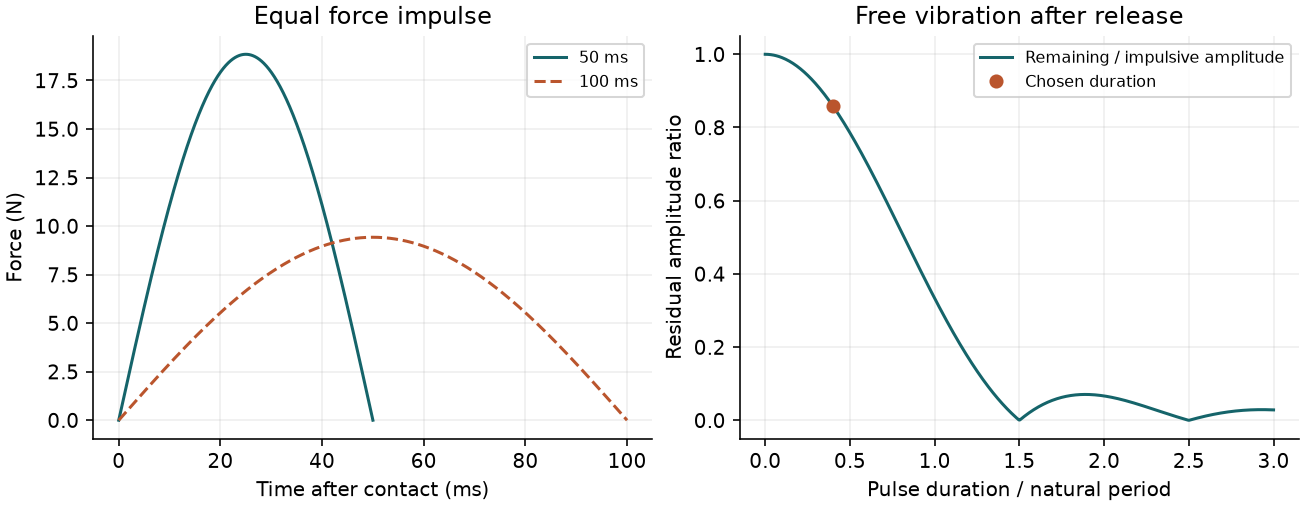
For a 2 kg instrument with natural frequency 8 Hz and a pulse of 0.6 N s, an instantaneous impulse gives \(A=5.968\) mm. A 50 ms contact occupies 0.4 natural periods and leaves only 5.123 mm. In the notebook, compare the closed result with direct numerical integration of the complex forcing history. Halve the duration while preserving impulse and inspect the approach to the impulsive limit. The force peak must increase to conserve the area.
If an accelerometer is used to check the result, separate the interval during which the hammer is in contact from the ring-down after release. During free vibration the acceleration satisfies \(\ddot x=-\omega^2x\), and the measured acceleration amplitude divided by \(\omega^2\) gives the residual displacement amplitude. For the 50 ms example this predicts about 12.94 m/s² during the ring-down. During contact the force term \(F(t)/m\) also contributes to the acceleration. Applying the same conversion to the largest acceleration in the whole record could therefore assign the forcing pulse to the free vibration. A force transducer identifies the release time independently.
At a duration of 1.5 natural periods, the remaining oscillation of this model vanishes. Does this make such a pulse equivalent to a force that never acted?
Work through the solution
At \(r=3\pi\) the cosine numerator is zero and the denominator is finite. Positive parts of the pulse delivered at different phases cancel in the final modal state. During contact there is displacement, stored spring energy and a transient force in the support. A specimen containing a second mode will weight the same pulse at another frequency. A cancellation for one mode says little about the maximum support displacement during contact or the other mode’s final amplitude.
Interactive calculation · Half sine force
Vary the notebook inputs and compare both plotted observables. The same equations generate the browser curves and the notebook reference; fixed material, geometry and model assumptions are stated in the readout.
Interactive calculation · Half sine residual
Vary the notebook inputs and compare both plotted observables. The same equations generate the browser curves and the notebook reference; fixed material, geometry and model assumptions are stated in the readout.
Select a time interval and a reference point
For a short collision, a finite change of velocity occurs over a time in which positions change very little. Integrate Newton’s law over that interval. A force that is harmless in an ordinary static calculation can deliver a large impulse if sustained long enough. Conversely, gravity often contributes very little over a millisecond. Compare its estimated impulse \(mg\Delta t\) with the contact impulse before neglecting it.
For planar rigid-body motion the impulse–momentum balances about the mass centre \(G\) and about an inertially fixed point \(O\) are
The superscripts denote states just before and after contact. A hinge can deliver an unknown impulse but exerts no moment impulse about its own centre when modelled as an ideal pin. Choosing that point can eliminate unknowns when calculating angular speed. Kinetic energy is generally lost to deformation, contact vibration and other processes. It cannot supply a conservation equation without an additional elastic-impact assumption.
Apply the contact condition at the points that meet
For a smooth frictionless collision choose the normal from the incoming body towards the target. The separation speed along that normal equals the specified coefficient of restitution \(e\) times the approach speed. Evaluate velocities of the actual points in contact; the target’s mass-centre speed can be different if the force also rotates it. For a contact point at distance \(a\) along a pinned bar and normal perpendicular to the bar, the normal contact velocity immediately after impact is \(a\omega^+\).
Take a small slider of mass 1.0 kg moving at 3.0 m/s into a stationary slender uniform bar of mass 3.0 kg, length 0.60 m, pinned at one end. It strikes at \(a=0.40\,\mathrm m\), perpendicular to the bar. The bar inertia about the pin is
Let \(J\) be the positive impulse delivered to the bar. The slider exits at \(3-J/1\), and the bar receives angular speed \(Ja/I_O\).
Close the collision and audit its energy
With \(e=0.50\), the restitution condition is \(a(Ja/I_O)-(3-J)=0.50(3)\), giving \(J=4.5/[1+0.4^2/0.36]=3.115\,\mathrm{N\,s}\). Thus \(\omega^+=3.46\,\mathrm{rad/s}\) and the slider rebounds slowly at −0.115 m/s. The bar’s contact point recedes at 1.385 m/s, exactly 1.50 m/s faster than the slider after separation.
The initial kinetic energy was 4.50 J. The final energy is
The energy loss is physically consistent with the specified restitution. The pin impulse need not vanish although its moment impulse vanished. The bar’s centre moves at \(0.30(3.46)=1.04\,\mathrm{m/s}\); its linear momentum gain happens to equal about 3.12 N s for this impact position, very close to the contact impulse. Indeed \(a=I_O/(m_bL/2)=0.40\,\mathrm m\) is the centre-of-percussion location, for which the ideal transverse pin impulse vanishes exactly.
Determine whether a rough impact sticks or slides
The smooth collision model leaves tangential velocities unaffected. A rough planar impact can also exchange tangential impulse and rotational momentum. Consider a solid disc of radius \(R\) striking a fixed horizontal surface at its lowest point. Take horizontal right and vertical up as positive; angular speed is counterclockwise positive. Just before impact let centre velocities be \(u^-,v^-\) and angular speed \(\omega^-\). The horizontal speed of its contact point is \(g_t^-=u^-+R\omega^-\). A rightward tangential impulse \(J_t\) produces both a centre velocity increase \(J_t/m\) and a positive angular change \(RJ_t/I_G\).
The post-impact contact velocity is \(g_t^+=g_t^-+(1/m+R^2/I_G)J_t\). For the horizontal surface the normal impulse passes through the centre; restitution requires \(J_n=-m(1+e)v^-\) for \(v^-<0\). The tangential impulse needed to eliminate slip is
Under a simple Coulomb impulse approximation compare this required magnitude with \(\mu J_n\). If it lies inside the bound the contact can finish without tangential slip. Otherwise take the limiting friction impulse opposing the pre-impact relative slip. This elementary model assumes no change in slip direction before the limiting impulse is reached, negligible external impulse, and no tangential elastic restitution. Using only the disc centre’s velocity to form the stick condition would miss its rotational compliance.
Compare two surfaces with the same normal restitution
A solid disc has \(m=2.0\,\mathrm{kg}\), \(R=0.10\,\mathrm m\),
Its centre approaches at \(u^-=3.0,\ v^-=-2.0\,\mathrm{m/s}\), with zero initial spin. For \(e=0.50\), \(J_n=6.0\,\mathrm{N\,s}\) and \(v^+=1.0\,\mathrm{m/s}\). The inverse tangential effective mass is
Thus \(J_t^{\rm stick}=-2.0\,\mathrm{N\,s}\) and the friction coefficient needed is at least \(2/6=0.333\).
On a surface with \(\mu=0.20\), \(J_t=-1.2\,\mathrm{N\,s}\), giving \(u^+=2.4\,\mathrm{m/s}\) and \(\omega^+=-12\,\mathrm{rad/s}\). The contact-point speed remains \(2.4-1.2=1.2\,\mathrm{m/s}\) to the right, consistent with the chosen sliding direction. On a surface with \(\mu=0.50\), the sticking impulse is achievable. It gives \(u^+=2.0\,\mathrm{m/s}\), \(\omega^+=-20\,\mathrm{rad/s}\), and zero instantaneous tangential contact speed. The disc still leaves the surface vertically because \(v^+=1.0\). Here sticking means zero relative tangential velocity at separation and does not mean a permanently attached body. The original 13 J of kinetic energy drops to 7.48 J in the sliding case and 7.00 J in the sticking case, consistent with frictional dissipation and a normal restitution below unity.
A high-speed camera that measures only the centre trajectory would determine the change in centre momentum and hence the tangential impulse, provided other horizontal impulses are negligible. Marking the disc edge permits an independent angular check: in the sliding case the ratio \(I_G|\Delta\omega|/(R m|\Delta u|)\) is
A substantial measured deviation could indicate an additional contact couple, a second impact point or uncertainty in inertia. Measuring spin is particularly important near the transition to sticking because centre velocity by itself cannot establish that the tangential contact speed has vanished.
A marked rim therefore provides an observable that a centre-tracking experiment alone cannot supply.