Choose the wall process before eliminating variables
Take a steady one-dimensional calorically perfect gas with \(G=\rho u\) constant, no shaft work and constant pipe area. Write \(M=u/\sqrt{\gamma RT}\), \(h_0=c_pT+u^2/2=c_pT_0\). An adiabatic wall fixes \(T_0\) even when wall friction creates entropy. A frictionless wall which supplies heat changes \(T_0\) while preserving the axial momentum flux \(p+\rho u^2\). Measure static and stagnation variables independently to distinguish these processes.
Integrate the frictional momentum loss
For hydraulic diameter \(D\) define the Darcy factor by \(\tau_w=f_D\rho u^2/8\). A slice has perimeter-to-area ratio \(4/D\), so momentum balance is \(dp+\rho u\,du+f_D\rho u^2dx/(2D)=0\). Differentiate constant \(G\) and \(T_0\) to obtain \(d\rho/\rho=-du/u\) and \(dT/T=-(\gamma-1)M^2du/u\). Substitute in \(dp/p=d\rho/\rho+dT/T\) and \(dM/M=du/u-dT/(2T)\):
Integrate from inlet \(M_1\) to outlet \(M_2\). Defining the remaining distance to sonic conditions by \(F(1)=0\) gives
For air with \(\gamma=1.4\), \(M_1=0.4\), \(M_2=0.7\), the two function values are 2.30849 and 0.20814. With \(D=0.050\) m and constant \(f_D=0.020\), the required length is 5.25 m. The maximum length at the stated inlet condition is 5.77 m. A longer duct requires different inlet conditions or mass flow. A quoted Fanning coefficient is one quarter of this Darcy coefficient.
Remove friction and allow heat transfer
The constant momentum flux becomes \(p(1+\gamma M^2)=p^*(1+\gamma)\), where the star denotes the sonic state on this same momentum line. Use mass conservation and the ideal-gas law to get \(T/T^*=[(1+\gamma) M/(1+\gamma M^2)]^2\). Multiply by the ratio between stagnation and static temperatures at each state to obtain
For the same inlet and outlet Mach numbers this ratio rises from 0.52903 to 0.90850. If \(T_{01}=350\) K, the outlet stagnation temperature is 601.1 K. The heat added per unit mass for \(c_p=1005\) J/(kg K) is approximately 252 kJ/kg. The sonic-line maximum \(T_0^*=661.6\) K places an upper bound on additional heat at the fixed inlet state. In the friction case the stagnation temperature remained at 350 K throughout.
Why both subsonic cases accelerate
Mass flux per area is fixed. The change of pressure and temperature required by momentum and wall conditions reduces density on these subsonic paths. Velocity rises. Supersonic and subsonic branches require explicit tracking when inverting a sonic-reference relation.
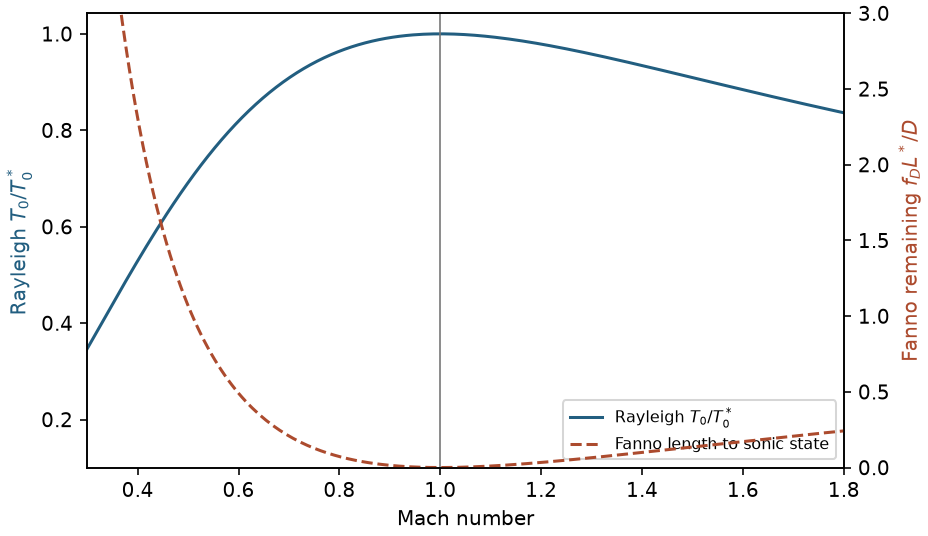
Interactive calculation · Approach a sonic state by two different wall processes
Vary the heat-capacity ratio and inlet Mach number. Compare the remaining friction-length budget with the heat addition required to reach the Rayleigh sonic reference. The two dimensionless ordinates have different definitions.
Exercises on distinguishing mechanisms
A frictional pipe with the worked inlet already carries gas at Mach 0.7 at a pressure tap. How much more straight pipe reaches the mathematical choking limit?
Worked solution
The remaining friction length is \(D F(0.7)/f_D=0.520\) m. This calculation assumes the same Darcy factor up to the sonic state.
A well-insulated pipe test gives a large stagnation-pressure loss but nearly identical measured stagnation temperatures. Could a frictionless Rayleigh model with steady net heating explain both quantities?
Worked solution
Net heating necessarily raises \(h_0\). The nearly unchanged stagnation temperature supports adiabatic frictional loss or another adiabatic irreversible process. Static temperatures alone do not distinguish acceleration from wall heat.
Further reading · Gerhart, Hochstein and Gerhart, Munson, Young and Okiishi’s Fundamentals of Fluid Mechanics, 9th ed., Sections 11.8–11.9.