From first principles
Derive the area–velocity relation for an isentropic stream
Consider a steady, quasi-one-dimensional flow through a smooth duct of area \(A\). Assume negligible viscosity, heat exchange and elevation change, and no shocks. Density \(\rho\) and speed \(V\) vary between stations. Mass conservation gives constant \(\rho VA\), so taking logarithmic differentials relates three fractional changes.
Streamwise momentum gives
For an isentropic change, sound speed satisfies \(a^2=(\partial p/\partial\rho)_s\) so the pressure differential can be eliminated in favour of density. With \(M=V/a\) this yields
Subsonic flow accelerates in a contraction because its density variation is comparatively small. A supersonic stream accelerates in a diverging duct because density falls more rapidly. A smooth transition through \(M=1\) with nonzero velocity gradient requires a stationary area, usually the minimum area of a nozzle. Reservoir state and downstream pressure determine whether that sonic condition is actually reached.
Derivation and applications
Recover subsonic Mach number from stagnation pressure
A forward-facing pressure probe brings a small sample of moving gas nearly to rest. Relating the resulting pressure to speed requires accounting for compressibility. Consider a calorically perfect ideal gas, constant heat-capacity ratio \(\gamma>1\), no heat input or shaft work, and subsonic flow brought reversibly to rest. Neglect the height change. Use \(a^2=\gamma R T\), Mach number \(M=V/a\) and \(c_p=\gamma R/(\gamma-1)\). The steady energy balance gives
For an isentropic ideal gas, \(p/\rho^\gamma\) is constant. Using the gas law to eliminate density yields a pressure ratio as a power of the temperature ratio. This provides a relation between a stagnation tap and a separate static tap at the same upstream state.
Solve for the nonnegative speed magnitude. A static temperature measurement is needed to convert dimensionless Mach number into dimensional velocity. Expanding the pressure law for small Mach number recovers the familiar dynamic pressure as its leading term.
Both pressures in the ratio must be absolute. A supersonic probe can form a shock and its recovered stagnation pressure then differs from the reversible upstream value.
Worked example
Estimate air speed from two pressure readings
For air take \(\gamma=1.40\), \(R=287\) J/(kg K), \(T=290\) K, \(p=90.0\) kPa and \(p_0=106\) kPa. Their ratio is 1.178, giving \(M=\sqrt{5[(106/90)^{2/7}-1]}=0.489\). The sound speed is 341 m/s, so the flow speed is about 167 m/s. The incompressible pressure estimate using static density would be higher because the gas compresses while it decelerates.
Change the inputs and inspect this calculation below
Second application
Predict the pressure ratio of a calibration stream
A second air stream has measured speed 102 m/s and static temperature 288 K, yielding \(a=340\) m/s and \(M=0.300\). At static pressure 100 kPa, the stagnation rise is
The leading incompressible expression predicts
Their 0.14 kPa difference sets a scale for the pressure resolution needed to detect compressibility here.
Interactive calculation · Change the inputs of this example
Use the adjustable quantities to test the two worked calculations above. The plot recomputes this derivation’s balance or constitutive relation; its numerical readout reports the quantities needed for the forward calculation and the inverse or design question. Keep the fixed assumptions stated in the readout when comparing with the example values.
Incorporate expansion work and mass conservation
Gas accelerates through a nozzle by converting enthalpy into kinetic energy. At sufficiently high speeds, density changes appreciably and a constant-density volume balance fails. For steady one-dimensional adiabatic flow without shaft work or appreciable elevation change, \(h+V^2/2=h_0\). A calorically perfect gas has \(h=c_pT\); its local sound speed is \(a=\sqrt{\gamma RT}\), and Mach number is \(M=V/a\). Evaluate \(a\) at local static temperature, rather than at the upstream reservoir temperature.
Assume the acceleration is reversible, so \(dp=a^2d\rho\) along the isentrope. Differential momentum balance gives \(dp=-\rho VdV\), hence \(d\rho/\rho=-M^2dV/V\). Inserting this in continuity \(d\rho/\rho+dV/V+dA/A=0\) gives the area–velocity relation
A subsonic stream accelerates through a converging passage. A supersonic stream accelerates through a diverging one. A smooth transition through sonic conditions requires a stationary area, conventionally a minimum-area throat for acceleration from subsonic to supersonic speed. A converging nozzle supplied from rest can first reach Mach one at its smallest area, the exit.
Obtain the throat state from the reservoir
In the upstream reservoir the flow is essentially at rest, so its static pressure and temperature are stagnation values \(p_0,T_0\). Combining \(c_p(T_0-T)=V^2/2\) with \(c_p=\gamma R/(\gamma-1)\) gives
Apply the ideal-gas isentropic pressure–temperature relation to find the critical pressure and temperature ratios at \(M=1\).
With exit area fixed, lowering back pressure increases mass flow until the exit becomes sonic. Further reduction in back pressure does not change the ideal throat state for fixed reservoir conditions. Expansion downstream can then adjust the emerging jet to its surroundings.
Estimate a choked discharge
An insulated converging air nozzle has throat area \(50\,\mathrm{mm^2}\) and reservoir conditions 300 kPa absolute and 300 K. Use \(R=287\,\mathrm{J/(kg\,K)}\) and \(\gamma=1.40\). The critical temperature is \(300(2/2.4)=250\,\mathrm K\), critical pressure \(300(2/2.4)^{3.5}=158.5\,\mathrm{kPa}\), density \(158500/(287\times250)=2.21\,\mathrm{kg/m^3}\) and critical speed \(\sqrt{1.4(287)(250)}=317\,\mathrm{m/s}\).
Atmospheric back pressure of 100 kPa lies below the critical pressure, so the ideal mass flow is
A back pressure of 210 kPa would leave this converging nozzle unchoked, and the exit state must then be calculated from that back pressure. Real contraction and boundary-layer losses can reduce the flow through a calibrated orifice compared with the ideal nozzle prediction; a measured discharge coefficient accounts for those effects within its tested range.
Predict changes at a choked throat
At fixed reservoir pressure, the critical temperature is proportional to \(T_0\), critical density to \(1/T_0\) and critical speed to \(\sqrt{T_0}\). Their product shows that the choked mass flow scales as \(p_0A^*/\sqrt{T_0}\) for the same gas. Warming the original reservoir from 300 to 360 K at unchanged absolute pressure therefore reduces the ideal mass flow by \(\sqrt{300/360}=0.913\), to about 0.0320 kg/s. Increasing throat area or reservoir pressure has a direct linear effect while the downstream pressure stays low enough to maintain choking.
Derive the admissible jump from conservation laws
Supersonic gas in a duct can decelerate abruptly through a normal shock. The shock is thin compared with the duct dimensions, so treat it as a stationary discontinuity of unchanged area. Take a calorically perfect gas, no heat or shaft work and negligible elevation change. Mass, streamwise momentum and stagnation enthalpy are conserved:
Entropy increases through the shock, so the two end states cannot be joined with the isentropic pressure–temperature relation. Set \(r=\rho_2/\rho_1=V_1/V_2\). Momentum gives \(p_2/p_1=1+\gamma M_1^2(1-1/r)\) and the gas law gives
Substitution into the energy equation yields two roots, one for unchanged flow and the compression solution
For \(M_1>1\) this second state has higher density and lower Mach number. As \(M_1\to1^+\), every state ratio tends to unity. For very large upstream Mach number the compression ratio approaches \((\gamma+1)/(\gamma-1)\) in the constant-specific-heat approximation, although real-gas changes eventually limit that approximation.
Calculate a diffuser’s stagnation-pressure loss
Air upstream of a normal shock has \(M_1=2.0,\ p_1=80\,\mathrm{kPa}\) absolute and \(T_1=250\,\mathrm K\). Use \(\gamma=1.4,\ R=287\,\mathrm{J/(kg\,K)}\). The density ratio is
Hence \(p_2=360\,\mathrm{kPa}\) and \(T_2=250(4.50/2.667)=421.9\,\mathrm K\). The downstream Mach number is
Upstream speed is approximately 634 m/s and mass conservation gives about 238 m/s downstream.
The stagnation temperature upstream is \(250[1+0.2(4)]=450\,\mathrm K\); downstream it is \(421.9[1+0.2(0.577)^2]=450\,\mathrm K\) as required by energy conservation. Evaluate stagnation pressure separately from each local state by a hypothetical isentropic deceleration on its own side. Upstream \(p_{01}=80(1.8)^{3.5}=626\,\mathrm{kPa}\), whereas downstream \(p_{02}=360(1.0667)^{3.5}=451\,\mathrm{kPa}\). Recovery \(p_{02}/p_{01}=0.721\) shows that a large static pressure rise can accompany a 28% loss of stagnation pressure. For the same stagnation temperature the entropy rise is \(-R\ln(0.721)=94\,\mathrm{J/(kg\,K)}\), a positive value consistent with the irreversible deceleration.
A pitot tube facing the upstream supersonic flow forms its own shock ahead of the tip. The final stagnation pressure measured there corresponds ideally to isentropic deceleration after the probe’s shock, about 451 kPa here, rather than to the upstream isentropic stagnation pressure of 626 kPa. A conventional subsonic pitot reduction applied to the reading would therefore infer an incorrect upstream speed. By contrast, a static pressure tap placed sufficiently far upstream can still report the 80 kPa static state. The ratio \(451/80=5.64\) illustrates why the probe configuration must be stated when comparing a pressure ratio with a compressible-flow prediction.
The downstream temperature calculation can also be checked using mass flux. The upstream density is \(80000/[287(250)]=1.12\,\mathrm{kg/m^3}\) and the measured downstream static values imply \(360000/[287(421.9)]=2.97\,\mathrm{kg/m^3}\). Multiplication by the corresponding velocities gives roughly \(707\,\mathrm{kg/(m^2s)}\) on both sides. A calculation conserving stagnation pressure instead would generally fail one of these basic balances even if its pressure trend looked plausible.
The shock also changes the area needed to choke a downstream passage. For a given gas the choked mass flow scales as \(A^*p_0/\sqrt{T_0}\). Stagnation temperature is unchanged but stagnation pressure drops to 72.1% of its upstream value. Passing the same mass flow therefore requires a downstream critical area larger by \(1/0.721=1.39\). This does not mean the physical duct jumps in area at the normal shock. The critical area is the sonic reference area for an isentropic stream tube drawn from each side, and the two hypothetical reference conditions differ because entropy has increased.
A converging test section downstream that was sized from the upstream stagnation pressure may consequently choke earlier than expected. The entropy and critical-area tests point to the same lost capacity from different directions: one uses the gas state, the other its maximum deliverable mass flux. Together with conservation of actual mass flux at the shock, they make it possible to distinguish a real shock loss from a simple mismatch between static and total pressure instrumentation.
Find the two states that share a nozzle area ratio
For steady isentropic flow of a calorically perfect gas, combine continuity with stagnation enthalpy and the isentropic pressure law. The critical area \(A^*\) is the area giving Mach one for the same mass flow and stagnation state.
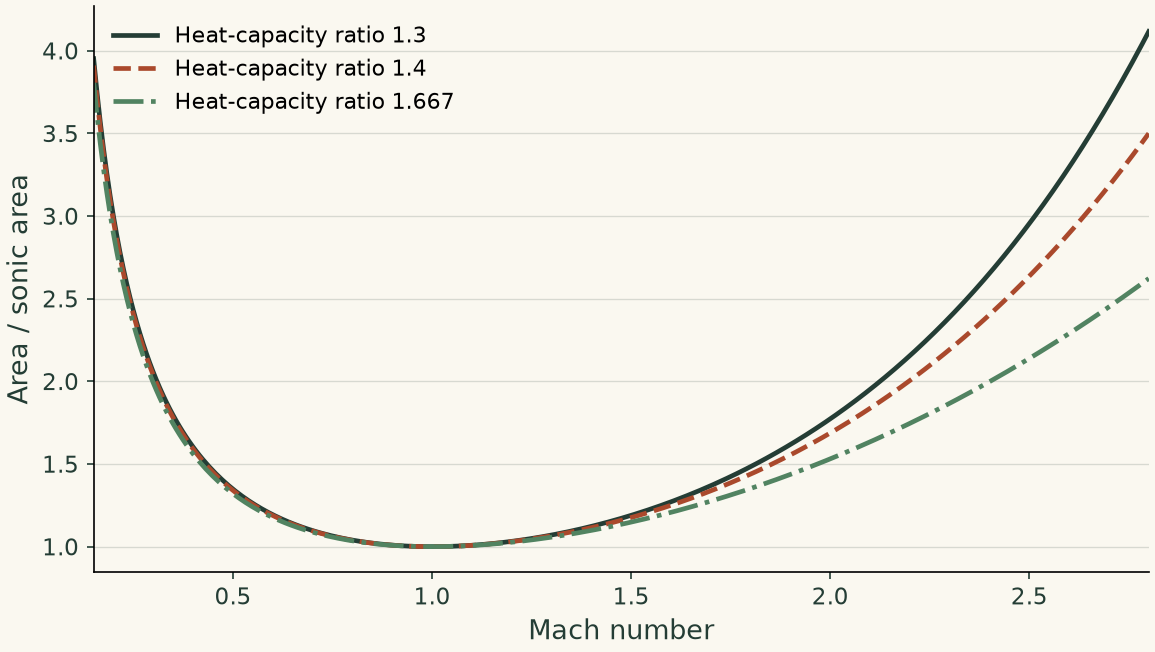
Read values from the plot
| Mach number | Heat-capacity ratio 1.3 | Heat-capacity ratio 1.4 | Heat-capacity ratio 1.667 |
|---|---|---|---|
| 0.15 | 3.9522 | 3.9103 | 3.8063 |
| 0.8125 | 1.0344 | 1.0333 | 1.0305 |
| 1.475 | 1.1714 | 1.1597 | 1.135 |
| 2.1375 | 2.0248 | 1.8977 | 1.6749 |
| 2.8 | 4.1165 | 3.5001 | 2.6222 |
Interactive calculation · change the inputs of this example
Change heat-capacity ratio and target area. Track both Mach branches and their common sonic limit.
The curves below are recalculated from this section’s equations in your browser. The fixed reference plot above remains available for comparison.