Draw the control surface around the bead
Let the gas have temperature \(T_g\) and the bead a uniform temperature \(T_s\). A large, isothermal enclosure at \(T_w\) fills the bead's field of view. Use kelvins throughout. Convection supplies the bead with heat at \(h A(T_g-T_s)\). A diffuse grey bead emits \(\epsilon\sigma A T_s^4\) and absorbs \(\epsilon\sigma A T_w^4\) from the enclosure. The absorptivity and emissivity are equal for the grey surface. The common area \(A\) cancels from the steady energy balance when axial conduction through the support is negligible.
For a hotter gas, \(F(T_w)\) is positive, \(F(T_g)\) is nonpositive, and \(F'(T_s)=-h-4\epsilon\sigma T_s^3\) is strictly negative. There is exactly one equilibrium between the two reservoir temperatures. A colder gas reverses their ordering and keeps the same argument. This physical bracket gives a bisection solver two trustworthy endpoints. With positive heat capacity, a small rise in bead temperature makes the net heat input negative, which restores equilibrium.
The factorization \(T_s^4-T_w^4=(T_s-T_w)(T_s+T_w)(T_s^2+T_w^2)\) gives an exact coefficient \(h_r=\epsilon\sigma(T_s+T_w)(T_s^2+T_w^2)\). At the root,
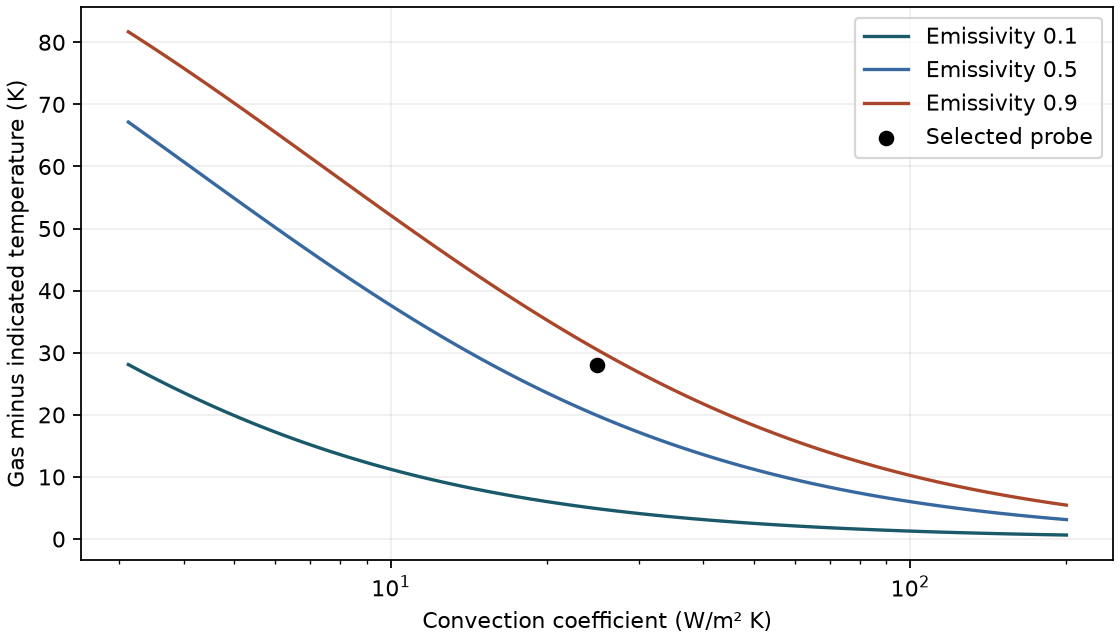
A shiny surface and a fast gas stream therefore act on different terms of the same equation. A larger bead changes the transient response through its mass-to-area ratio, and may also change \(h\). Area alone cannot correct the steady reading at fixed \(h\).
Predict the indicated temperature
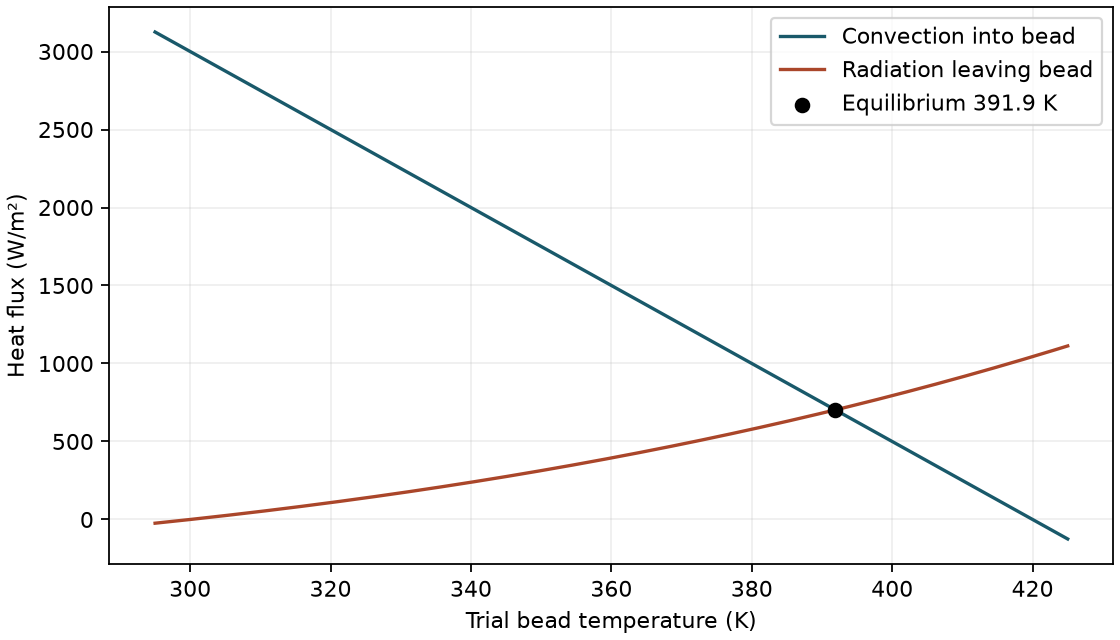
Take \(T_g=420\) K, \(T_w=300\) K, \(h=25\) W m\(^{-2}\) K\(^{-1}\) and \(\epsilon=0.8\). At 390 K, convection supplies 750 W m\(^{-2}\) and the radiative loss is approximately 682 W m\(^{-2}\). The bead thus warms. At 400 K the convective input has fallen to 500 W m\(^{-2}\) while radiative loss reaches 794 W m\(^{-2}\). The intersection gives \(T_s=391.90\) K, an under-reading of 28.10 K. The two independently evaluated fluxes at equilibrium agree to round-off. Doubling \(h\) gives 403.34 K for the same gas and wall. Metal lead wires connected to a cold mount could supply a third heat path, which the two-flux residual cannot independently diagnose.
 Open full-size diagram
 Open full-size diagram
Problem 1 · Correct a recorded temperature
The probe reads 400 K. The walls remain at 300 K, \(h=25\) W m\(^{-2}\) K\(^{-1}\) and \(\epsilon=0.8\). Recover the gas temperature without iteration. How would a hotter enclosure affect the sign of this correction?
Work through the solution
Rearranging the balance gives
The correction is \(793.85/25=31.75\) K, giving 431.75 K. If the walls were hotter than the bead, absorbed radiation would exceed emitted radiation and the correction to the reading would be negative. A Celsius temperature can be reported at the end after the fourth powers have been evaluated in kelvins.
Problem 2 · Specify a minimum convection coefficient
For the original gas at 420 K, find \(h\) required for the under-reading to be at most 5 K. Then reduce the emissivity to 0.2 and repeat. Explain the ratio.
Work through the solution
At the limiting reading \(T_s=415\) K the required coefficient is \(\epsilon\sigma(415^4-300^4)/5\). For \(\epsilon=0.8\) this is approximately 196 W m\(^{-2}\) K\(^{-1}\). The required coefficient scales directly with emissivity at this prescribed reading, so the lower-emissivity bead needs about 49 W m\(^{-2}\) K\(^{-1}\). Above those coefficients the gas transfers more heat at the limiting temperature and drives the equilibrium closer to 420 K.
Interactive calculation · Probe balance
Change the physical and numerical inputs of the notebook model. Compare the updated curves and balance checks with the recorded notebook figures. Each plot uses the same equations and assumptions documented in that notebook; its readout names any analytical or reduced-model reference.
Interactive calculation · Probe bias
Change the physical and numerical inputs of the notebook model. Compare the updated curves and balance checks with the recorded notebook figures. Each plot uses the same equations and assumptions documented in that notebook; its readout names any analytical or reduced-model reference.