Write an energy budget for a cooling part
A warm metal part is set on an insulating support in a room. It cools fastest at first. How long will it take to come within 10 K of the room temperature, and which properties of the part or the surrounding air determine that time?
Draw the system boundary around the part. Assume it has a nearly uniform temperature \(T(t)\), mass \(m\) and constant specific heat \(c_p\). Its total heat capacity is \(C=mc_p\) in J/K. A small temperature change \(dT\) changes its stored energy by \(C\,dT\). With constant surrounding temperature \(T_\infty\), convection carries heat out through exposed area \(A\) at rate \(hA(T-T_\infty)\). Neglect heat generation, radiation and conduction through the support. Energy conservation gives
For a body warmer than the room the right-hand side is negative. As the temperature difference shrinks, the heat loss per second decreases.
Find the time constant and check the uniform-temperature assumption
Set \(\theta=T-T_\infty\). For constant \(h\), separation of variables gives
Integration from the initial temperature yields
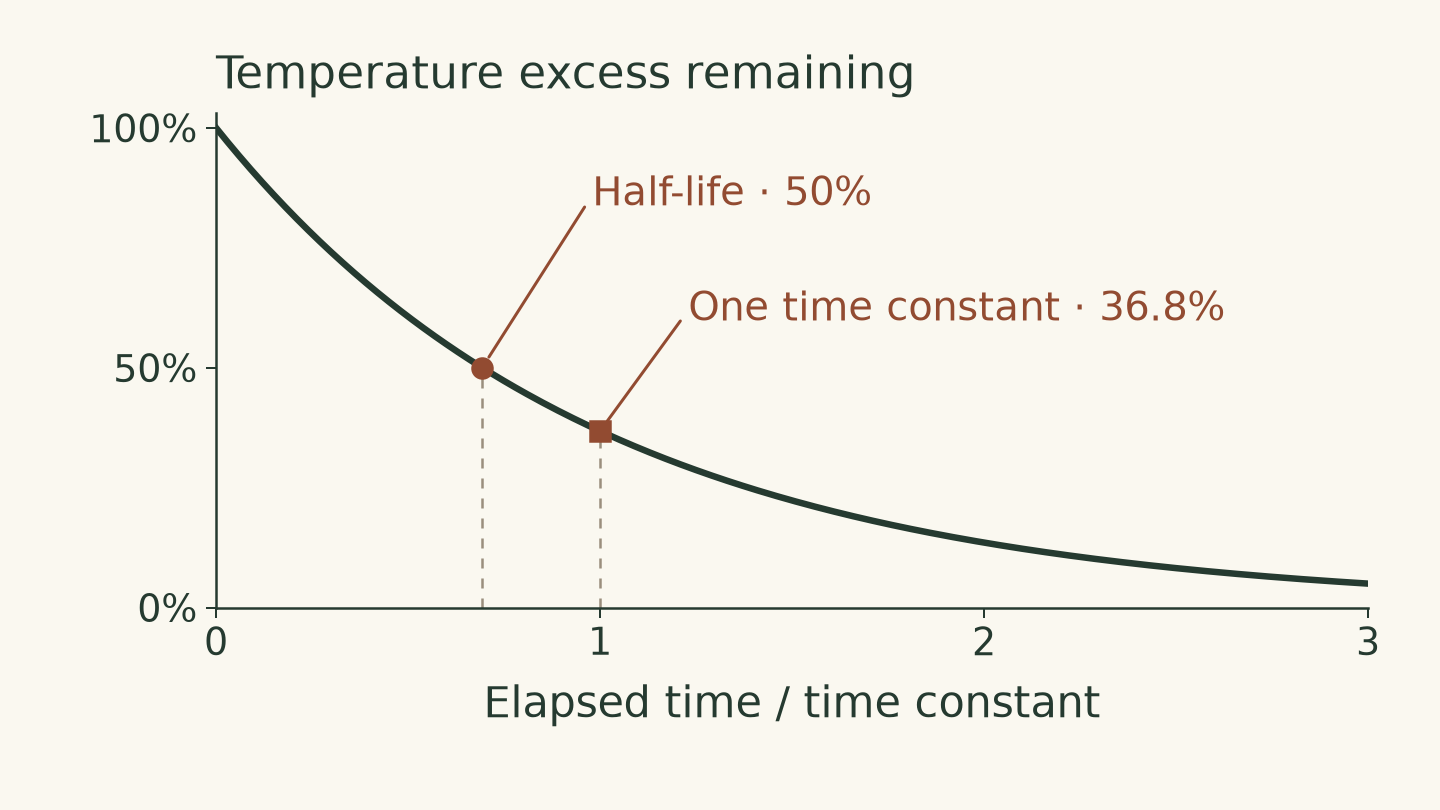
After one time constant the temperature difference is \(1/e\) of its initial value. A check on the single-temperature model is the Biot number \(Bi=h(V/A)/k\), where \(V\) is the body volume and \(k\) its conductivity. A value well below 0.1 means resistance to heat conduction inside the part is small compared with resistance at its surface. A poorly conducting body may have a cool surface while its centre stays warm.
Further study · MIT’s Transient Heat Transfer connects the uniform-temperature assumption to the ratio of internal and surface thermal resistances.
Cool from 350 K to 310 K
Take \(T_\infty=300\) K, \(C=900\) J/K, \(A=0.060\) m² and \(h=15\) W/(m²·K). The thermal conductance is \(hA=0.90\) W/K and \(\tau=900/0.90=1000\) s. The initial heat loss is
A target of 310 K leaves 10 K of the original 50 K temperature difference. Solve \(10/50=e^{-t/1000}\) to get \(t=1000\ln 5=1609\) s, or 26.8 min. During this interval the part releases \(900(350-310)=36\,000\) J. Dividing that energy by the initial 45 W would underestimate the time, because the heat loss has fallen to 9 W at the target.
Tutorial on cooling measurements
1. Infer a convection coefficient
A repeat experiment starts at 350 K in the same 300 K room. After 700 s the measured part temperature is 325 K. Estimate \(h\) using the given area and heat capacity. When should it reach 312.5 K under those conditions?
Solution to the cooling measurement
The excess temperature has halved, so
Thus \(h=C/(A\tau)=14.9\) W/(m²·K). A further half-life of 700 s takes the excess from 25 K to 12.5 K. The target occurs 1400 s after the start.
2. Decide whether a single thermometer is enough
Consider two samples with \(V/A=0.0050\) m exposed to \(h=15\) W/(m²·K). One has \(k=200\) W/(m·K), the other \(k=0.10\) W/(m·K). For which sample would a surface temperature be a reasonable estimate of the core temperature during cooling?
Solution to the temperature-gradient check
The Biot numbers are
In the first sample conduction readily equalises internal temperatures. In the second an appreciable gradient can develop. A surface sensor can reach a chosen threshold while the core is still warmer, so a core measurement or spatial conduction model is needed.
Optional numerical comparison
Compare each stored temperature with \(300+50e^{-t/1000}\) K in the lumped cooling calculation. Check the value at one time constant (318.39 K) and calculate the largest absolute discrepancy over the full history. With the supplied time step it should be below 0.001 K. OneSimulation example of convective cooling.