1. Set up and run
Use CPython 3.13 and OneSimulation Runtime 0.2.1a8. Open View content in Gumroad, download the ZIP for your platform, extract it and put step-import.py beside the wheel. Enter the Gumroad licence key when the activation command prompts for it.
macOS · Apple Silicon
python3.13 -m venv .venv-onesimulation
.venv-onesimulation/bin/python -m pip install './onesimulation-0.2.1a8-cp313-cp313-macosx_11_0_arm64.whl[meshing,compute,visualization]'
.venv-onesimulation/bin/python -m pip check
.venv-onesimulation/bin/onesimulation-license activate-gumroad
.venv-onesimulation/bin/python step-import.py
Ubuntu 22.04 · x86-64
python3.13 -m venv .venv-onesimulation
.venv-onesimulation/bin/python -m pip install './onesimulation-0.2.1a8-cp313-cp313-linux_x86_64.whl[meshing,compute,visualization]'
.venv-onesimulation/bin/python -m pip check
.venv-onesimulation/bin/onesimulation-license activate-gumroad
.venv-onesimulation/bin/python step-import.py
Windows x64 · PowerShell
py -3.13 -m venv .venv-onesimulation
.\.venv-onesimulation\Scripts\python.exe -m pip install './onesimulation-0.2.1a8-cp313-cp313-win_amd64.whl[meshing,compute,visualization]'
.\.venv-onesimulation\Scripts\python.exe -m pip check
.\.venv-onesimulation\Scripts\onesimulation-license.exe activate-gumroad
.\.venv-onesimulation\Scripts\python.exe step-import.py
For the notebook, install JupyterLab in the same Python environment if needed (python -m pip install jupyterlab). Start it with python -m jupyterlab from that environment. Results are written to onesimulation_results/.
2. Model and face assignments
With STEP_FILE = None, the script creates the sleeve, exports it as STEP, then imports that file for meshing. This exercises the same import path as an external CAD file.
| Input | Benchmark value |
|---|---|
| Geometry | 100 mm long, radii 12 and 18 mm |
| Material | Stainless steel 304, E = 193 GPa |
| Boundary conditions | Lower end fixed, upper face at 40 MPa, free cylindrical walls |
| Discretization | Quadratic FEM, 1,731 tetrahedra in the reference run |
Run survey_step before editing the face groups. The sample uses faces 0 and 2 for the cylindrical walls, 1 for the fixed end and 3 for the load. The fast mesh has a 6 mm target size. The refined profile uses 3 mm.
3. Results and checks
- Computed elongation
- 20.49 µm
- Bar formula
- 20.73 µm
- Relative difference
- 1.15%
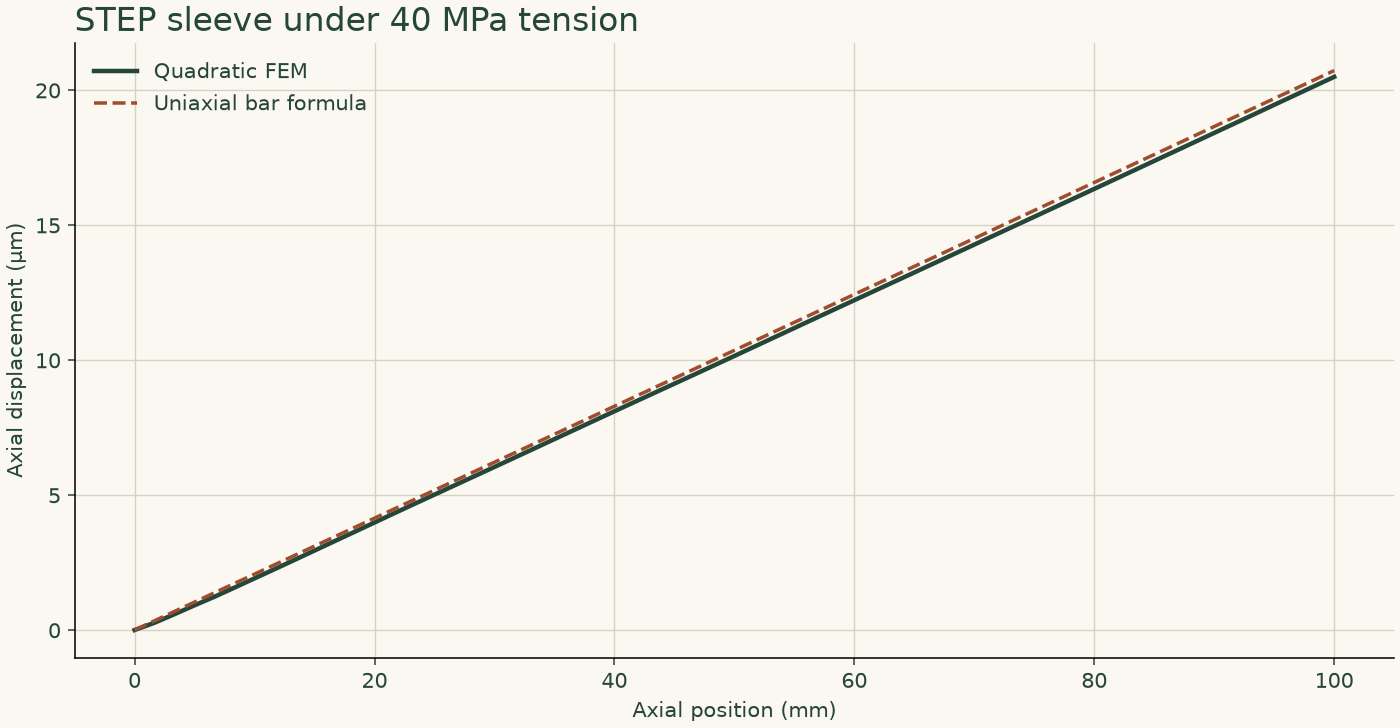
The ideal force is σπ(R² − r²), about 22.62 kN. Integrating the traction on the triangulated end face gives 22.58 kN. This check helps catch a wrong face assignment or unit conversion. The lower clamp restricts lateral contraction, so the bar formula u = σL/E is an approximate displacement reference.
4. Adapt the model
Set STEP_FILE to your file, inspect its face indices and set the length unit. Replace the load, constraints and material in the script. Choose a reference and a tolerance for that geometry before interpreting the displacement field.
The example assumes small strains and linear elasticity. It does not include contact, yielding or thermal loading.
Source code
Read the full Python script
"""Calculate and verify the axial deformation of a steel sleeve imported from STEP.

Use the OneSimulation runtime and the setup instructions in the STEP tutorial.
"""

from importlib.metadata import version
from pathlib import Path
from time import perf_counter
import csv
import json
import numpy as np
import matplotlib.pyplot as plt

from onesim.cad import CadGeometryBuilder
from onesim.cad.d3 import AnnularCylinder, ImportedSolid
from onesim.cad.exchange import survey_step
from onesim.materials.library import standard_material
from onesim.meshing import TetrahedralMesher
from onesim.numerics import Numerics
from onesim.numerics.fem import FiniteElement, Lagrange
from onesim.numerics.linear import SparseDirect
from onesim.physics.solid_mechanics import (
    FixedDisplacement, LinearElasticity, Traction, TractionFree,
)
from onesim.simulation import Problem, Simulation

assert version("onesimulation") == "0.2.1a8"
STEP_FILE = None
PROFILE = "FAST"
PROFILES = {"FAST": {"target_size": 0.006}, "REFINED": {"target_size": 0.003}}
config = PROFILES[PROFILE]
output_dir = Path("onesimulation_results")
output_dir.mkdir(exist_ok=True)

INNER_RADIUS, OUTER_RADIUS, LENGTH = 0.012, 0.018, 0.100
TENSILE_STRESS = 40.0e6
MATERIAL = standard_material("stainless_steel_304")

if STEP_FILE is None:

    design = AnnularCylinder(inner_radius=INNER_RADIUS,
                              outer_radius=OUTER_RADIUS, length=LENGTH)
    built_geometry = CadGeometryBuilder().build(design)
    step_path = output_dir / "sleeve.step"
    built_geometry.kernel.export_step(built_geometry.reference, step_path)
    expected_volume = design.measure
else:
    step_path = Path(STEP_FILE)
    expected_volume = None
assert step_path.is_file() and step_path.stat().st_size > 0, step_path
print(f"STEP file: {step_path} ({step_path.stat().st_size / 1024:.1f} KiB)")

survey = survey_step(step_path)
print(f"Faces: {survey.face_count}; Volume: {survey.volume:.6e} m^3; "
      f"Unit: {survey.unit}")
print(f"Bounding box: "
      + ", ".join(f"{value:+.4f}" for value in survey.bounds))
print()
print(f"{'Index':>5}  {'Name':<10} {'Area / m^2':>14}  Normal")
for face in survey:
    normal = ", ".join(f"{value:+.3f}" for value in face.normal)
    print(f"{face.index:>5}  {face.member:<10} {face.area:>14.6e}  ({normal})")

if expected_volume is not None:

    relative_volume_error = abs(survey.volume / expected_volume - 1.0)
    assert relative_volume_error < 1e-9, relative_volume_error
    print(f"\nRelative volume difference from the design: {relative_volume_error:.3e}")

FACE_COUNT = 4
FACE_GROUPS = (
    ("inner_wall", (0,)),
    ("fixed_end", (1,)),
    ("outer_wall", (2,)),
    ("loaded_end", (3,)),
)
solid = ImportedSolid(path=str(step_path), unit="m",
                        face_count=FACE_COUNT, face_groups=FACE_GROUPS)
material = MATERIAL.create()
model = LinearElasticity(domain=solid.volume, material=material)
problem = Problem(
    name="Imported STEP sleeve under uniform tension",
    geometry=solid, physics=(model,),
    boundary_conditions=(
        FixedDisplacement(boundary=solid.boundaries.fixed_end,
                          physics=model, value=(0.0, 0.0, 0.0)),
        Traction(boundary=solid.boundaries.loaded_end, physics=model,
                 value=(0.0, 0.0, TENSILE_STRESS)),
        TractionFree(boundary=solid.boundaries.inner_wall
                     | solid.boundaries.outer_wall, physics=model),
    ),
)

start_time = perf_counter()
mesh = TetrahedralMesher(target_size=config["target_size"]).generate(solid)
meshing_seconds = perf_counter() - start_time
start_time = perf_counter()
result = Simulation(
    problem=problem, mesh=mesh,
    numerics=Numerics(spatial=FiniteElement(element=Lagrange(order=2)),
                      linear_solver=SparseDirect()),
).solve_stationary()
solve_seconds = perf_counter() - start_time
displacement = result.field(model.displacement)
print(f"Tetrahedra: {mesh.cell_count}; Mesh nodes: {len(mesh.coordinates)}; "
      f"FEM nodes: {len(displacement.values)}")
print(f"Meshing: {meshing_seconds:.2f} s; Solving: {solve_seconds:.2f} s")

facets_by_group = {
    name: len(mesh.facets(getattr(solid.boundaries, name)))
    for name, _ in FACE_GROUPS
}
total_boundary_facets = len(mesh.facets(solid.boundaries.all))
assert sum(facets_by_group.values()) == total_boundary_facets
print("Boundary facets per named face:", facets_by_group)

mean_radius = 0.5 * (INNER_RADIUS + OUTER_RADIUS)
angles = np.linspace(0.0, 2.0 * np.pi, 13)[:-1]
loaded_end_points = np.column_stack((
    mean_radius * np.cos(angles), mean_radius * np.sin(angles),
    np.full_like(angles, LENGTH),
))
loaded_end_displacements = np.asarray(displacement.evaluate(loaded_end_points))
fixed_end_points = np.column_stack((
    mean_radius * np.cos(angles), mean_radius * np.sin(angles),
    np.zeros_like(angles),
))
max_fixed_displacement = float(np.max(np.abs(displacement.evaluate(fixed_end_points))))

z = np.linspace(0.0, LENGTH, 61)
axial_points = np.column_stack((np.full_like(z, mean_radius), np.zeros_like(z), z))
axial_displacements = np.asarray(displacement.evaluate(axial_points))
youngs_modulus = float(MATERIAL.properties["youngs_modulus"])
bar_reference = TENSILE_STRESS * z / youngs_modulus
computed_elongation = float(loaded_end_displacements[:, 2].mean())
reference_elongation = TENSILE_STRESS * LENGTH / youngs_modulus
relative_elongation_error = abs(computed_elongation / reference_elongation - 1.0)

operator = result.operators[model.model_id]
_, _, nodal_loads = operator.conditions(0.0)
integrated_load = np.asarray(nodal_loads).reshape(-1, 3).sum(axis=0)
cross_section = np.pi * (OUTER_RADIUS**2 - INNER_RADIUS**2)
expected_force = TENSILE_STRESS * cross_section

relative_transverse_load = float(np.linalg.norm(integrated_load[:2]) / expected_force)
relative_axial_load_error = float(abs(integrated_load[2] / expected_force - 1.0))

mises = np.asarray(result.field(model.von_mises_stress).evaluate(
    np.array([[mean_radius, 0.0, LENGTH / 2]])))
relative_mises_error = float(abs(mises[0] / TENSILE_STRESS - 1.0))

assert np.isfinite(axial_displacements).all() and np.isfinite(mises).all()
assert max_fixed_displacement < 1e-12
assert relative_transverse_load < 1e-12
assert relative_axial_load_error < 0.01
assert float(np.ptp(loaded_end_displacements[:, 2])) / abs(computed_elongation) < 0.01
assert relative_elongation_error < 0.03
assert relative_mises_error < 0.02

print(f"Elongation: {computed_elongation * 1e6:.3f} um; "
      f"Bar formula: {reference_elongation * 1e6:.3f} um "
      f"(difference {100 * relative_elongation_error:.2f} %)")
print(f"Integrated tensile force: {integrated_load[2]:.6f} N; "
      f"exact annulus: {expected_force:.6f} N "
      f"(faceting difference {100 * relative_axial_load_error:.3f} %)")
print(f"Midheight von Mises stress: {mises[0] / 1e6:.3f} MPa "
      f"(difference {100 * relative_mises_error:.2f} %)")

csv_path = output_dir / "step_sleeve.csv"
with csv_path.open("w", encoding="utf-8", newline="") as csv_file:
    writer = csv.writer(csv_file)
    writer.writerow(["z_m", "ux_m", "uy_m", "uz_m", "bar_reference_uz_m"])
    writer.writerows(np.column_stack((z, axial_displacements, bar_reference)))

import onesim.visualization as visualization
from onesim.results.storage import write_for_paraview

cream, ink, green, copper = "#F7F2E7", "#223D35", "#336B57", "#B66E43"
plt.rcParams.update({"font.family": "DejaVu Sans", "font.size": 11,
                     "text.color": ink, "axes.labelcolor": ink,
                     "xtick.color": ink, "ytick.color": ink,
                     "svg.fonttype": "none"})
fig, ax = plt.subplots(figsize=(8, 4.5), facecolor=cream)
ax.set_facecolor(cream)
ax.plot(z * 1000, axial_displacements[:, 2] * 1e6, color=green, linewidth=2.4,
        label="OneSimulation, quadratic FEM on the imported sleeve")
ax.plot(z * 1000, bar_reference * 1e6, color=copper, linewidth=1.6,
        linestyle="--", label=r"Bar formula $u_z=\sigma z/E$")
ax.set_xlabel("Axial position z / mm")
ax.set_ylabel(r"Elongation $u_z$ / µm")
ax.set_title("STEP sleeve under 40 MPa tensile stress", color=ink)
ax.legend(frameon=False)
ax.grid(True, color=ink, alpha=0.12)
fig.tight_layout()
png_path = output_dir / "step_sleeve.png"
svg_path = output_dir / "step_sleeve.svg"
fig.savefig(png_path, dpi=200)
fig.savefig(svg_path)

PARAVIEW_FIELDS = (model.displacement, model.von_mises_stress, model.stress)
paraview_files = [
    write_for_paraview(result, mesh, PARAVIEW_FIELDS,
                       output_dir / f"step_sleeve.{suffix}")
    for suffix in ("vtk", "xdmf")
]
for path in paraview_files:
    assert path.is_file() and path.stat().st_size > 1000, path
    print(f"ParaView file: {path} ({path.stat().st_size / 1024:.1f} KiB)")

figure = visualization.result(result.result_set, model.von_mises_stress.field_id,
                              title="von Mises stress (Pa)")
assert figure.data, "The result plot has no data traces"
figure

verification = {
    "passed": True,
    "profile": PROFILE,
    "runtime_version": version("onesimulation"),
    "example": "linear elastic tension on a solid imported from STEP",
    "step_file": str(step_path),
    "step_file_bytes": int(step_path.stat().st_size),
    "imported_face_count": int(survey.face_count),
    "declared_face_count": FACE_COUNT,
    "imported_volume_m3": float(survey.volume),
    "imported_bounds_m": [float(value) for value in survey.bounds],
    "face_group_boundary_facets": facets_by_group,
    "boundary_facets_total": int(total_boundary_facets),
    "mesh_cells": int(mesh.cell_count),
    "mesh_nodes": int(len(mesh.coordinates)),
    "fem_nodes": int(len(displacement.values)),
    "material": MATERIAL.name,
    "material_quality": MATERIAL.quality,
    "youngs_modulus_pa": youngs_modulus,
    "applied_tension_pa": TENSILE_STRESS,
    "cross_section_m2": float(cross_section),
    "computed_elongation_m": computed_elongation,
    "bar_formula_elongation_m": reference_elongation,
    "elongation_relative_difference": relative_elongation_error,
    "integrated_force_n": integrated_load.tolist(),
    "target_force_n": float(expected_force),
    "axial_load_relative_difference": relative_axial_load_error,
    "transverse_load_relative_error": relative_transverse_load,
    "midheight_von_mises_pa": float(mises[0]),
    "midheight_von_mises_relative_difference": relative_mises_error,
    "mesh_seconds": float(meshing_seconds),
    "solve_seconds": float(solve_seconds),
    "output_files": [str(csv_path), str(png_path), str(svg_path),
                     *(str(path) for path in paraview_files)],
    "limitations": [
        "STEP read with the bundled CAD kernel; other exchange formats are not qualified",
        "Boundaries are named by kernel face index; recheck the face table after a CAD change",
        "Nominal handbook material values at 20 degC; no certified material data",
        "Small-strain stationary isotropic linear elasticity; no contact, plasticity or thermal load",
        "Bar formula is an approximate reference; the clamped end suppresses lateral contraction",
        "One mesh is not a convergence study",
        "The loaded end face is triangulated, so the integrated force is slightly below the exact annulus",
        "ParaView export samples the quadratic solution at the written mesh vertices",
        "No experimental or COMSOL validation",
    ],
}
assert all(Path(path).stat().st_size > 0 for path in verification["output_files"])
report_path = output_dir / "step_sleeve_verification.json"
report_path.write_text(json.dumps(verification, indent=2, ensure_ascii=False),
                     encoding="utf-8")
print(json.dumps(verification, indent=2, ensure_ascii=False))
Focus – Structures & Mechanics covers this commercial workflow. Gumroad shows the seven-day trial and the monthly price before you confirm.