Follow the energy in a discharging loop
Connect a charged capacitor to an inductor and resistor in series, then leave the circuit without a source. As the capacitor empties, the current grows. When the capacitor first reaches zero voltage, the inductor still carries current. That current continues to move charge, giving the capacitor the opposite polarity.
Assume ideal, constant components and neglect propagation time along the wires. Let \(q\) be the charge on the plate that starts positive and define \(i=\dot q\). Discharge then gives a negative current in this convention. Summing the voltages round the loop gives \(L\dot i+Ri+q/C=0\), where \(L\) is inductance, \(R\) resistance and \(C\) capacitance. Multiplying by \(i\) gives the energy balance
The first term stores magnetic energy and the second stores electric energy. The resistor dissipates power whenever current flows. Reversing the sign of the charge is therefore compatible with a decrease in total stored energy.
Find the condition for a reversal
Substitute \(i=\dot q\) in the loop law to get \(L\ddot q+R\dot q+q/C=0\). Trying \(q=e^{st}\) gives \(s^2+2\alpha s+\omega_0^2=0\), with \(\alpha=R/(2L)\) and \(\omega_0=1/\sqrt{LC}\). If \(\alpha<\omega_0\), the roots are \(-\alpha\pm i\omega_d\), where \(\omega_d=\sqrt{\omega_0^2-\alpha^2}\). Charge oscillates as the amplitudes decay.
For an initial voltage \(V_0\) and zero current, \(q(0)=CV_0\) and \(\dot q(0)=0\). The cosine coefficient in the real solution is \(CV_0\). Enforcing the zero initial slope sets the sine coefficient, giving
Differentiating gives
The voltage reaches its first negative minimum when the current returns to zero at \(t=\pi/\omega_d\). At this instant the residual energy is back in the capacitor.
Further reading · RLC Series Circuits (OpenStax, University Physics II §14.6).
Predict the first reversal and the negative peak
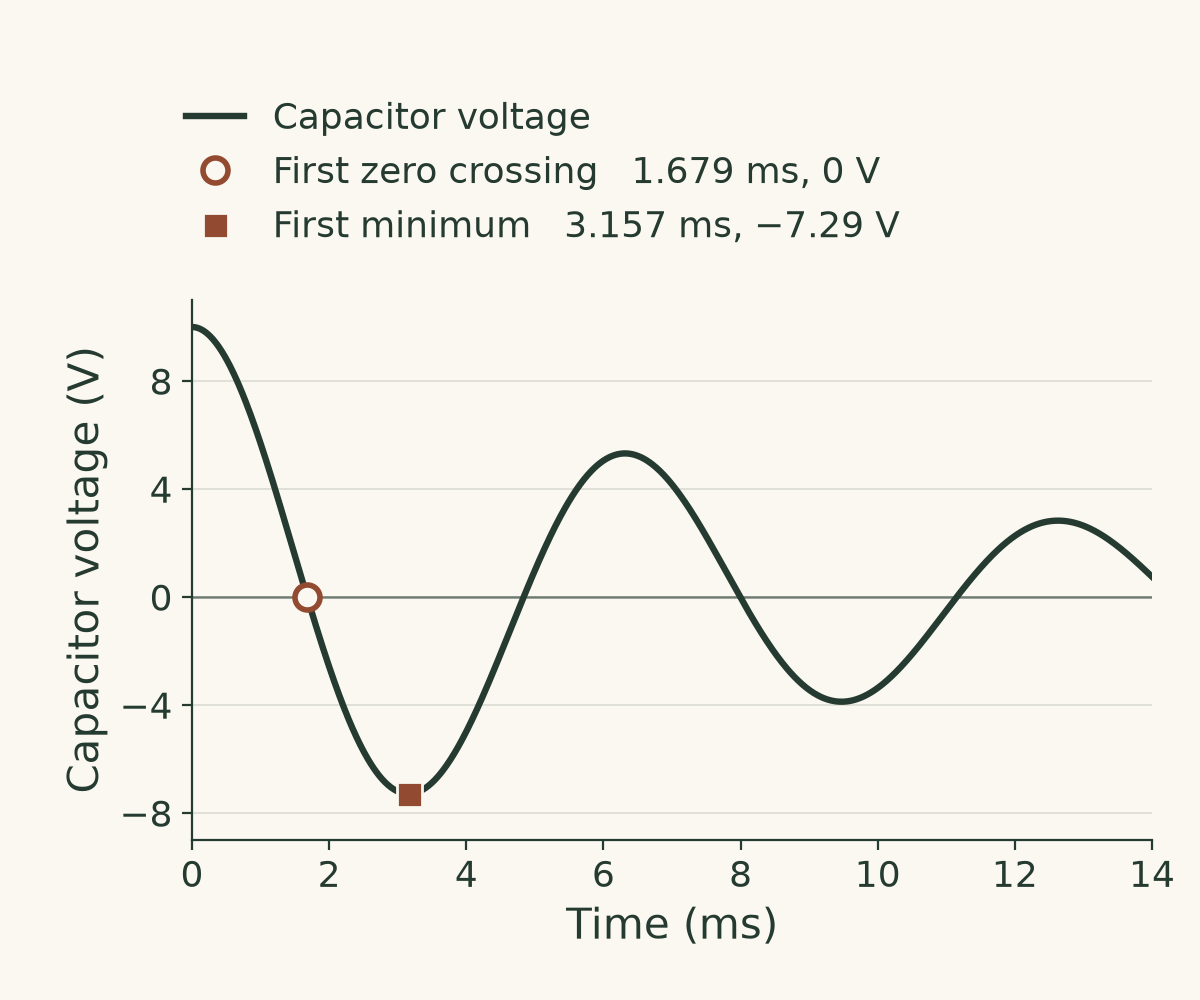
Take \(L=10\) mH, \(C=100\) µF, \(R=2.0\) Ω and \(V_0=10.0\) V. The initial charge is \(1.00\) mC. The angular frequencies are \(\omega_0=1000\) rad/s and \(\omega_d=\sqrt{1000^2-100^2}=995.0\) rad/s, since \(\alpha=100\) s⁻¹.
To locate the polarity reversal, set \(q/C=0\). The exponential factor stays positive, so the bracket in the charge solution must vanish. This gives
The first positive solution is in the second quadrant, at \(t=[\pi-\arctan(\omega_d/\alpha)]/\omega_d=1.679\) ms. The capacitor is momentarily empty and the inductor continues to drive current.
The current first returns to zero after \(\pi/995.0=3.157\) ms. Then
A full period takes 6.315 ms. At that time the voltage is positive again, at \(+5.32\) V. The successive extrema show how much oscillation survives each cycle.
Tutorial exercises
Account for the missing energy
Calculate the heat released in the resistor between connection and the first negative peak. Explain how the answer can be found without knowing the entire current history.
Show the solution
At both endpoints \(i=0\), so the inductor stores zero energy. Initially \(CV_0^2/2=5.00\) mJ. At the first negative peak the capacitor holds \(C(7.29\,\mathrm V)^2/2=2.66\) mJ. The energy balance assigns the difference, 2.34 mJ, to \(\int Ri^2\,dt\). Squaring the voltage counts the energy of either polarity.
Choose a resistance for critical damping
Keep the original \(L\), \(C\), initial voltage and initial current. Find the boundary resistance at which oscillations disappear and determine the sign of \(q\) there.
Show the solution
The characteristic roots coincide at \(\alpha=\omega_0\), so
The repeated root gives
The initial conditions fix \(A=CV_0\), \(B=\omega_0CV_0\). Hence \(q=CV_0(1+\omega_0t)e^{-\omega_0t}\) stays positive and tends to zero as energy dissipates.
Optional numerical comparison
The OneSimulation series-circuit model starts with the capacitor at 10 V and uses the component values from the worked example. First locate the voltage zero crossing and compare with 1.679 ms. Then locate the first sign change of the current after \(t=0\), interpolating between samples if needed. At that instant compare the simulated time and capacitor voltage with 3.157 ms and −7.29 V. Repeat with half the time step and check how the discrepancies change. Series RLC discharge calculation.