Differentiate an entropy measured in counts
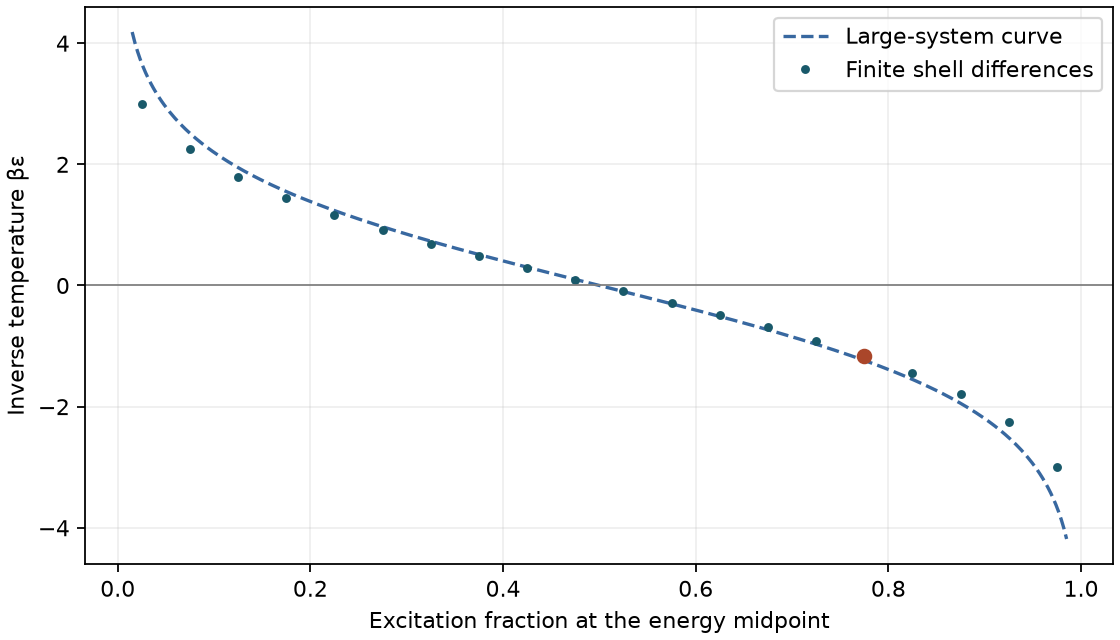
Let \(N\) distinguishable, weakly coupled sites each carry energy zero or \(\varepsilon\). A state with \(n\) excitations has \(E_n=n\varepsilon\). The multiplicity of the narrow, fixed-energy shell equals the number of ways to place the excitations, \(W_n={N\choose n}\). Use the Boltzmann shell entropy \(S_n=k_B\ln W_n\). The temperature inferred from the population of two adjacent shells samples the derivative at an energy midway between them. Dividing their multiplicities before taking a logarithm gives an exact finite-system expression,
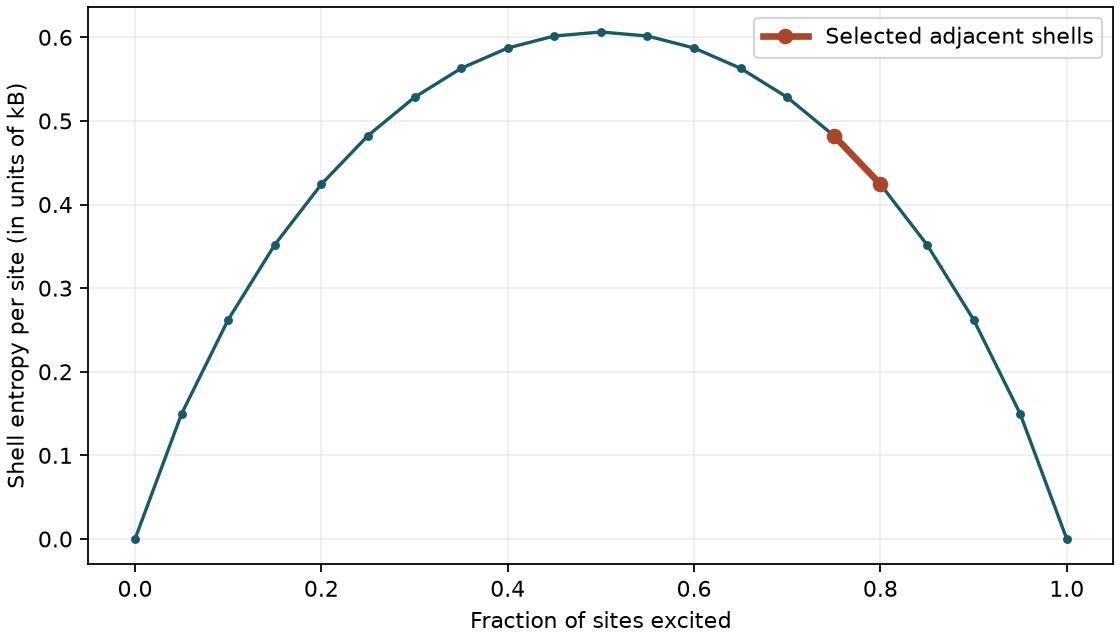
Adding an excitation near the bottom initially opens more arrangements. Beyond the middle, it closes them. The decreasing entropy on this upper branch assigns a negative inverse temperature to the population. In the limit of large \(N\) at fixed excitation fraction \(p\), the slope becomes \(\ln[(1-p)/p]\). The same relationship follows from \(p/(1-p)=\exp(-\beta\varepsilon)\) for a canonical two-level system.
The upper energy bound allows a distribution weighted towards high energy to normalise. In experiment the degrees of freedom considered must also equilibrate amongst themselves on a timescale shorter than their relaxation into ordinary, effectively unbounded environmental modes. This calculation describes the spin subsystem during that interval.
Predict the direction of an exchange
Take \(N=20\) and examine the transition from 15 to 16 excitations. The multiplicity ratio is \(5/16\), the dimensionless inverse temperature is −1.1632, and \(k_BT/\varepsilon\) is approximately −0.860. The reflected transition from 4 to 5 has ratio \(16/5\) and the opposite slope. The same number of possible arrangements at energies reflected about the midpoint gives opposite entropy gradients.
Suppose system A initially has 16 excitations and the same-sized system B has 4. Moving one quantum from A to B multiplies the product of their multiplicities by \((16/5)^2=10.24\). A weak contact that samples the available microstates favours transfer out of the inverted specimen. More generally, when A gives up a small positive energy \(q\), the entropy change is \(\Delta S/k_B\simeq(\beta_B-\beta_A)q\). An inverted subsystem therefore gives up heat to an ordinary positive-temperature subsystem when the coupling permits energy exchange.
 Open full-size diagram
 Open full-size diagram
Exercise · the temperature halfway up an odd spectrum
For eleven sites find the adjacent shells with exactly zero inverse temperature. What site occupation does this represent in the canonical description?
Work through the solution
Setting \(11-n=n+1\) gives \(n=5\). Five and six excitations have the same multiplicity, giving zero entropy slope at \(E=5.5\varepsilon\). In the canonical ensemble \(\beta=0\) gives equal probabilities for both site energies. The average excitation number is 5.5 although individual measurements return integers.
Exercise · infer a population inversion
A spin measurement yields three excited sites for every site in the lower state, in a sample large enough to neglect finite-size corrections. Calculate the inverse temperature and the mean energy of 100 equivalent sites.
Work through the solution
Here \(p=3/4\). The Boltzmann ratio gives \(\beta\varepsilon=-\ln3\simeq-1.099\), and the mean energy is
At the positive inverse temperature \(+\ln3/\varepsilon\) the mean falls to \(25\varepsilon\). The two occupations have the same binary mixing entropy and opposite response to an infinitesimal energy exchange.
Try it · Negative temperature
Change the inputs and compare the recalculated curves with the preceding derivation and baseline figure. The axes give the units; the numerical readout states the model assumptions and any limiting cases. Reset the inputs to return to the reference setting.
Download the corresponding editable notebook. The browser recalculates the reduced equations directly; the notebook exposes the full calculation and its checks.