Close a loop before assigning a phase
Choose three normalised spinors \(|A\rangle,|B\rangle,|C\rangle\). Their individual phases change under \(|j\rangle\mapsto e^{i\gamma_j}|j\rangle\). In the cyclic product \(Z=\langle A|B\rangle\langle B|C\rangle\langle C|A\rangle\) every phase occurs once with each sign. This product is a gauge-independent complex quantity although none of the three overlap phases separately is.
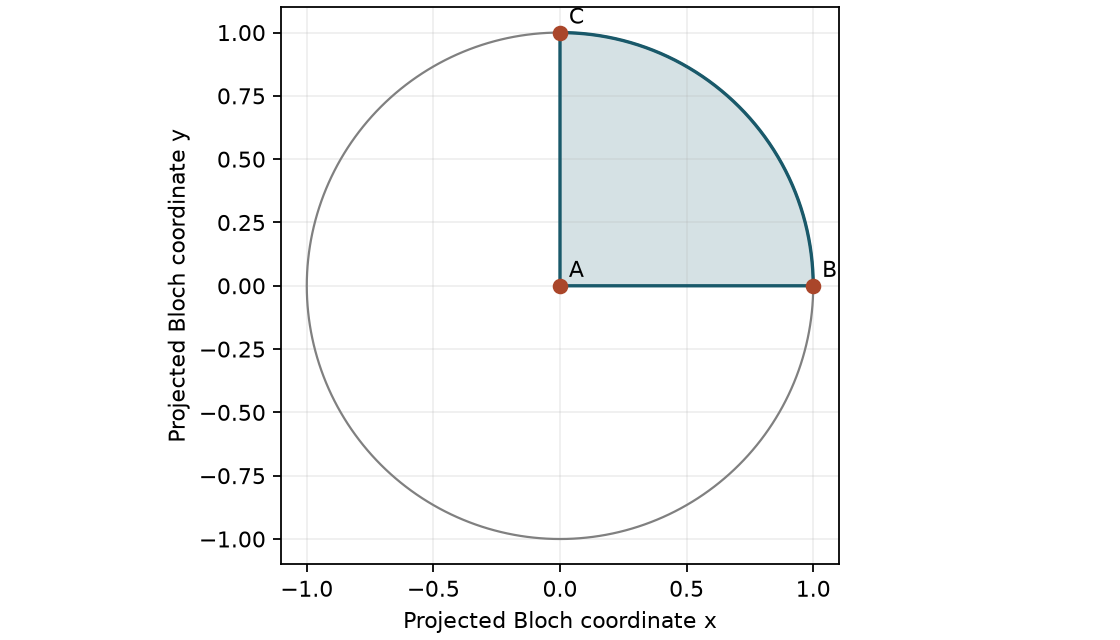
Take \(A\) at the north pole of the Bloch sphere, \(B\) on its equator at longitude zero and \(C\) on the equator at longitude \(\varphi\) with \(-\pi<\varphi<\pi\). Choose \(A=(1,0)\), \(B=(1,1)/\sqrt2\) and \(C=(1,e^{i\varphi})/\sqrt2\). Direct multiplication gives
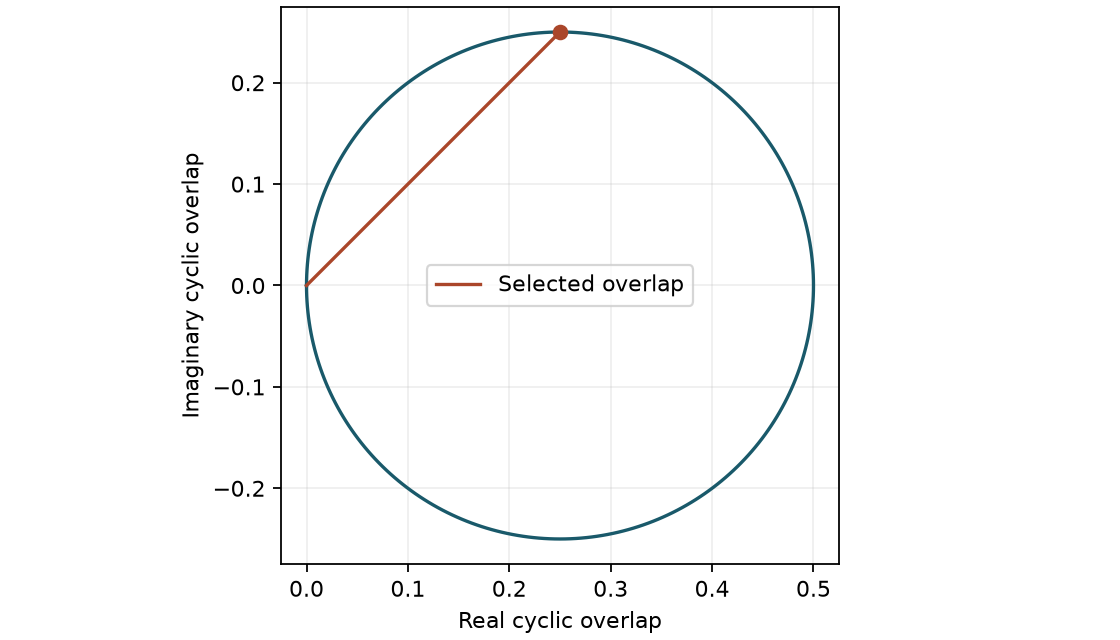
The oriented triangle bounded by the two meridians and the shortest equator arc has solid angle \(\Omega=\int_0^\varphi d\phi\int_0^{\pi/2}\sin\theta\,d\theta=\varphi\). The overlap product therefore has argument \(+\Omega/2\) for this order. The geometric phase of a ket parallel-transported along the oriented shortest geodesics is the negative of this overlap-product argument. Stating which sign is reported prevents an apparent contradiction. This construction requires no arbitrary differentiation of eigenvector phases.
Separate a well-defined angle from an observable signal
At 90 degrees longitude the triangle encloses \(\pi/2\) steradians. The complex product is \((1+i)/4\), its magnitude is about 0.354 and its argument is \(\pi/4\). As longitude approaches 180 degrees, the equatorial states approach orthogonality. The magnitude tends to zero, and even a small absolute uncertainty in the measured complex product yields a large angular uncertainty. Exactly at orthogonality there is no unique shortest equatorial arc or measurable phase of the zero complex number.
 Open full-size diagram
 Open full-size diagram
Exercise · reverse the circuit
What happens to amplitude and phase if the experiment uses \(A,C,B\) in place of \(A,B,C\)?
Work through the solution
Hermitian symmetry conjugates every overlap while the scalar factors can be reordered. The new product equals \(Z^*\). Its magnitude stays fixed and both signed phase conventions reverse.
Exercise · estimate the angular uncertainty
A measured overlap has magnitude 0.02 and a small perpendicular complex uncertainty of magnitude 0.002. What is the first-order phase uncertainty? Compare with a magnitude of 0.4.
Work through the solution
For a small transverse displacement the angular change is \(\delta\theta\simeq|\delta Z_\perp|/|Z|\). The answers are 0.10 rad and 0.005 rad. Identical absolute detector noise therefore gives very different phase precision near an orthogonal pair.
Try it · Geometric phase
Change the inputs and compare the recalculated curves with the preceding derivation and baseline figure. The axes give the units; the numerical readout states the model assumptions and any limiting cases. Reset the inputs to return to the reference setting.
Download the corresponding editable notebook. The browser recalculates the reduced equations directly; the notebook exposes the full calculation and its checks.