Count histories or evolve a population
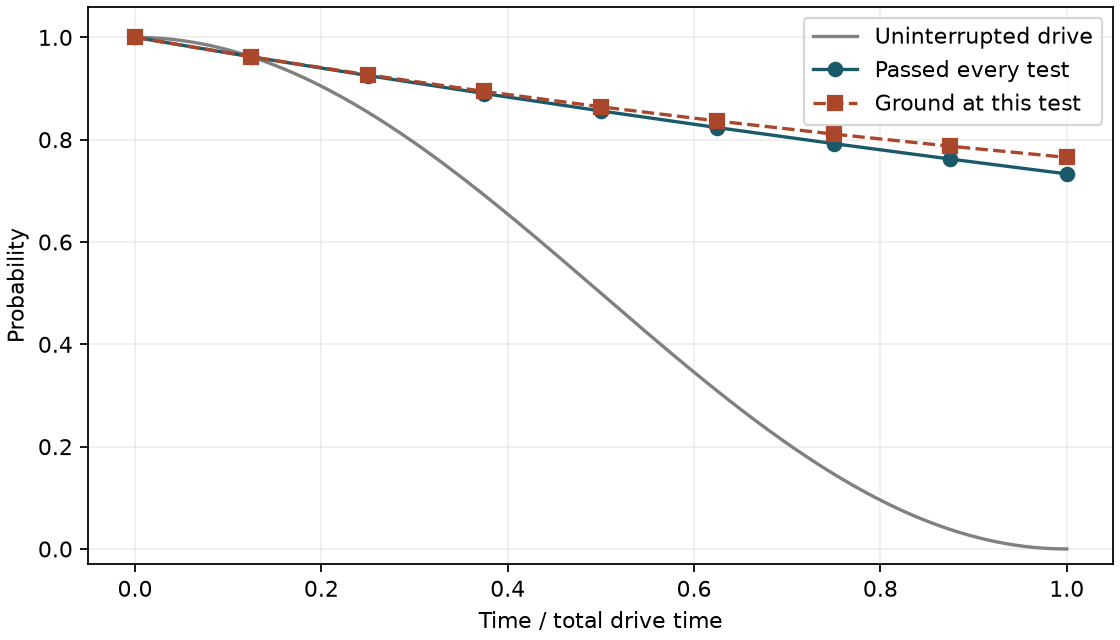
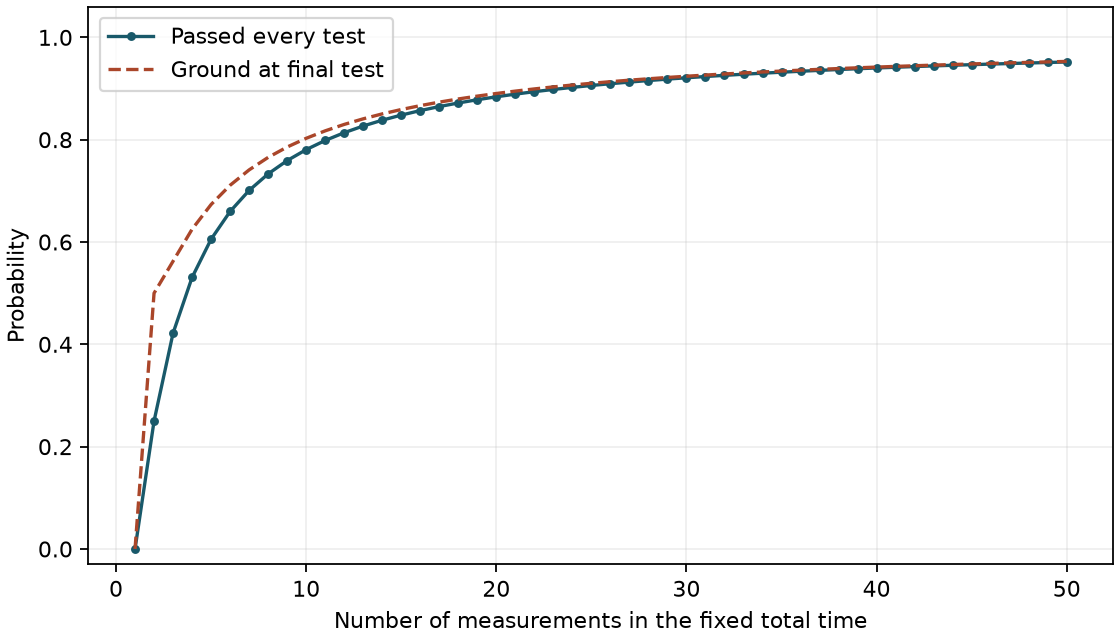
Write the resonant Hamiltonian in the rotating frame as \(H=\hbar\Omega\sigma_x/2\). A pulse of duration \(T/N\) rotates the initial ground state into \(\cos(\alpha/2)|0\rangle-i\sin(\alpha/2)|1\rangle\) with \(\alpha=\Omega T/N\). The probability of passing one ground-state test is \(c=\cos^2(\alpha/2)\). Each successful projection prepares the same ground state for the next interval. The probability that a complete record contains only successes is consequently \(P_{\rm all}=c^N\).
For an unread measurement, keep the atoms detected in either state. The projection removes the off-diagonal density-matrix elements, leaving a classical mixture just before the next pulse. If \(p_j\) denotes the ground fraction after measurement \(j\), the next pulse maps it to \(p_{j+1}=c p_j+(1-c)(1-p_j)\). The excess population \(z_j=2p_j-1\) then obeys \(z_{j+1}=(2c-1)z_j\). Starting in the ground state gives
Leaving the ground state in one interval and returning in a later one contributes to the final fraction. It removes that run from the all-success record. The two probabilities therefore refer to different experimental questions, even though they use exactly the same sequence of pulses and measurements.
Follow a half-turn in two steps
Choose \(\Omega T=\pi\) and make two evenly spaced measurements, including the one at the end. Each pulse is a quarter-turn of the Bloch vector and gives either result with equal probability following either previous outcome. The four two-result strings have probability one quarter each. Only 00 passes every test, whereas 00 and 10 both finish in the ground state. The fractions are therefore 0.25 and 0.50. With a single final measurement the undisturbed half-turn ends entirely in the excited state.
At fixed total duration and very large \(N\), Taylor expansion gives
The survival probability tends to one because the transition probability per interval is quadratic in its short duration. This prediction assumes ideal instantaneous projective measurements and coherent rotations between them. A measurement with a fixed finite duration cannot be packed arbitrarily densely into a fixed time.
 Open full-size diagram
 Open full-size diagram
Exercise · recover a mixed population
If the atom initially occupies the ground state with probability 0.7 and has no coherences, find the final ground probability for four measurements and a total pulse area of \(\pi\).
Work through the solution
The initial contrast is 0.4. Each interval multiplies it by \(\cos(\pi/4)=1/\sqrt2\). Four steps give contrast 0.1, so the final ground fraction is \((1+0.1)/2=0.55\). The all-pass probability would instead contain a first measurement conditioned on the initially mixed preparation.
Exercise · budget the number of tests
Estimate the number of ideal tests needed for 99 percent all-pass survival during a coherent half-turn. Check the estimate with the editable input.
Work through the solution
Equating the logarithm of 0.99 to \(-\pi^2/(4N)\) gives \(N\simeq245.5\). Rounding up to 246 and evaluating the exact cosine power gives about 0.99002. This estimate concerns survival over an entire record. Filtering out only the atoms ending in the excited state would estimate a different probability.
Try it · Zeno
Change the inputs and compare the recalculated curves with the preceding derivation and baseline figure. The axes give the units; the numerical readout states the model assumptions and any limiting cases. Reset the inputs to return to the reference setting.
Download the corresponding editable notebook. The browser recalculates the reduced equations directly; the notebook exposes the full calculation and its checks.