Check the constraint force after solving for speed
Use \(\theta=0\) at the bottom, increasing along the rising side. Let \(R\) be the radius of the bead centre's path, \(v_0\) its bottom speed and \(u=v_0^2/(gR)\). The smooth guide does no work. The rise in gravitational energy \(mgR(1-\cos\theta)\) therefore gives
This relation applies only while the bead follows the circle and the computed speed is real.
With inward radial direction positive, force balance is
Substitution gives
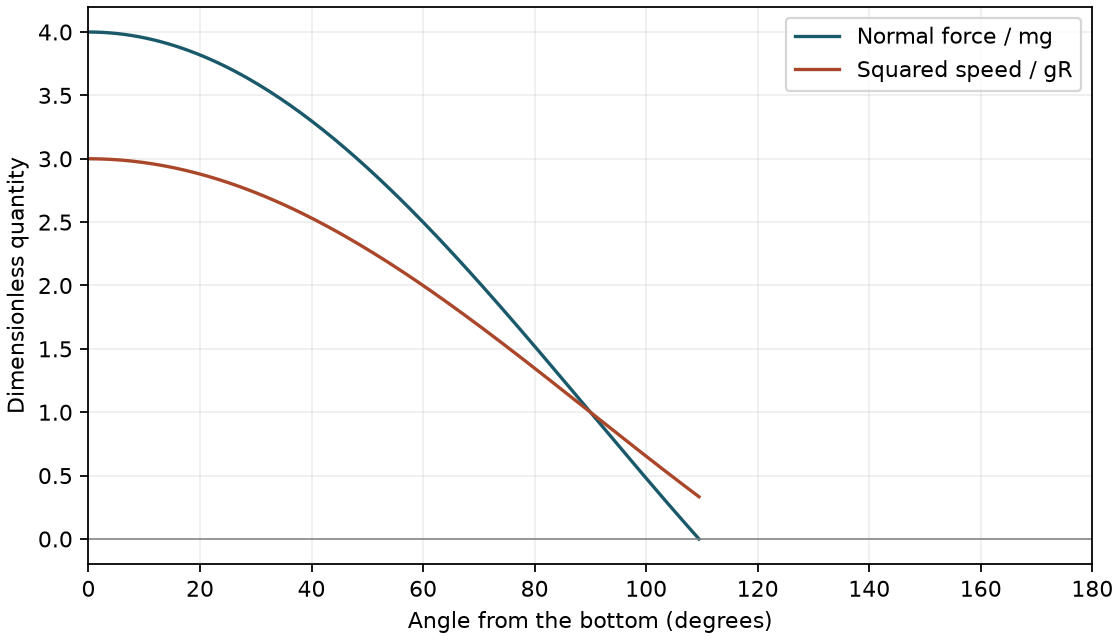
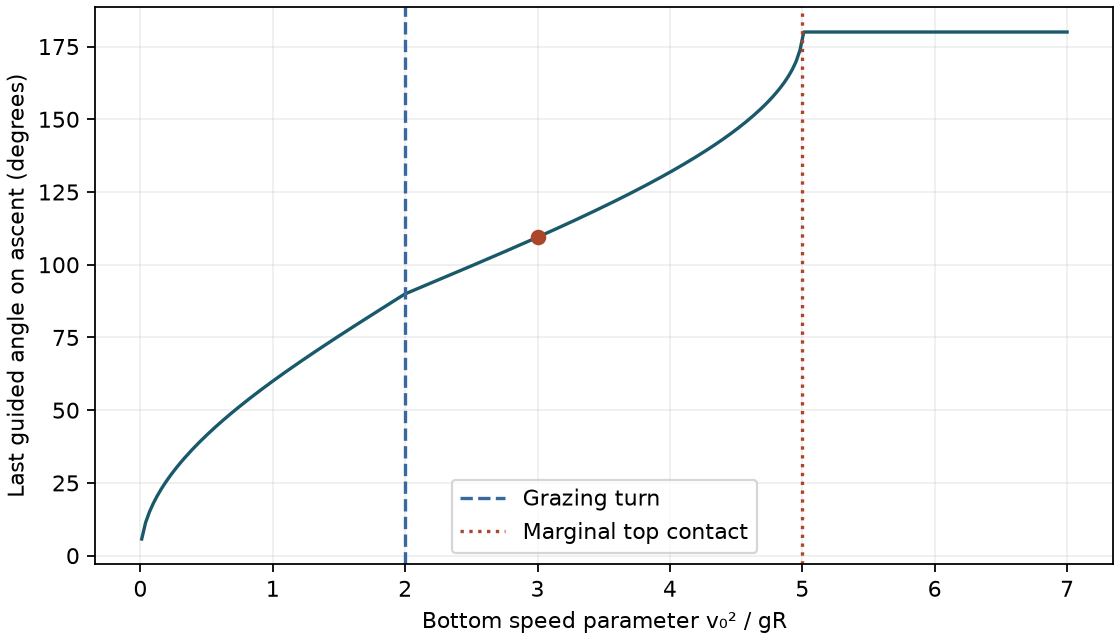
A guide underneath the bead can push but cannot pull. For \(u<2\) the speed first reaches zero while the contact force is still positive. For \(2<u<5\) the force reaches zero with positive speed at \(\cos\theta=(2-u)/3\). Above that point circular motion would require a negative normal force. For \(u>5\) the bead can remain in contact throughout the circle. At the boundaries \(u=2\) gives a zero-speed, zero-normal grazing turn at the side and \(u=5\) gives marginal contact at the top. A captive slotted carriage or a bead threaded onto a wire has a different constraint and can transmit force of either sign.
Distinguish an energetically accessible top from a feasible trajectory
Let \(R=0.25\) m and choose \(v_0=\sqrt{3gR}=2.71\) m/s. The guide loses contact when \(\cos\theta=-1/3\), or at 109.5 degrees from the bottom. The remaining speed there is \(\sqrt{gR/3}=0.904\) m/s. Raising the initial energy so that \(u=4\) pays the gravitational energy cost to reach the top, but a continuously guided motion still fails the nonnegative force condition earlier. The mechanical-energy and force-balance tests answer different questions.
 Open full-size diagram
 Open full-size diagram
Exercise · find the lower turning point
For \(u=1\), determine the turning angle and force there.
Work through the solution
Zero speed requires \(\cos\theta=1-u/2=1/2\), hence \(\theta=60^\circ\). The contact force then balances the outward radial component of gravity, \(N=mg\cos\theta=mg/2\). It remains compressive through the turn.
Exercise · size a classroom loop
A bottom speed of 2.0 m/s is available. What is the largest ideal path radius for continuous contact through the top?
Work through the solution
The limiting condition is \(v_0^2=5gR\), so \(R=4/(5\cdot9.81)=0.0815\) m. This is the radius of the bead centre. Rolling friction, rotational kinetic energy or a different channel radius would alter this calculation.
Try it · Guide contact
Change the inputs and compare the recalculated curves with the preceding derivation and baseline figure. The axes give the units; the numerical readout states the model assumptions and any limiting cases. Reset the inputs to return to the reference setting.
Download the corresponding editable notebook. The browser recalculates the reduced equations directly; the notebook exposes the full calculation and its checks.