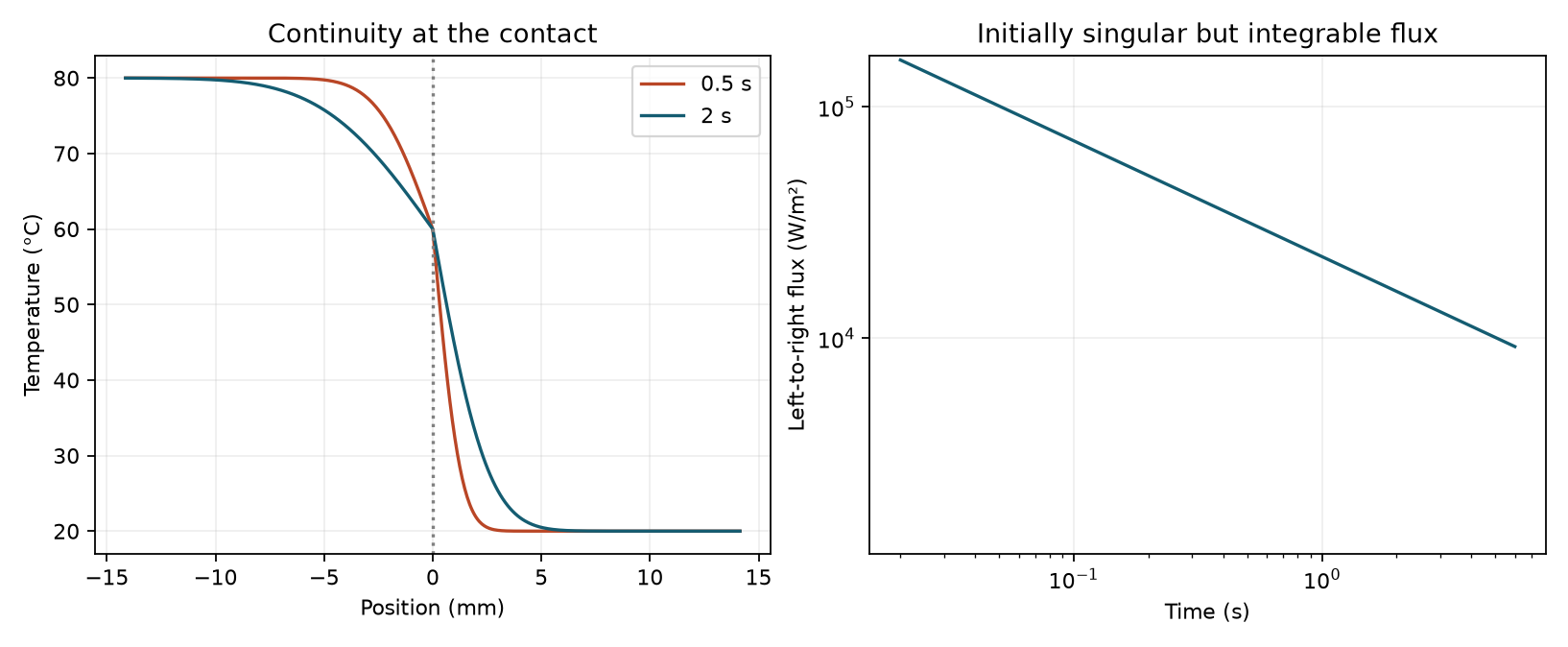
Touch two long solids: which temperature does the interface acquire?
Two long solids, initially at different uniform temperatures, touch at x = 0. Compare the interface temperature determined by thermal effusivity with whole temperature profiles, then check heat conservation. The experiment uses SI units and assumes perfect contact and short observation times.
Open editable notebook · Download .ipynb · Chapter 7 · Interfaces, contact resistance and Robin data
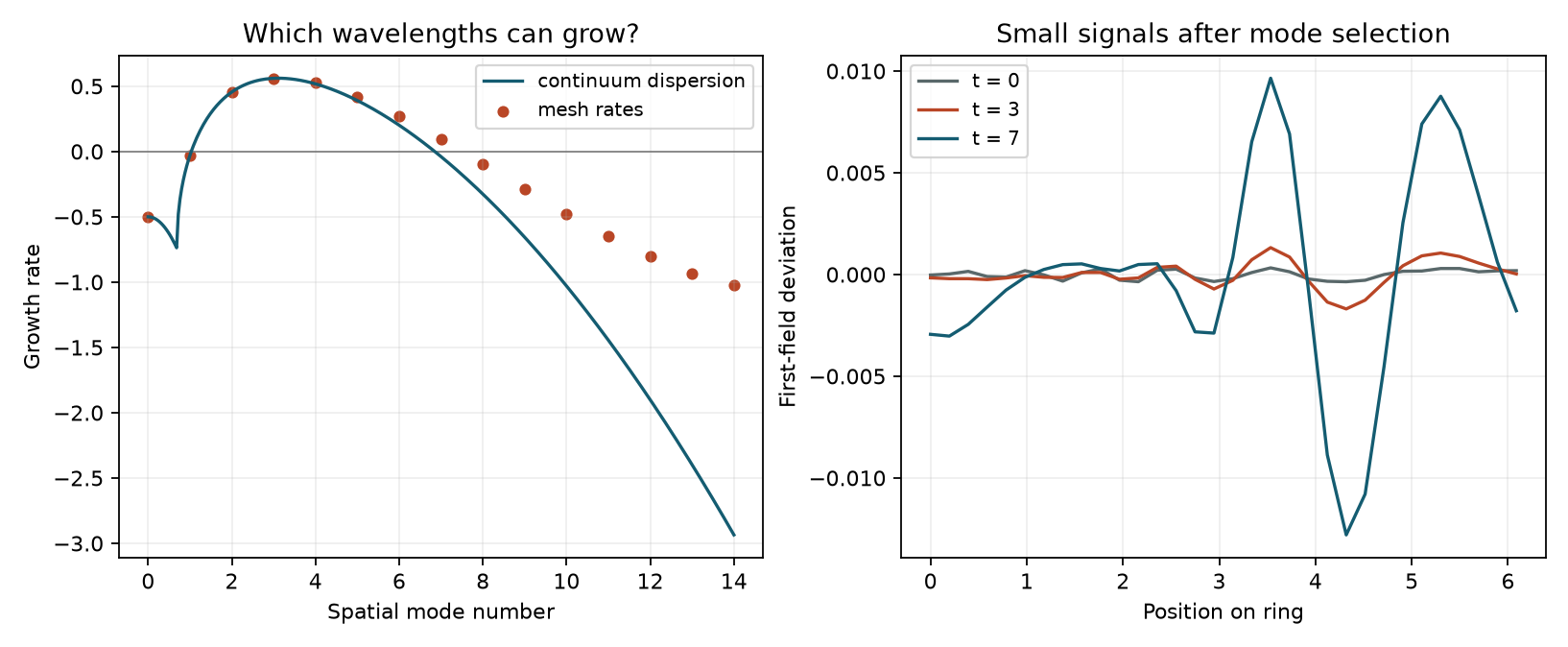
When diffusion destabilises a uniform state
Two scalar signals on a ring respond locally to each other and exchange signal with their neighbours. A single well-mixed cell returns to its reference state after a small disturbance. Can coupled cells amplify a spatial pattern? Derive a condition for this surprising outcome and test how faithfully a finite grid represents its wavelength.
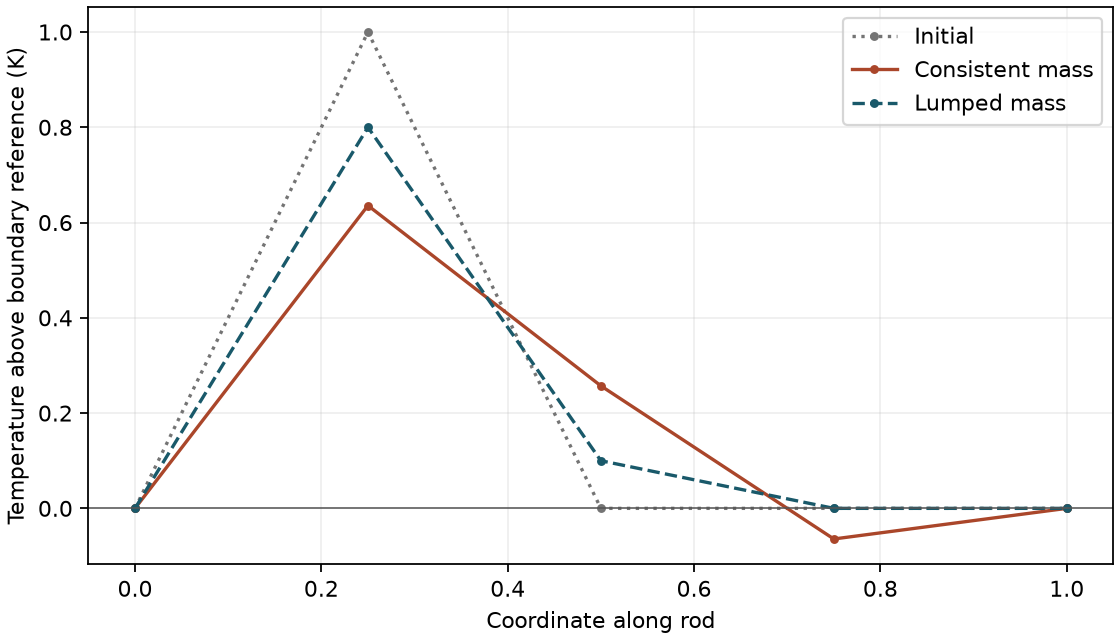
Can a stable finite-element heat step turn a cold node negative?
Start a conducting rod with one positive temperature pulse. Assemble the heat capacity from first principles and determine when an explicit step respects both decay and the sign of every temperature.
Open editable notebook · Download .ipynb · Spatial discretisation and field equations
Fundamentals / Numerical mathematics / Numerical partial differential equations
Numerical partial differential equations · Computational notebooks
Change an input, run the Python cells and compare the result with the derivation. You can also download each notebook for Jupyter.