Use the turning points to identify the energy loss mechanism
For a viscous damper the free equation is \(m\ddot x+c\dot x+kx=0\). In the underdamped regime let \(\omega_n=\sqrt{k/m}\), \(\zeta=c/(2\sqrt{km})\) and \(\omega_d=\omega_n\sqrt{1-\zeta^2}\). Released from \(x(0)=A_0\) with zero velocity, the displacement is \(A_0e^{-\zeta\omega_nt}[\cos\omega_dt+(\zeta\omega_n/\omega_d)\sin\omega_dt]\). Turning points occur every \(\pi/\omega_d\). Their absolute sizes have a constant ratio \(e^{-\pi\zeta/\sqrt{1-\zeta^2}}\).
Now let a dry guide exert a constant opposing force of magnitude \(F\). During a sliding half-cycle its sign remains fixed. Starting from a positive peak with \(kx>F\), the spring accelerates the mass to the left while friction acts to the right. Subtract the shifted equilibrium \(F/k\) from the coordinate. The remainder obeys an undamped oscillator equation, so the next turning point after \(\pi/\omega_n\) is \(2F/k-x\). For a release from the other side, replace \(F/k\) by its signed counterpart. The magnitudes of successive peaks fall by \(2F/k\) while the mass still crosses the origin. At a turning point where \(|kx|\le F\), static friction can support the spring and the body sticks there. Here the static threshold is idealised as equal to the sliding force.
Match the first peak and predict the next three
Let \(m=1\) kg, \(k=1000\) N/m, \(F=0.6\) N and \(A_0=12\) mm. Dry friction subtracts 1.2 mm of magnitude per sliding half-cycle. The first return is at −10.8 mm. A viscous model can reproduce its magnitude if its half-period peak ratio is \(0.9\). Solving \(\delta=\pi\zeta/\sqrt{1-\zeta^2}\) for \(\delta=-\ln(0.9)\) gives \(\zeta=0.0335\). Its fourth half-cycle peak is \(12(0.9)^4=7.87\) mm, whereas the dry-friction prediction is 7.20 mm. A single peak pair cannot distinguish the models. Several peaks well above the instrument resolution can.
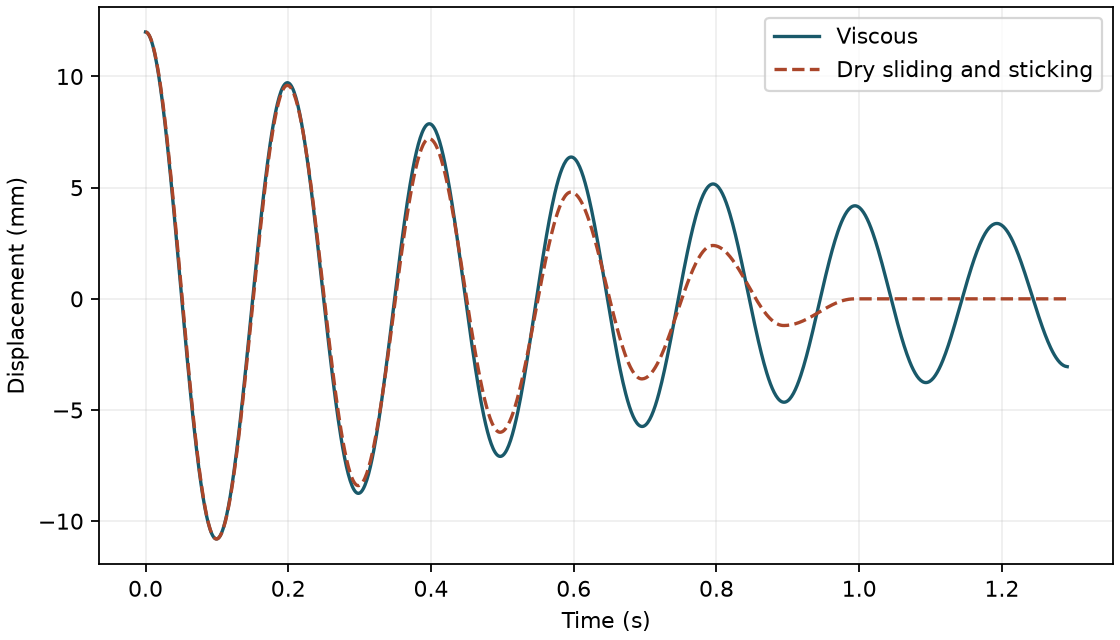 Open full-size diagram
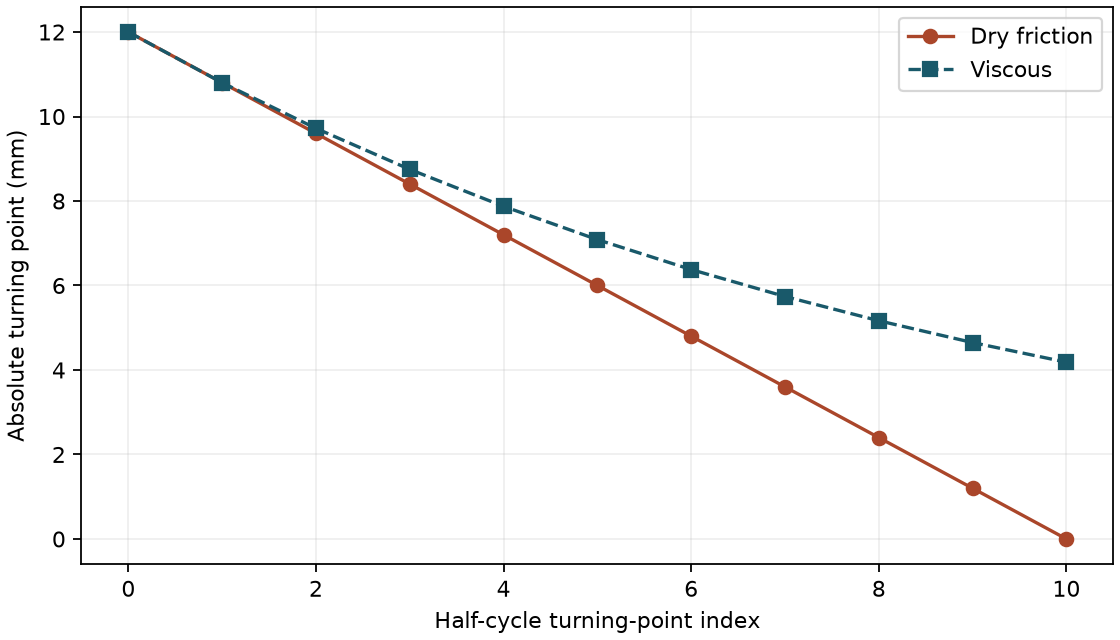 Open full-size diagram
Exercise · estimate sliding friction
A 1000 N/m guide returns through peak magnitudes 7.2, 6.0 and 4.8 mm. Estimate its friction and predict the following magnitude.
Work through the solution
The decrement per half-cycle is 1.2 mm. The corresponding force is \(k(0.0012)/2=0.60\) N. The next alternating peak magnitude is 3.6 mm, still well above the sticking threshold of 0.6 mm.
Exercise · check the last interval
A positive turning point is 0.9 mm and \(F/k=0.6\) mm. Will the mass reach a negative turning point?
Work through the solution
Sliding restarts because \(0.9>0.6\). The next position is \(2(0.6)-0.9=0.3\) mm, still positive. Since \(0.3<0.6\), static friction can hold it there. Extrapolating a positive linear amplitude envelope through zero would lose the actual final position.
Interactive calculation · Dry vs viscous
Change the physical and numerical inputs of the notebook model. Compare the updated curves and balance checks with the recorded notebook figures. Each plot uses the same equations and assumptions documented in that notebook; its readout names any analytical or reduced-model reference.
Interactive calculation · constant loss versus fractional loss
Compare turning points from the same piecewise sliding solution and matched viscous oscillator. Continue until dry friction reaches its sticking condition.