Remove the final state before separating variables
Take two large, parallel plates separated by \(H\), with \(y=0\) at the fixed plate. The liquid starts from rest. At \(t=0\) the upper plate begins to move at constant speed \(U\). For an incompressible Newtonian liquid with no imposed pressure gradient, the unidirectional velocity \(u(y,t)\) has zero convective acceleration. The streamwise momentum balance on a thin slice then reduces to
With constant viscosity, kinematic viscosity \(\nu=\mu/\rho\) is the momentum diffusivity.
Use \(\eta=y/H\) and \(F=\nu t/H^2\). The linear profile \(u/U=\eta\) solves the eventual steady equation and both wall conditions. Subtract it by setting \(w=u/U-\eta\). Both boundaries now require \(w=0\), which selects eigenfunctions \(\sin(n\pi\eta)\) for \(w_F=w_{\eta\eta}\). Each amplitude decays as \(\exp(-n^2\pi^2 F)\). The interior initially has \(w=-\eta\). Multiplying by a sine and integrating from zero to one gives
Combining the parts gives
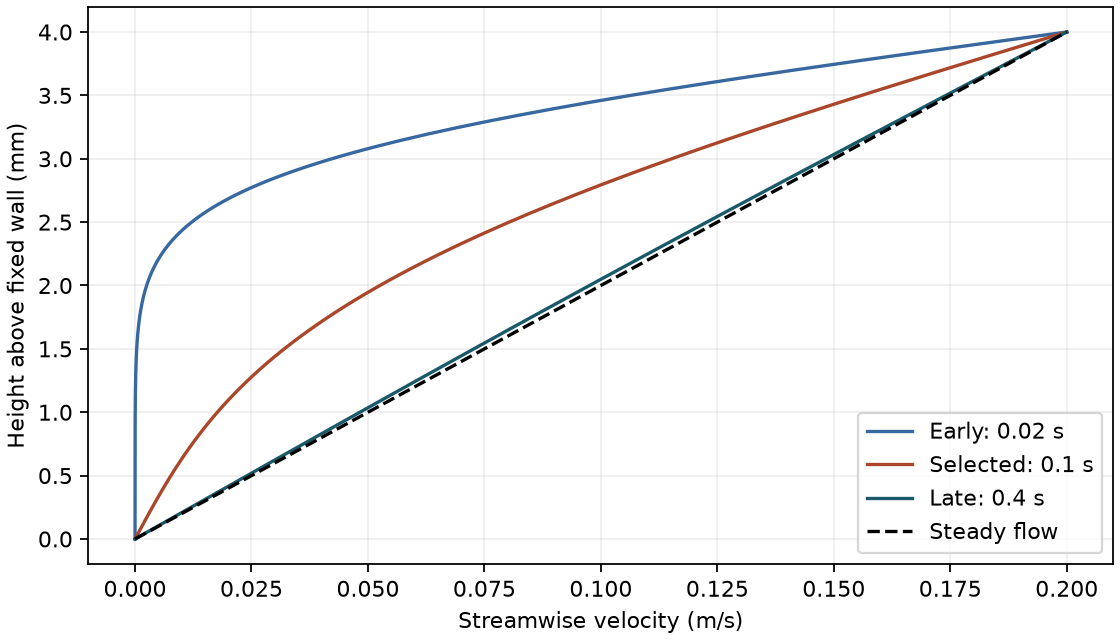
For any positive time, higher modes decay rapidly. At the initial top corner the sudden change in surface velocity conflicts with the initially resting liquid. The mathematical wall gradient there diverges as \(t\downarrow0\). A finite starting acceleration would regularize that prediction. Fluid well away from that wall sees little change until the diffusion distance, of order \(\sqrt{\nu t}\), becomes comparable with its distance to the moving surface.
Distinguish stored momentum from transmitted shear
Integrating the profile over the gap eliminates the even sine modes. The dimensionless volume flow per unit span becomes
Differentiating at the walls gives
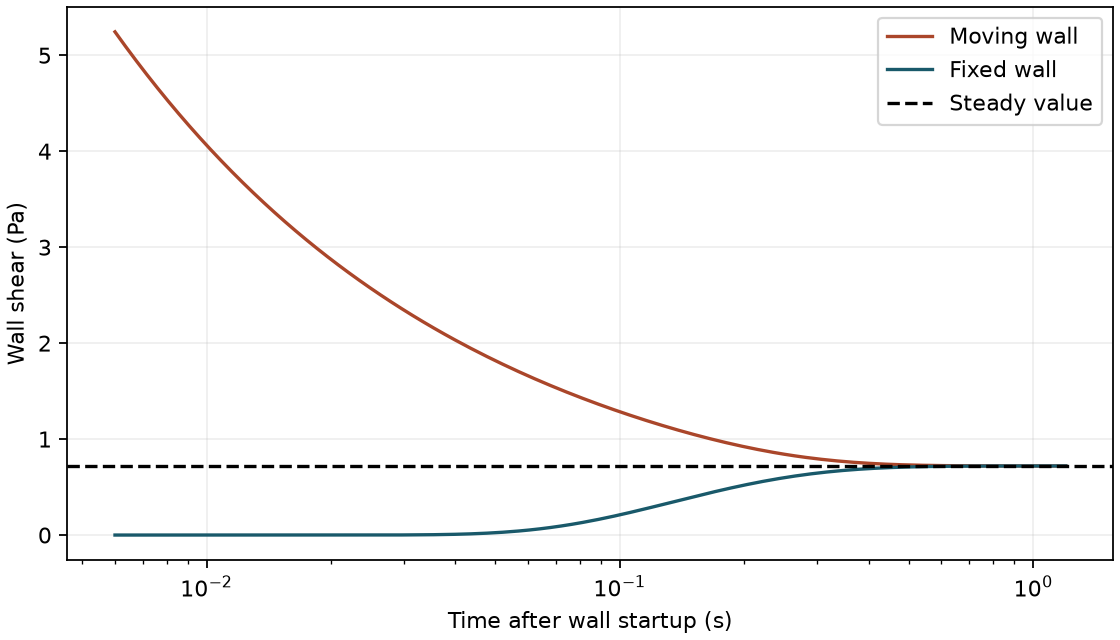
Here both symbols report \(\mu u_y\) evaluated in the positive \(y\) direction. The forces on the fluid act in opposite directions, so the net streamwise force per unit plate area is \(\tau_\mathrm{top}-\tau_\mathrm{bottom}\).
Set \(H=4\) mm, \(\nu=1.6\times10^{-5}\) m\(^2\)/s, \(\rho=900\) kg/m\(^3\) and \(U=0.20\) m/s. The gap diffusion time is 1 s. At 0.1 s the flow is \(0.34894 UH\), already 69.8% of its final value. The wall gradients still differ sharply, measuring 1.7843 and 0.2929 times the eventual shear of 0.72 Pa. Integrating the original momentum equation over the layer verifies that their difference accelerates the stored streamwise momentum, \(\rho\,dq/dt\).
 Open full-size diagram
 Open full-size diagram
Problem 1 · Predict the flow-settling time
Estimate when the flow reaches 99% of its final value. Why is one mode enough for this estimate?
Work through the solution
Divide the missing flow by its final value to obtain \((8/\pi^2)\sum_{n\ {\rm odd}}e^{-n^2\pi^2 F}/n^2\). Its leading term reaches 0.01 at \(F=\ln[8/(0.01\pi^2)]/\pi^2=0.44532\), or 0.44532 s with the given gap. At this time the next contributing mode contains \(e^{-9\pi^2F}/9\), below \(10^{-17}\). At much earlier times several modes reconstruct the thin moving layer.
Problem 2 · Double the gap
The plate speed and liquid stay fixed while \(H\) doubles. Compare the 99% settling time, steady shear, and steady flow per unit width in the two gaps.
Work through the solution
The dimensionless solution reaches the same settling criterion at the same \(F\). Since \(t=FH^2/\nu\), the wider gap takes four times as long, about 1.78 s. The steady gradient is \(U/H\), so its shear halves to 0.36 Pa. The steady flow is the area under a triangle of height \(U\) and width \(H\), namely \(UH/2\). It doubles to \(8.0\times10^{-4}\) m\(^2\)/s.
Interactive calculation · Startup couette
Change the physical and numerical inputs of the notebook model. Compare the updated curves and balance checks with the recorded notebook figures. Each plot uses the same equations and assumptions documented in that notebook; its readout names any analytical or reduced-model reference.
Interactive calculation · Startup shear
Change the physical and numerical inputs of the notebook model. Compare the updated curves and balance checks with the recorded notebook figures. Each plot uses the same equations and assumptions documented in that notebook; its readout names any analytical or reduced-model reference.