To reproduce the case, put its notebook and accompanying inputs in the same folder. Use the Python environment set up in the installation tutorial. Start with the original parameters and compare the result with the check reported below.
Run this example yourself. The OneSimulation Runtime brings the full Python library and an MCP server for Codex and Claude Code. It starts with a seven-day trial, then from €19 per month before any applicable tax.
What it computes
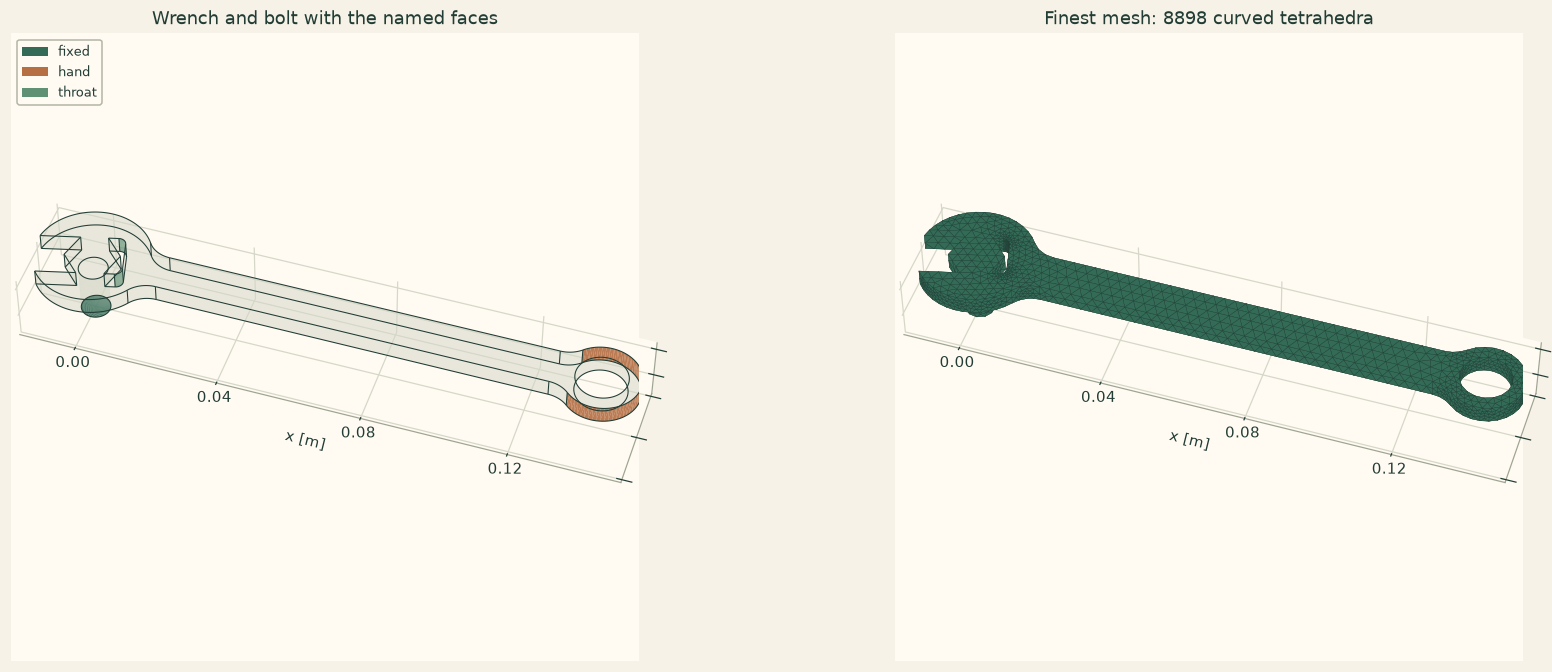
Wrench and bolt are read as one solid from a STEP file with named faces. OneSimulation meshes it with curved quadratic tetrahedra, refined in the throat fillets on three levels, and solves 3D elasticity. The script that builds the STEP file with the CAD objects of OneSimulation is part of the download.
What it checks
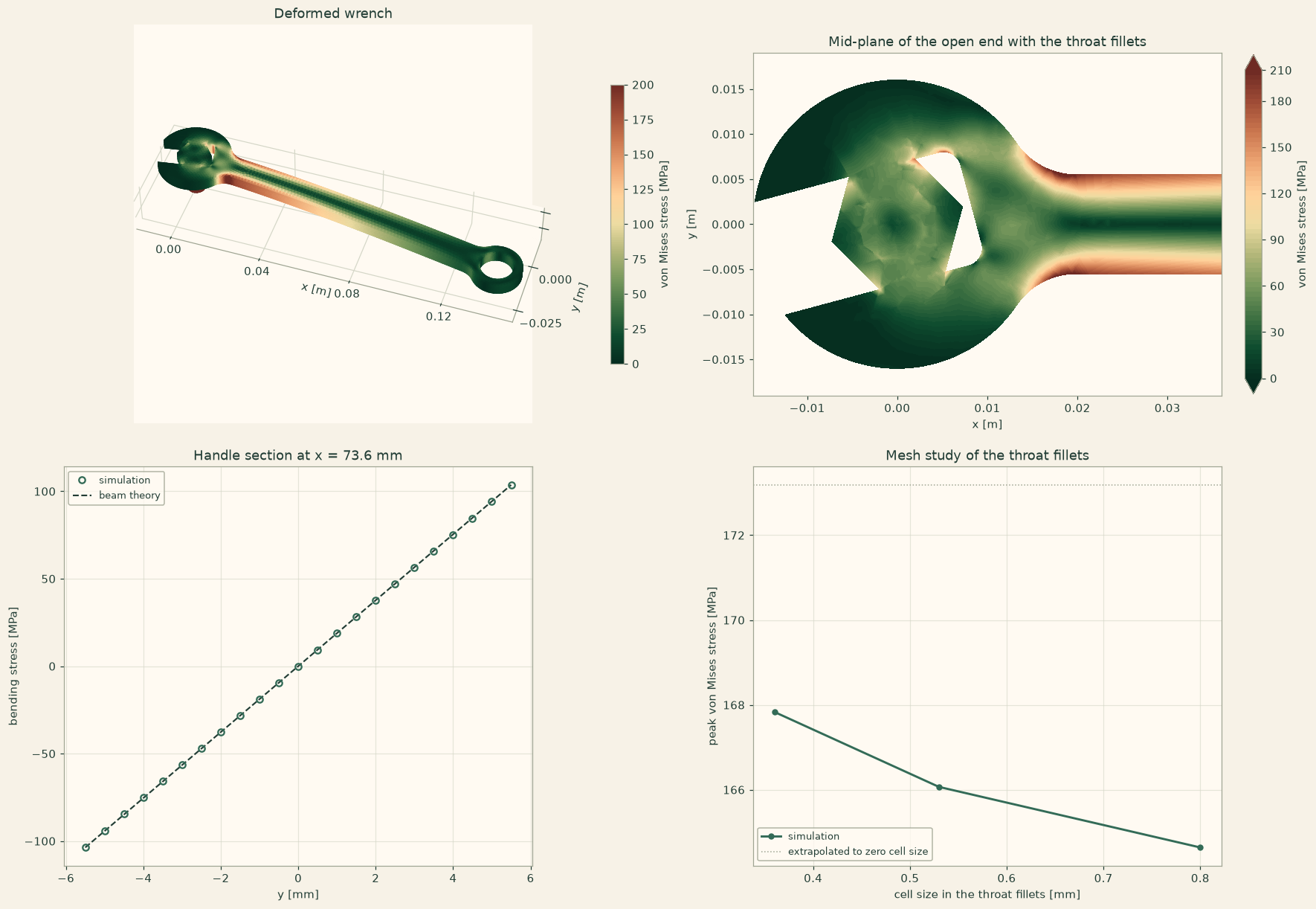
The reaction at the fixed shank balances the hand force to 0.15 %, the bending stress in the handle matches beam theory to 0.2 %, and the peak stress in the throat fillets changes by 1 % between the two finest meshes.
Geometry
The notebook starts at the import of the CAD file wrench_stress_analysis.step: STEP (AP242), readable by any CAD program, with the names of the faces that the boundary conditions use. Put it next to the notebook.
The geometry script
The script wrench_stress_analysis_geometry.py builds the geometry with the CAD objects of OneSimulation and writes the file. Change a dimension there, run it, and run the notebook again.
"""Geometry of the OneSimulation example "Stresses and strains in a wrench".

Builds a 13 mm combination wrench that grips the hexagon head of an M8 bolt with the CAD objects
of OneSimulation, names the faces the simulation refers to and writes wrench_stress_analysis.step.
"""

import numpy as np
from onesim.cad.d2 import Profile
from onesim.cad.d3 import Box, Cylinder, Prism, UnionFromObjects

mm = 1e-3
thickness, head_radius, across_flats = 5 * mm, 16 * mm, 13 * mm
throat, throat_fillet, jaw_angle = 8.5 * mm, 2 * mm, np.radians(15)
length, handle_height, ring_radius, bore_radius, neck_fillet = (
    140 * mm,
    11 * mm,
    10.5 * mm,
    7 * mm,
    8 * mm,
)
shank_radius, shank_length = 4 * mm, 15 * mm
low = -thickness / 2


def upright(edge, x=None, y=None):
    """True for an edge along z, optionally at the given x or |y|."""
    start, end = np.asarray(edge.start), np.asarray(edge.end)
    return (
        np.allclose(start[:2], end[:2], atol=1e-9)
        and (x is None or abs(start[0] - x) < 1e-9)
        and (y is None or abs(abs(start[1]) - y) < 1e-9)
    )


head = Cylinder(radius=head_radius, length=thickness, origin=(0, 0, low))
slot = Box(
    length=3 * head_radius + throat,
    width=across_flats,
    height=2 * thickness,
    origin=(-3 * head_radius, -across_flats / 2, -thickness),
)
jaws = head - slot
jaws = jaws.fillet(
    throat_fillet, edges=jaws.select(edges=lambda edge: upright(edge, x=throat))
)

corners = [
    (
        across_flats / np.sqrt(3) * np.cos(k * np.pi / 3),
        across_flats / np.sqrt(3) * np.sin(k * np.pi / 3),
    )
    for k in range(6)
]
hexagon = Prism(profile=Profile.polygon(corners), height=thickness, origin=(0, 0, low))
shank = Cylinder(
    radius=shank_radius, length=shank_length, origin=(0, 0, low - shank_length)
)
open_end = UnionFromObjects(objects=[jaws, hexagon, shank]).rotated(
    (0, 0, 1), jaw_angle
)

handle = Box(
    length=length - 8 * mm - (head_radius - 3 * mm),
    width=handle_height,
    height=thickness,
    origin=(head_radius - 3 * mm, -handle_height / 2, low),
)
ring = Cylinder(
    radius=ring_radius, length=thickness, origin=(length, 0, low)
) - Cylinder(radius=bore_radius, length=2 * thickness, origin=(length, 0, -thickness))
wrench = UnionFromObjects(objects=[open_end, handle, ring])
wrench = wrench.fillet(
    neck_fillet,
    edges=wrench.select(edges=lambda edge: upright(edge, y=handle_height / 2)),
)

wrench = wrench.grouped(
    fixed=wrench.select(
        faces=lambda face: abs(face.center[2] - (low - shank_length)) < 1e-9
    ),
    hand=wrench.select(
        faces=lambda face: face.kind == "cylinder"
        and abs(face.radius - ring_radius) < 1e-9
        and face.center[0] > length
    ),
    throat=wrench.select(
        faces=lambda face: face.kind == "cylinder"
        and abs(face.radius - throat_fillet) < 1e-9
    ),
)
wrench.save("wrench_stress_analysis.step")
The notebook
The complete notebook, cell by cell. Run it to produce the figures and the comparison printout.
A combination wrench has an open end and a box end. The open end grips the hexagon head of an M8 bolt whose shank is held fixed at its far end, and the hand pushes on the box end with \(F=150\) N perpendicular to the handle, in the plane of the wrench. The torque on the bolt is carried through the jaws, the rounded throat of the open end and the neck between head and handle.
Wrench and bolt come as one solid from the CAD file wrench_stress_analysis.step (bonded jaws, as in the original problem statement). The file names three face groups: fixed, hand and throat. The script wrench_stress_analysis_geometry.py builds the part with the CAD objects of OneSimulation and writes the file.
| face | condition |
|---|---|
fixed: end face of the bolt shank | \(\mathbf u=0\) |
hand: outer rim of the box end | traction \(-p\,\mathbf e_y\) on the upper half, total force \(F\) |
| every other face | traction free |
Reference. Global equilibrium (reaction at the fixed face against the applied load), Euler-Bernoulli beam theory in the prismatic handle, \(\sigma_{xx}=M\,y/I\) with \(M=F\,(x_F-x)\), and a mesh study of the peak von Mises stress in the two throat fillets.
import numpy as np
from onesim.cad.d2 import Plane
from onesim.cad.exchange import load
from onesim.materials import IsotropicSolid
from onesim.meshing import LocalRefinement, TetrahedralMesher
from onesim.numerics import Numerics
from onesim.numerics.fem import FiniteElement, Lagrange
from onesim.numerics.linear import SparseDirect
from onesim.physics.solid_mechanics import (
    FixedDisplacement,
    LinearElasticity,
    Traction,
    TractionFree,
)
from onesim.results.comparisons import convergence
from onesim.simulation import Problem, Simulation
from onesim.visualization import plots, theme

theme.set()
Geometry and mesh
load returns the solid with its faces; the named groups of the file are available as wrench.boundaries. Three meshes of curved quadratic tetrahedra differ in the cell size on the two throat fillets; the other round faces get 1.2 mm cells, the rest 3 mm.
wrench = load("wrench_stress_analysis.step")
faces = wrench.boundaries
other_round_faces = (
    wrench.select(faces=lambda face: face.kind == "cylinder") - faces.throat
)
sizes = [0.0008, 0.00053, 0.00036]
meshes = [
    TetrahedralMesher(
        target_size=0.003,
        geometry_order=2,
        refinements=(
            LocalRefinement(region=other_round_faces, target_size=0.0012),
            LocalRefinement(region=faces.throat, target_size=size),
        ),
    ).generate(wrench)
    for size in sizes
]

view = plots.Camera(elevation=48, azimuth=-72)
fig = plots.figure(1, 2, size=(16, 6))
plots.geometry(
    wrench,
    selection={"fixed": faces.fixed, "hand": faces.hand, "throat": faces.throat},
    labels=False,
    camera=view,
    title="Wrench and bolt with the named faces",
    ax=fig[0],
)
plots.mesh(
    meshes[-1],
    groups=("all",),
    legend=False,
    camera=view,
    title=f"Finest mesh: {meshes[-1].cell_count} curved tetrahedra",
    ax=fig[1],
)
plots.show()
Model
Structural steel. The hand force is spread evenly over the upper half of the box-end rim, so the traction is the force divided by half the area of that face. The same problem is solved on the three meshes.
force, thickness, handle_height, ring_centre, ring_radius = (
    150.0,
    0.005,
    0.011,
    0.140,
    0.0105,
)
steel = IsotropicSolid(
    density=7850.0,
    specific_heat_capacity=475.0,
    thermal_conductivity=44.5,
    youngs_modulus=200e9,
    poisson_ratio=0.30,
    thermal_expansion_coefficient=12.3e-6,
)
model = LinearElasticity(domain=wrench.volume, material=steel)
hand_area = sum(face.area for face in wrench.faces if face.id in faces.hand.members)
pressure = force / (hand_area / 2)
problem = Problem(
    name="Wrench",
    geometry=wrench,
    physics=(model,),
    boundary_conditions=(
        FixedDisplacement(boundary=faces.fixed, physics=model, value=(0.0, 0.0, 0.0)),
        Traction(
            boundary=faces.hand,
            physics=model,
            value=lambda x, y, z: np.stack(
                (0 * y, np.where(y > 0, -pressure, 0.0), 0 * y), axis=-1
            ),
        ),
        TractionFree(boundary=faces.all - faces.fixed - faces.hand, physics=model),
    ),
)
numerics = Numerics(
    spatial=FiniteElement(element=Lagrange(order=2)), linear_solver=SparseDirect()
)
results = [
    Simulation(problem=problem, mesh=mesh, numerics=numerics).solve_stationary()
    for mesh in meshes
]
displacement, stress, mises = (
    results[-1].field(f)
    for f in (model.displacement, model.stress, model.von_mises_stress)
)
Results
The reaction at the fixed shank end must balance the hand force. In the handle the bending stress follows beam theory; the line of action of the hand force is the centroid of the loaded arc.
half_angle = hand_area / 2 / (ring_radius * thickness)
line_of_action = ring_centre + ring_radius * np.sin(half_angle) / half_angle
y = np.linspace(-handle_height / 2 + 1e-6, handle_height / 2 - 1e-6, 23)
bending = stress.evaluate(
    np.column_stack((np.full_like(y, 0.0736), y, np.zeros_like(y)))
)[:, 0]
beam = force * (line_of_action - 0.0736) * y / (thickness * handle_height**3 / 12)
peaks = [
    result.field(model.von_mises_stress)
    .sample(along=faces.throat, subdivisions=4)
    .values.max()
    for result in results
]
study = convergence(peaks, sizes)

reaction = displacement.reaction(faces.fixed)
print(
    f"reaction at the fixed face: ({reaction[0]:.2f}, {reaction[1]:.2f}, {reaction[2]:.2f}) N against the hand force of {force:.0f} N"
)
print(
    f"largest displacement: {1e3 * np.abs(displacement.sample(along=faces.hand).values).max():.3f} mm"
)
print(
    f"bending stress at the handle surface: simulation {np.polyfit(y, bending, 1)[0] * handle_height / 2 / 1e6:.2f} MPa, "
    f"beam theory {beam[-1] / 1e6:.2f} MPa"
)
print("fillet cell size [mm]   tetrahedra   peak von Mises stress in the throat [MPa]")
for size, mesh, peak in zip(sizes, meshes, peaks):
    print(f"{1e3 * size:20.2f} {mesh.cell_count:12d} {peak / 1e6:28.2f}")
print(
    f"change between the two finest meshes {100 * study.change:.1f} %, observed order {study.order:.1f}, "
    f"extrapolated peak {study.extrapolated / 1e6:.0f} MPa"
)
Figure
The von Mises stress on the deformed wrench (displacement magnified 8 times) and in the mid-plane of the open end, where the two throat fillets carry the peak; the bending stress across the handle and the mesh study of the fillet peak.
megapascal = lambda s, position: s / 1e6
fig = plots.figure(2, 2, size=(16, 11))
plots.surface(
    mises,
    component=megapascal,
    deformation=displacement,
    deformation_scale=8.0,
    limits=(0, 200),
    camera=view,
    label="von Mises stress [MPa]",
    title="Deformed wrench",
    ax=fig[0],
)
plots.section(
    mises,
    plane=Plane(origin=(0, 0, 0), normal=(0, 0, 1)),
    component=megapascal,
    limits=(0, 200),
    subdivisions=3,
    label="von Mises stress [MPa]",
    title="Mid-plane of the open end with the throat fillets",
    xlimits=(-0.016, 0.036),
    ylimits=(-0.019, 0.019),
    ax=fig[1],
)
plots.line(
    points={"simulation": (1e3 * y, bending / 1e6)},
    reference={"beam theory": (1e3 * y, beam / 1e6)},
    xlabel="y [mm]",
    ylabel="bending stress [MPa]",
    title="Handle section at x = 73.6 mm",
    ax=fig[2],
)
plots.line(
    1e3 * np.array(sizes),
    {"simulation": np.array(peaks) / 1e6},
    markers=True,
    hlines={"extrapolated to zero cell size": study.extrapolated / 1e6},
    xlabel="cell size in the throat fillets [mm]",
    ylabel="peak von Mises stress [MPa]",
    title="Mesh study of the throat fillets",
    ax=fig[3],
)
plots.show()
Going further
Reduce the throat fillet radius in wrench_stress_analysis_geometry.py, write the STEP file again and follow the peak stress; shorten the shank to see the support act on the torsion field; or replace the bonded jaws by frictional contact (onesim.physics.solid_mechanics).