To reproduce the case, put its notebook and accompanying inputs in the same folder. Use the Python environment set up in the installation tutorial. Start with the original parameters and compare the result with the check reported below.
Run this example yourself. The OneSimulation Runtime brings the full Python library and an MCP server for Codex and Claude Code. It starts with a seven-day trial, then from €19 per month before any applicable tax.
What it computes
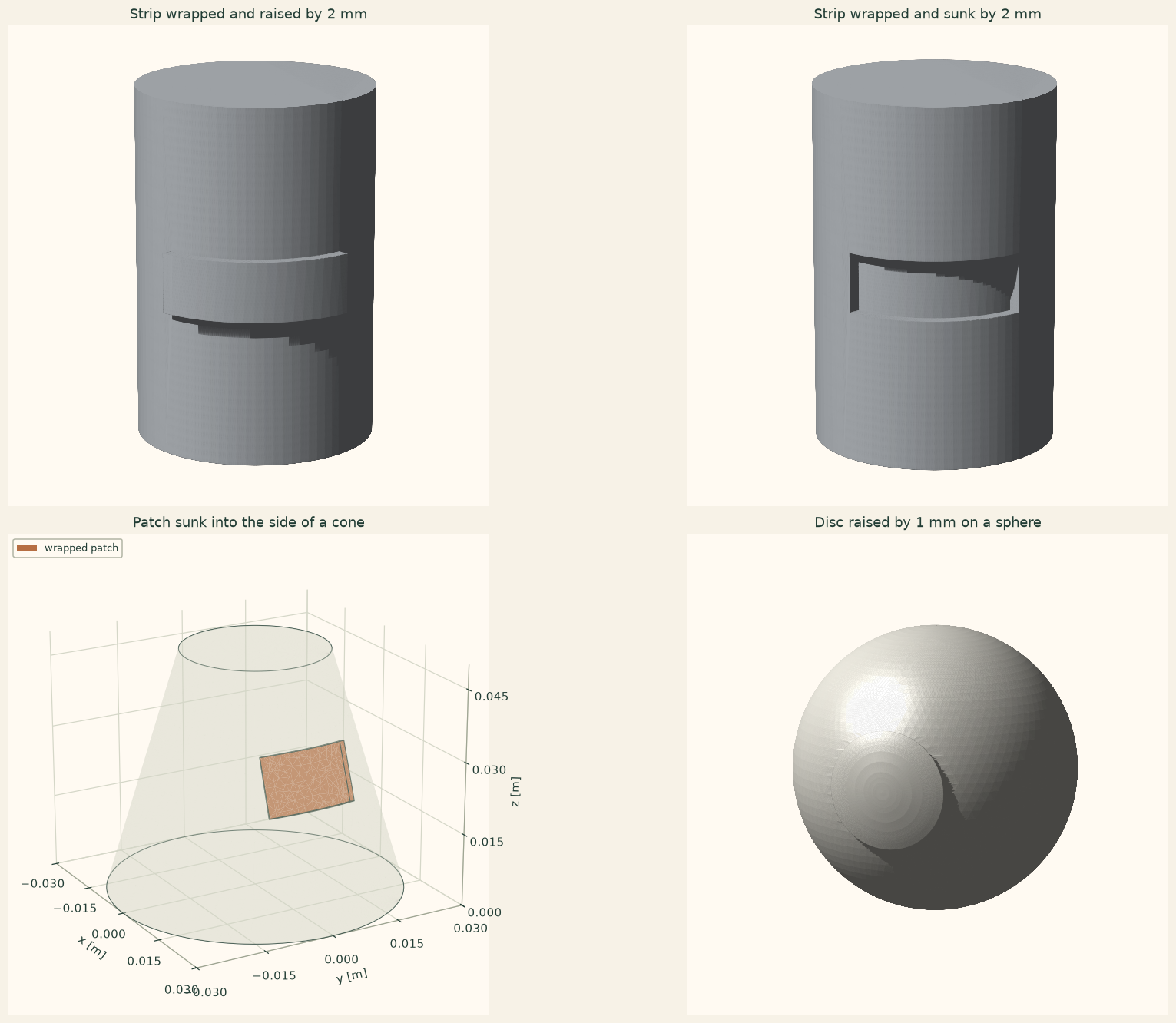
OneSimulation unrolls cylinders and cones into the plane, lays the profile there and rolls it up with the face; on the sphere distances are measured along the surface. The wrapped outlines are raised or sunk into the body, compared with a plain projection and meshed with tetrahedra.
What it checks
The raised and sunk strips add 630.000 and remove 570.000 mm3 exactly as the unrolled-sector formulas say, the lettering adds 81.771 against 81.772 mm3, the patch covers exactly its 240 mm2 on the cone and the disc covers 446.389 mm2 on the sphere against 446.390 mm2 for the geodesic circle (the flat circle would be 452.389 mm2); a plain projection adds 6.2 % too much.
The notebook
The complete notebook, cell by cell. Run it to produce the figures and the comparison printout.
Lettering on a bottle, a grip pattern on a handle, a heating track on a pipe, a label strip on a shaft: a flat outline is laid onto a curved face so that its lengths are kept. On a cylinder or a cone the face can be unrolled into the plane; the outline is drawn there and rolled up with the face. On a sphere, which cannot be unrolled, distances from the anchor point are measured along the surface (geodesic polar coordinates).
part.wrap(profile, face, height, at=point) wraps the profile onto one face around the point at and raises it by height (sinks it for a negative height). The faces of the wrapped feature form the group wrap. For comparison, part.emboss(...) projects the profile straight onto the face, which stretches it where the face turns away.
Reference. A strip of width \(w\) (around) and height \(h\) (along) on a cylinder of radius \(R\) covers the angle \(w/R\). Raised by \(t\) it adds \(V=\tfrac12\,\tfrac{w}{R}\,\big((R+t)^2-R^2\big)\,h\), sunk by \(t\) it removes \(\tfrac12\,\tfrac{w}{R}\,\big(R^2-(R-t)^2\big)\,h\). A cone unrolls without stretching, so a patch covers exactly its own area on the side face. A circle of radius \(\rho\) on a sphere of radius \(R_s\) covers the cap \(2\pi R_s^2\,(1-\cos(\rho/R_s))\), not the projected \(\pi\rho^2\).
import numpy as np
from onesim.cad.d2 import Profile
from onesim.cad.d3 import Cone, Cylinder, Sphere
from onesim.meshing import TetrahedralMesher
from onesim.meshing.quality import quality
from onesim.visualization import plots, theme

theme.set()
A label strip and lettering on a shaft
A shaft of 20 mm radius and 60 mm length. A strip of 30 x 10 mm is wrapped around it across the seam of the wall and raised by 2 mm; the same strip sunk by 2 mm; and the letters "ONE", 12 mm high, raised by 1 mm on the other side.
radius, length, width, height, rise = 0.02, 0.06, 0.03, 0.01, 0.002
shaft = Cylinder(radius=radius, length=length)
strip = Profile.rectangle(width, height, origin=(-width / 2, -height / 2))
raised = shaft.wrap(
    strip, shaft.boundaries.outer_wall, rise, at=(radius, 0.0, length / 2)
)
sunk = shaft.wrap(
    strip, shaft.boundaries.outer_wall, -rise, at=(radius, 0.0, length / 2)
)
projected = shaft.emboss(
    strip, shaft.boundaries.outer_wall, rise, at=(radius, 0.0, length / 2)
)
letters = Profile.text("ONE", 0.012)
lettered = raised.wrap(
    letters, raised.boundaries.outer_wall, 0.001, at=(-radius, 0.0, length / 2)
)

added = 0.5 * (width / radius) * ((radius + rise) ** 2 - radius**2) * height
removed = 0.5 * (width / radius) * (radius**2 - (radius - rise) ** 2) * height
lettering = (
    sum(item.area for item in letters)
    * ((radius + 0.001) ** 2 - radius**2)
    / (2 * radius)
)
print(
    f"raised strip:  {(raised.measure - shaft.measure) * 1e9:9.3f} mm3 added,   closed form {added * 1e9:9.3f} mm3"
)
print(
    f"sunk strip:    {(shaft.measure - sunk.measure) * 1e9:9.3f} mm3 removed, closed form {removed * 1e9:9.3f} mm3"
)
print(
    f"projected:     {(projected.measure - shaft.measure) * 1e9:9.3f} mm3 added ({(projected.measure - shaft.measure) / added - 1:+.1%}: "
    f"the projection stretches the strip)"
)
print(
    f"lettering:     {(lettered.measure - raised.measure) * 1e9:9.3f} mm3 added,   closed form {lettering * 1e9:9.3f} mm3"
)
print(
    f"faces of the wrapped strip: {len(raised.boundaries.wrap.members)}; lettered shaft: {len(lettered.faces)} faces"
)

mesh = TetrahedralMesher(target_size=0.004).generate(lettered)
view = plots.Camera(elevation=15, azimuth=150)
fig = plots.figure(1, 2, size=(16, 7))
plots.geometry(
    lettered,
    selection={"wrapped strip and letters": lettered.boundaries.wrap},
    labels=False,
    camera=view,
    title="Shaft with a wrapped strip and lettering",
    ax=fig[0],
)
plots.mesh(
    mesh,
    groups=("all",),
    legend=False,
    camera=view,
    title=f"Mesh: {mesh.cell_count} tetrahedra",
    ax=fig[1],
)
plots.show()
On a cone and on a sphere
A patch of 20 x 12 mm is sunk 1 mm into the side of a cone (30 mm to 15 mm radius, 50 mm high); a disc of 12 mm radius is raised 1 mm on a ball of 30 mm radius.
cone = Cone(bottom_radius=0.03, top_radius=0.015, height=0.05)
grooved = cone.wrap(
    Profile.rectangle(0.02, 0.012, origin=(-0.01, -0.006)), cone.boundaries.side, -0.001
)
ball = Sphere(radius=0.03)
skin = ball.faces[0].id
reach = 0.012
capped = ball.wrap(
    Profile.circle(reach), ball.boundaries[skin], 0.001, at=(0.03, 0.0, 0.0)
)
covered = ball.topology.face(skin).area - capped.topology.face(skin).area
print(
    f"cone: side face area covered {(cone.topology.face('side').area - grooved.topology.face('side').area) * 1e6:.4f} mm2, "
    f"patch area {0.02 * 0.012 * 1e6:.4f} mm2"
)
print(
    f"sphere: cap covered {covered * 1e6:.4f} mm2, geodesic circle {2 * np.pi * 0.03**2 * (1 - np.cos(reach / 0.03)) * 1e6:.4f} mm2, "
    f"flat circle {np.pi * reach**2 * 1e6:.4f} mm2"
)

cone_mesh = TetrahedralMesher(target_size=0.004).generate(grooved)
ball_mesh = TetrahedralMesher(target_size=0.004).generate(capped)
for name, body, mesh in (("cone", grooved, cone_mesh), ("sphere", capped, ball_mesh)):
    print(
        f"{name}: {mesh.cell_count} cells, mesh volume {quality(mesh)['size'].sum() * 1e6:.4f} cm3, CAD {body.measure * 1e6:.4f} cm3"
    )
Figure
The raised and the sunk strip against the projected one, and the wrapped cone and sphere.
fig = plots.figure(2, 2, size=(16, 12))
plots.render(
    raised,
    camera=plots.Camera(elevation=15, azimuth=0),
    material="aluminium",
    title="Strip wrapped and raised by 2 mm",
    ax=fig[0],
)
plots.render(
    sunk,
    camera=plots.Camera(elevation=15, azimuth=0),
    material="aluminium",
    title="Strip wrapped and sunk by 2 mm",
    ax=fig[1],
)
plots.geometry(
    grooved,
    selection={"wrapped patch": grooved.boundaries.wrap},
    labels=False,
    camera=plots.Camera(elevation=20, azimuth=-30),
    title="Patch sunk into the side of a cone",
    ax=fig[2],
)
plots.render(
    capped,
    camera=plots.Camera(elevation=10, azimuth=20),
    material="ceramic",
    title="Disc raised by 1 mm on a sphere",
    ax=fig[3],
)
plots.show()
Going further
Wrap a grip pattern of many small profiles (Profile.slot) around a handle, wrap along the axis with direction=(0, 0, 1), or use the wrapped faces as a heated surface in a thermal model.