To reproduce the case, put its notebook and accompanying inputs in the same folder. Use the Python environment set up in the installation tutorial. Start with the original parameters and compare the result with the check reported below.
Run this example yourself. The OneSimulation Runtime brings the full Python library and an MCP server for Codex and Claude Code. It starts with a seven-day trial, then from €19 per month before any applicable tax.
What it computes
OneSimulation reads the half stratum from a STEP file, cuts it to its plane and solves plane-strain elastoplasticity of an elastic-perfectly plastic clay (Drucker-Prager at zero friction, i.e. von Mises with the undrained strength s_u) with quadratic triangles graded towards the footing edge, pushing the footing down under displacement control on three meshes. The script that builds the STEP file comes with the notebook.
What it checks
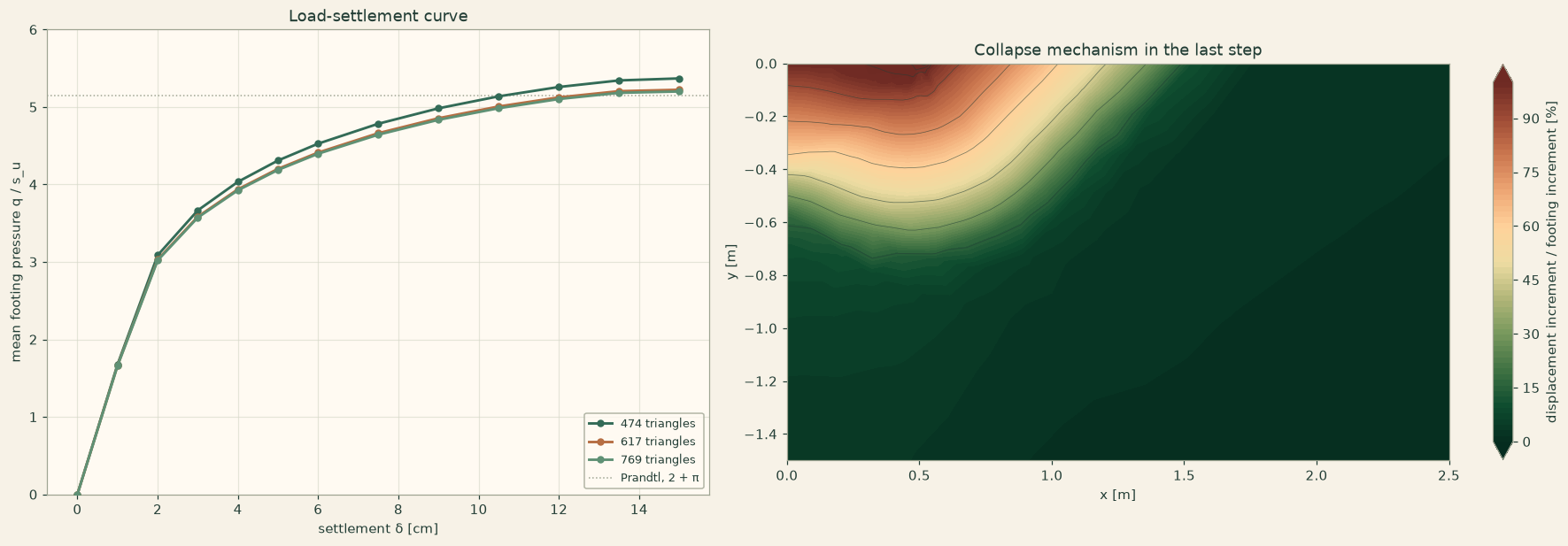
At 15 cm settlement the mean footing pressure reaches 5.37, 5.22 and 5.20 s_u on the three meshes, +4.4 %, +1.6 % and +1.1 % above Prandtl's collapse pressure (2 + π) s_u = 5.14 s_u, with the curve flattening (last increase 0.3 %) and the Prandtl mechanism visible in the displacement field.
Geometry
The notebook starts at the import of the CAD file strip_footing_bearing_capacity.step: STEP (AP242), readable by any CAD program, with the names of the faces that the boundary conditions use. Put it next to the notebook.
The geometry script
The script strip_footing_bearing_capacity_geometry.py builds the geometry with the CAD objects of OneSimulation and writes the file. Change a dimension there, run it, and run the notebook again.
"""Geometry of the OneSimulation example "Bearing capacity of a strip footing on clay".

Builds one half of the clay stratum below a strip footing of width B = 1 m: a block 5 m wide and
3 m deep, 1 m thick, with the symmetry plane at x = 0 and the ground surface at y = 0. The block
is made of two parts, the soil under the footing (x < 0.5 m) named footing and the rest, so the
ground surface is split at the edge of the footing. The part is written to
strip_footing_bearing_capacity.step; its faces are footing.x_min (symmetry plane under the
footing), footing.y_max (footing), footing.y_min, soil.x_max (far side), soil.y_max (free ground
surface) and soil.y_min (base).
"""

from onesim.cad.d3 import Box

width, depth, half_footing = 5.0, 3.0, 0.5
stratum = Box(
    length=half_footing, width=depth, height=1.0, origin=(0.0, -depth, 0.0)
).named("footing") | Box(
    length=width - half_footing,
    width=depth,
    height=1.0,
    origin=(half_footing, -depth, 0.0),
).named(
    "soil"
)
stratum.save("strip_footing_bearing_capacity.step")
The notebook
The complete notebook, cell by cell. Run it to produce the figures and the comparison printout.
How much load can a shallow foundation carry before the soil under it fails? For a long (strip) footing on saturated clay loaded quickly, the clay behaves undrained: it deforms at constant volume and fails when the shear stress reaches the undrained shear strength \(s_u\). Prandtl's solution of 1920 for a rigid-plastic half-space gives the collapse pressure of a smooth footing
independent of the footing width and of the stiffness of the soil (L. Prandtl, Z. Angew. Math. Mech. 1, 1921, 15-20; e.g. D.M. Potts and L. Zdravković, Finite Element Analysis in Geotechnical Engineering: Application, Telford 2001, where this case is a standard benchmark).
Model. The clay is elastic-perfectly plastic with the Drucker-Prager criterion at zero friction angle, which is the von Mises criterion; in plane strain its cohesion \(c=\tfrac{\sqrt3}{2}s_u\) gives the shear strength \(s_u\).
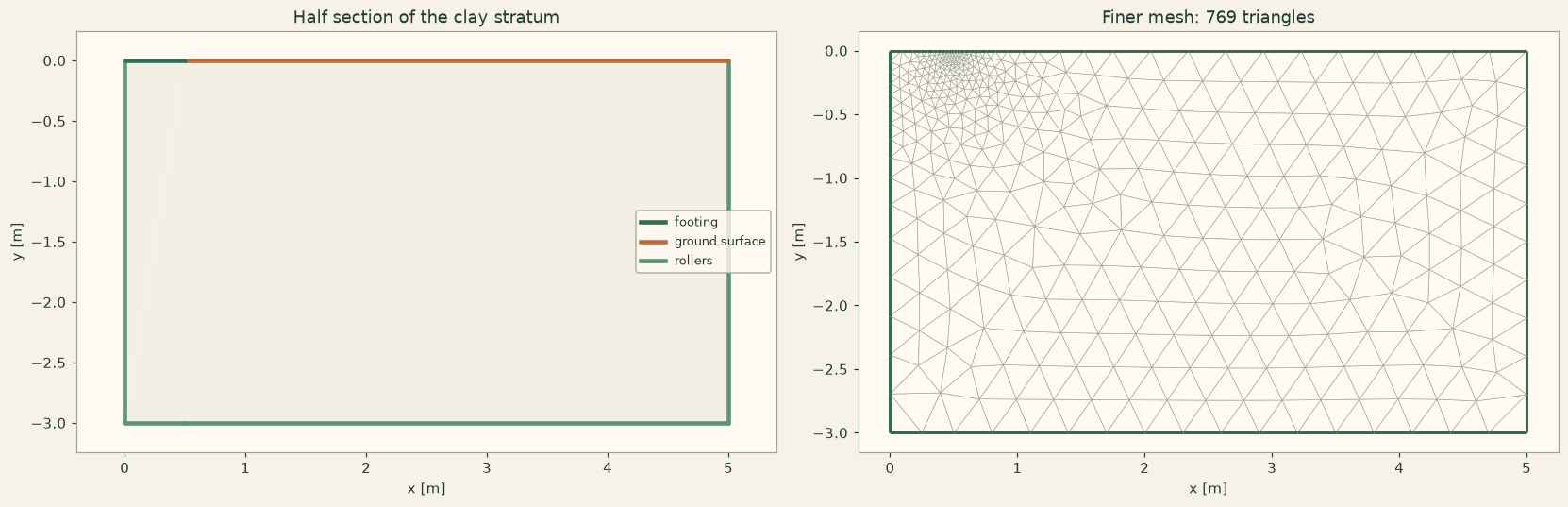
Setup. A footing of width \(B=1\) m on a clay stratum 3 m deep; one half is modelled, 5 m wide. \(E=10\) MPa, \(\nu=0.3\), \(s_u=50\) kPa. The footing is smooth and is pushed down by 0.15 m. The stratum comes from the CAD file strip_footing_bearing_capacity.step, written by strip_footing_bearing_capacity_geometry.py with the CAD objects of OneSimulation; the soil under the footing is its own block, so the ground surface is split at the edge of the footing.
| side | condition |
|---|---|
footing.y_max (under the footing) | \(u_y=-\delta\), smooth |
soil.y_max (ground surface) | free |
footing.x_min (symmetry), soil.x_max | \(u_x=0\) |
footing.y_min, soil.y_min (rigid base) | \(u_y=0\), smooth |
Reference. Prandtl's collapse pressure \((2+\pi)\,s_u=257.1\) kPa.
import numpy as np
from onesim.cad.exchange import load
from onesim.meshing import TriangularMesher
from onesim.numerics.fem import FiniteElement, Lagrange
from onesim.numerics.linear import SparseDirect
from onesim.numerics.nonlinear import DampedNewton
from onesim.physics.geotechnics import DruckerPragerSoil, FrictionalSolid
from onesim.visualization import plots, theme

theme.set()
Geometry and mesh
section cuts the stratum at mid-thickness; the cut faces keep their names. The triangles are graded towards the edge of the footing, where the stresses change fastest: three meshes with 6, 3 and 1.5 cm at the edge.
stratum = load("strip_footing_bearing_capacity.step")
plane = stratum.section((0, 0, 1), origin=(0, 0, stratum.size[2] / 2))
faces = plane.boundaries
edge_sizes = [0.06, 0.03, 0.015]
meshes = [
    TriangularMesher(
        target_size=0.3,
        size_field=lambda p, h=h: np.minimum(
            h + 0.15 * np.hypot(p[:, 0] - 0.5, p[:, 1]), 0.3
        ),
    ).generate(plane)
    for h in edge_sizes
]

fig = plots.figure(1, 2, size=(15, 5))
plots.geometry(
    plane,
    selection={
        "footing": faces["footing.y_max"],
        "ground surface": faces["soil.y_max"],
        "rollers": faces["footing.x_min"]
        | faces["soil.x_max"]
        | faces["footing.y_min"]
        | faces["soil.y_min"],
    },
    labels=False,
    title="Half section of the clay stratum",
    ax=fig[0],
)
plots.mesh(
    meshes[-1],
    groups=("all",),
    legend=False,
    title=f"Finer mesh: {meshes[-1].cell_count} triangles",
    ax=fig[1],
)
plots.show()
Model
Plane strain with quadratic triangles; the footing goes down in twelve steps to 0.15 m.
undrained_strength = 50e3
clay = FrictionalSolid(
    material=DruckerPragerSoil(
        youngs_modulus=10e6,
        poisson_ratio=0.3,
        cohesion=np.sqrt(3) / 2 * undrained_strength,
        friction_angle=0.0,
    ),
    kinematics="plane_strain",
)
settlement = np.r_[np.arange(0.0, 0.06, 0.01), np.arange(0.06, 0.151, 0.015)]
results = [
    clay.solve(
        mesh=mesh,
        times=settlement,
        spatial=FiniteElement(element=Lagrange(2)),
        nonlinear=DampedNewton(
            relative_tolerance=1e-8,
            absolute_tolerance=1e-6,
            maximum_iterations=60,
            linear_solver=SparseDirect(),
        ),
        displacements=(
            (faces["footing.x_min"], "x", 0.0),
            (faces["soil.x_max"], "x", 0.0),
            (faces["footing.y_min"] | faces["soil.y_min"], "y", 0.0),
            (faces["footing.y_max"], "y", lambda t: -t),
        ),
    )
    for mesh in meshes
]
pressure = [
    -result.reactions[
        :,
        (result.coordinates[:, 0] <= 0.5 + 1e-9)
        & (np.abs(result.coordinates[:, 1]) < 1e-9),
        1,
    ].sum(axis=1)
    / 0.5
    for result in results
]
Comparison with the reference
The mean footing pressure at the largest settlement against Prandtl's value, and its last increase, which shows how close the soil is to collapse.
prandtl = (2 + np.pi) * undrained_strength
print(f"Prandtl: q_f = (2 + π) s_u = {prandtl / 1e3:.1f} kPa")
print(
    f"{'size at the edge':>16s} {'triangles':>9s} {'q at δ = 0.15 m [kPa]':>22s} {'q / s_u':>8s} {'deviation':>10s} {'increase over the last step':>28s}"
)
for size, mesh, values in zip(edge_sizes, meshes, pressure):
    print(
        f"{100 * size:13.1f} cm {mesh.cell_count:9d} {values[-1] / 1e3:22.1f} {values[-1] / undrained_strength:8.3f}"
        f" {100 * (values[-1] / prandtl - 1):+9.1f} % {100 * (values[-1] / values[-2] - 1):27.2f} %"
    )
Figure
Load-settlement curves of the three meshes with Prandtl's value, and how far the soil moves in the last step per unit footing movement: near collapse this outlines the failure mechanism, the rigid wedge under the footing, the fan and the passive wedge beside it.
result, mesh = results[-1], meshes[-1]
nodes = len(mesh.coordinates)
increment = np.hypot(
    *(result.displacement[-1, :nodes] - result.displacement[-2, :nodes]).T
)
fig = plots.figure(1, 2, size=(16, 5.5))
plots.line(
    y={
        f"{mesh.cell_count} triangles": (100 * settlement, values / undrained_strength)
        for mesh, values in zip(meshes, pressure)
    },
    hlines={"Prandtl, 2 + π": 2 + np.pi},
    markers=True,
    ylimits=(0, 6),
    xlabel="settlement δ [cm]",
    ylabel="mean footing pressure q / s_u",
    title="Load-settlement curve",
    legend="lower right",
    ax=fig[0],
)
plots.heatmap(
    result.coordinates[:nodes, 0],
    result.coordinates[:nodes, 1],
    100 * increment / (settlement[-1] - settlement[-2]),
    triangles=np.asarray(mesh.cells),
    limits=(0, 100),
    contours=10,
    label="displacement increment / footing increment [%]",
    xlabel="x [m]",
    ylabel="y [m]",
    xlimits=(0, 2.5),
    ylimits=(-1.5, 0),
    title="Collapse mechanism in the last step",
    ax=fig[1],
)
plots.show()
Going further
Give the clay a friction angle and compare with the bearing capacity factor \(N_c=(N_q-1)\cot\varphi\); make the footing rough by fixing \(u_x\) under it; or move the base of the stratum up in strip_footing_bearing_capacity_geometry.py until the shallow layer raises the collapse load.