To reproduce the case, put its notebook and accompanying inputs in the same folder. Use the Python environment set up in the installation tutorial. Start with the original parameters and compare the result with the check reported below.
Run this example yourself. The OneSimulation Runtime brings the full Python library and an MCP server for Codex and Claude Code. It starts with a seven-day trial, then from €19 per month before any applicable tax.
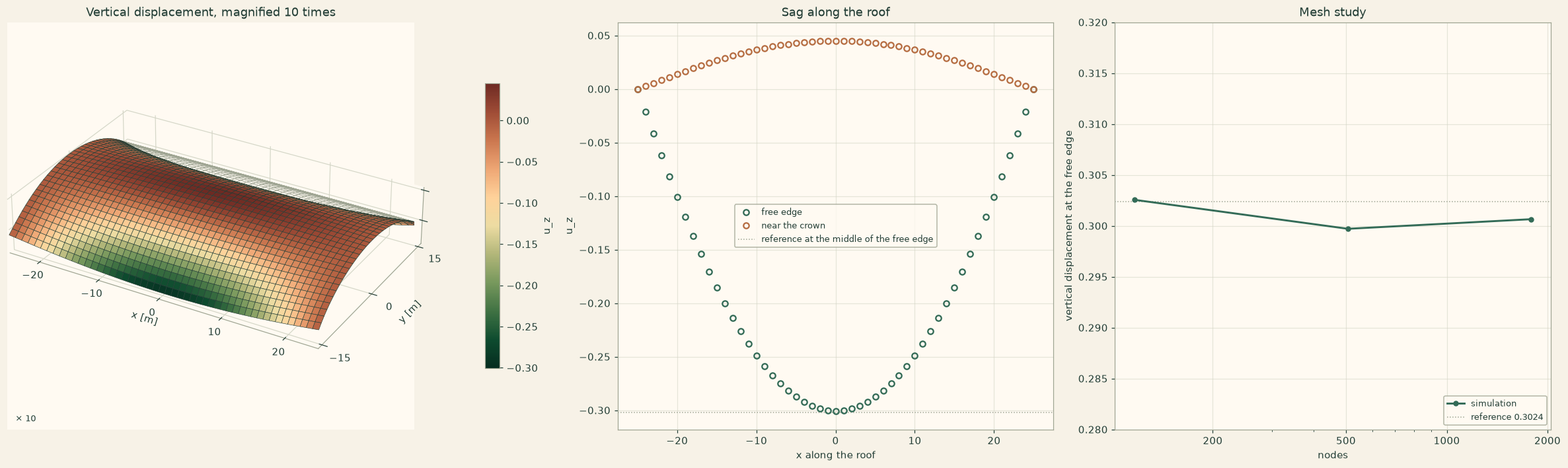
What it computes
OneSimulation reads the roof as a thin solid from the STEP file, reduces it to its mid-surface with the wall thickness, meshes it with paved quadrilaterals and solves it with shear-deformable shell elements on three meshes. The script that builds the STEP file comes with the notebook.
What it checks
The vertical displacement at the middle of the free edge is 0.3006 on the finest mesh against the reference 0.3024 (-0.58 %), and the vertical reactions balance the weight of the roof exactly (157068.6).
Geometry
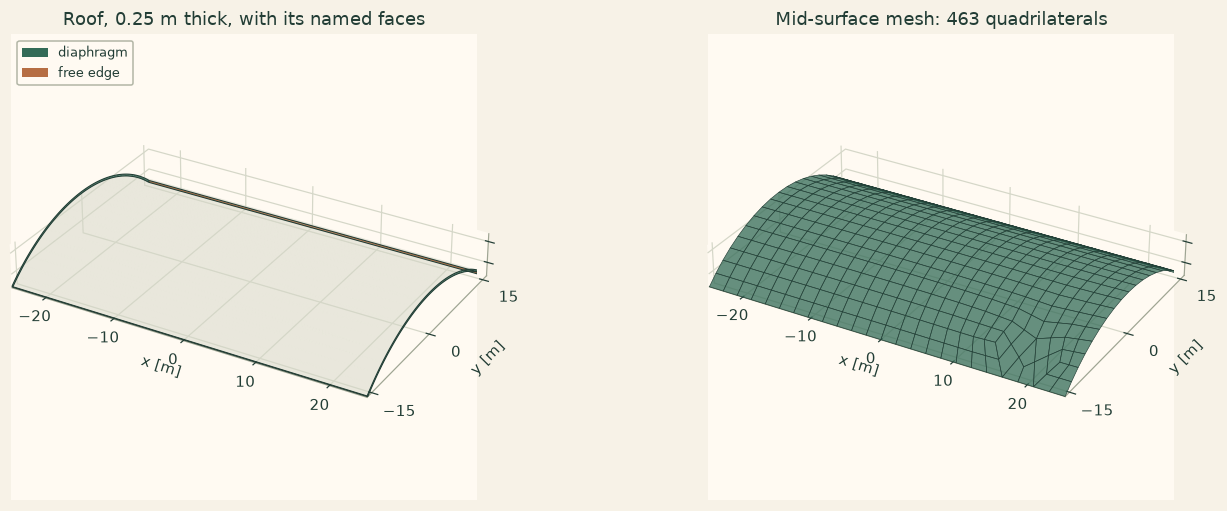
The notebook starts at the import of the CAD file scordelis_lo_roof_shell.step: STEP (AP242), readable by any CAD program, with the names of the faces that the boundary conditions use. Put it next to the notebook.
The geometry script
The script scordelis_lo_roof_shell_geometry.py builds the geometry with the CAD objects of OneSimulation and writes the file. Change a dimension there, run it, and run the notebook again.
"""Geometry of the OneSimulation example "Scordelis-Lo roof".

Builds the cylindrical roof of the benchmark, radius 25 m to the mid-surface, 50 m long along x,
spanning 40 degrees on either side of the crown and 0.25 m thick, as a thin solid with the CAD
objects of OneSimulation, and writes scordelis_lo_roof_shell.step. The faces are named diaphragm
(the two curved ends at x = -25 m and x = 25 m) and free_edge (the two straight edges).
"""

import numpy as np
from onesim.cad.d3 import AnnularCylinder

radius, length, thickness, half_angle = 25.0, 50.0, 0.25, np.radians(40.0)
tube = AnnularCylinder(
    inner_radius=radius - thickness / 2,
    outer_radius=radius + thickness / 2,
    length=length,
    origin=(-length / 2, 0.0, 0.0),
    axis=(1.0, 0.0, 0.0),
)
roof = tube.sector(
    2 * half_angle,
    axis=(1.0, 0.0, 0.0),
    start=(0.0, np.sin(half_angle), np.cos(half_angle)),
)
roof = roof.grouped(
    diaphragm=roof.select(
        faces=lambda face: face.kind == "plane"
        and abs(abs(face.center[0]) - length / 2) < 1e-6
    ),
    free_edge=roof.boundaries.sector_start | roof.boundaries.sector_end,
)
roof.save("scordelis_lo_roof_shell.step")
The notebook
The complete notebook, cell by cell. Run it to produce the figures and the comparison printout.
The roof is a segment of a circular cylinder: radius \(R=25\) m, length \(L=50\) m, spanning \(40°\) on either side of the crown, thickness \(t=0.25\) m. It rests at its two curved ends on rigid diaphragms that hold it in their plane but let it move along the axis and rotate freely; the two straight edges are free. The load is the dead weight, 90 per unit area of the mid-surface, acting downwards. The material has \(E=4.32\cdot10^8\) and \(\nu=0\) (consistent units).
| boundary | condition |
|---|---|
curved ends \(x=\pm L/2\) (diaphragm) | \(u_y=u_z=0\) |
straight edges (free_edge) | free |
| one point on the crown at mid-length | \(u_x=0\) (removes the rigid motion along the axis) |
The roof comes from the CAD file scordelis_lo_roof_shell.step as a thin solid with the named faces diaphragm and free_edge; the script scordelis_lo_roof_shell_geometry.py builds it with the CAD objects of OneSimulation. midsurface turns the thin solid into the sheet halfway through its wall, which carries the thickness for the shell model.
Reference. A. C. Scordelis and K. S. Lo, Computer analysis of cylindrical shells, J. American Concrete Institute 61 (1964) 539; R. H. MacNeal and R. L. Harder, A proposed standard set of problems to test finite element accuracy, Finite Elements in Analysis and Design 1 (1985) 3: the vertical displacement at the middle of the free edge is 0.3024 (deep shell theory).
import numpy as np
from onesim.cad.exchange import load
from onesim.meshing import SheetMesher
from onesim.physics.solid_mechanics import ElasticShell, ShellSurface
from onesim.visualization import plots, theme

theme.set()
Geometry and mesh
The mid-surface is meshed with paved quadrilaterals of three sizes.
roof = load("scordelis_lo_roof_shell.step")
faces = roof.boundaries
sheet = roof.midsurface()
radius, length, half_angle = 25.0, 50.0, np.radians(40.0)
sizes = [4.0, 2.0, 1.0]
meshes = [SheetMesher(target_size=size, paved=True).generate(sheet) for size in sizes]

view = plots.Camera(elevation=30, azimuth=-60)
fig = plots.figure(1, 2, size=(15, 5.5))
plots.geometry(
    roof,
    selection={"diaphragm": faces.diaphragm, "free edge": faces.free_edge},
    labels=False,
    camera=view,
    title=f"Roof, {sheet.thickness:.2f} m thick, with its named faces",
    ax=fig[0],
)
plots.mesh(
    meshes[1],
    camera=view,
    title=f"Mid-surface mesh: {len(meshes[1].quadrilaterals)} quadrilaterals",
    ax=fig[1],
)
plots.show()
Model
ElasticShell is a shear-deformable shell with five degrees of freedom per node, three displacements and two rotations about the local tangent axes. The supports are given node by node: the nodes on the two diaphragm ends and the node on the crown at mid-length.
shell = ElasticShell(
    youngs_modulus=4.32e8, poisson_ratio=0.0, thickness=sheet.thickness
)
results = []
for mesh in meshes:
    nodes = np.asarray(mesh.coordinates)
    ends = np.flatnonzero(np.isclose(np.abs(nodes[:, 0]), length / 2, atol=1e-6))
    crown = int(np.argmin(np.linalg.norm(nodes - (0.0, 0.0, radius), axis=1)))
    results.append(
        shell.solve(
            surface=ShellSurface(
                coordinates=nodes, quadrilaterals=np.asarray(mesh.quadrilaterals)
            ),
            supports=[(int(node), axis, 0.0) for node in ends for axis in ("y", "z")]
            + [(crown, "x", 0.0)],
            surface_load=(0.0, 0.0, -90.0),
        )
    )
Results
The vertical displacement at the middle of the free edge, the point \((0,\ R\sin40°,\ R\cos40°)\), against the reference value, and the balance of the reactions with the weight of the roof.
reference = 0.3024
edge = (0.0, radius * np.sin(half_angle), radius * np.cos(half_angle))
sags = [
    -result.displacement[
        np.argmin(np.linalg.norm(np.asarray(mesh.coordinates) - edge, axis=1)), 2
    ]
    for mesh, result in zip(meshes, results)
]
print(
    "cell size   quadrilaterals   nodes   displacement at the free edge   deviation from 0.3024"
)
for size, mesh, sag in zip(sizes, meshes, sags):
    print(
        f"{size:9.1f} {len(mesh.quadrilaterals):16d} {len(mesh.coordinates):7d} {sag:31.4f} {100 * (sag / reference - 1):+19.2f} %"
    )
print(
    f"vertical reactions {results[-1].reaction_force[:, 2].sum():.1f}, weight of the roof {90.0 * results[-1].area:.1f}"
)
Figure
The vertical displacement on the deformed roof (magnified 10 times), the sag along the free edge and near the crown, and the mesh study at the reference point.
mesh, result = meshes[-1], results[-1]
nodes = np.asarray(mesh.coordinates)
on_edge = np.flatnonzero(np.isclose(nodes[:, 1], edge[1], atol=1e-3))
on_crown = np.flatnonzero(np.abs(nodes[:, 1]) < 0.5)
fig = plots.figure(1, 3, size=(19, 5.5))
plots.mesh(
    mesh,
    values=result.displacement[:, 2],
    displacement=result.displacement,
    scale=10.0,
    camera=view,
    label="u_z",
    title="Vertical displacement, magnified 10 times",
    ax=fig[0],
)
plots.line(
    points={
        "free edge": (nodes[on_edge, 0], result.displacement[on_edge, 2]),
        "near the crown": (nodes[on_crown, 0], result.displacement[on_crown, 2]),
    },
    hlines={"reference at the middle of the free edge": -reference},
    xlabel="x along the roof",
    ylabel="u_z",
    title="Sag along the roof",
    legend="center",
    ax=fig[1],
)
plots.line(
    [len(mesh.coordinates) for mesh in meshes],
    {"simulation": sags},
    markers=True,
    hlines={"reference 0.3024": reference},
    scale="logx",
    ylimits=(0.28, 0.32),
    xlabel="nodes",
    ylabel="vertical displacement at the free edge",
    title="Mesh study",
    legend="lower right",
    ax=fig[2],
)
plots.show()
Going further
Change the opening angle or the thickness in scordelis_lo_roof_shell_geometry.py and write the STEP file again: a thinner roof makes locking visible in less robust shell elements. Add a layered layer_stiffness for a composite roof, or replace the dead weight by a snow load on the projected area.