To reproduce the case, put its notebook and accompanying inputs in the same folder. Use the Python environment set up in the installation tutorial. Start with the original parameters and compare the result with the check reported below.
Run this example yourself. The OneSimulation Runtime brings the full Python library and an MCP server for Codex and Claude Code. It starts with a seven-day trial, then from €19 per month before any applicable tax.
What it computes
OneSimulation cuts one 4 um period of the structure, drawn in micrometres, from STEP plates and solves the out-of-plane electric or magnetic field with quadratic triangles; Floquet ports feed the plane wave and absorb all diffraction orders, diffraction_efficiencies returns the power of every order, and the power dissipated in the gold gives the absorptance independently. The script that builds the STEP files comes with the notebook.
What it checks
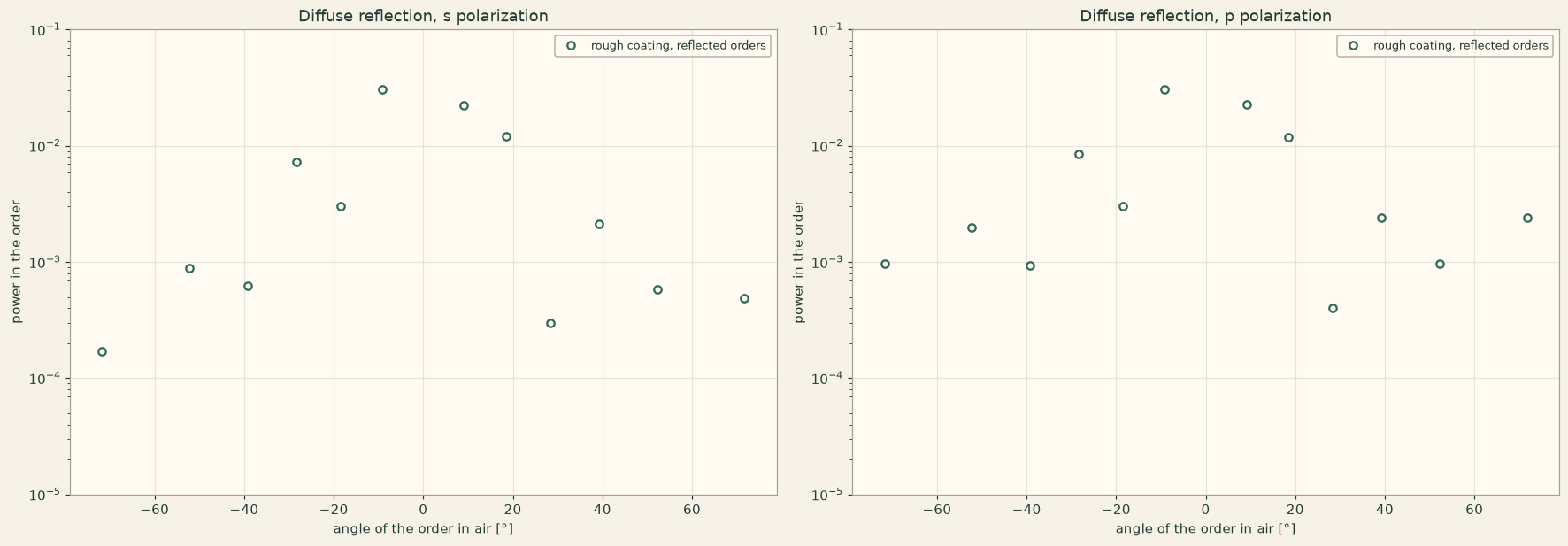
The flat coating reproduces the thin-film solution (R = 0.88763, T = 0.04919) to 4e-6 in both polarizations; for the rough coating the orders and the dissipated power close the energy balance to 3e-15, about 8 % of the light is reflected diffusely and the absorptance rises from 0.0632 to 0.0643 (s) and 0.0662 (p).
Geometry
The notebook starts at the import of the CAD files rough_surface_scattering_floquet.step, rough_surface_scattering_floquet_flat.step, rough_surface_scattering_floquet_glass.step, rough_surface_scattering_floquet_rough.step: STEP (AP242), readable by any CAD program, with the names of the faces that the boundary conditions use. Put them next to the notebook.
The geometry script
The script rough_surface_scattering_floquet_geometry.py builds the geometry with the CAD objects of OneSimulation and writes the files. Change a dimension there, run it, and run the notebook again.
"""Geometry of the OneSimulation example "Light scattered by a rough metal coating".

Builds with the CAD objects of OneSimulation, drawn in micrometres as thin plates, one period
(4 um wide along x) of a glass substrate with a gold coating, 1 um of glass below the coating and
1.5 um of air above it: the whole cell (rough_surface_scattering_floquet.step; y_min in the glass
and y_max in the air are the ports, x_min and x_max the periodic sides), the glass
(rough_surface_scattering_floquet_glass.step), a flat coating 50 nm thick
(rough_surface_scattering_floquet_flat.step) and a coating whose top surface is rough
(rough_surface_scattering_floquet_rough.step): a periodic sum of eight cosines with random phases,
15 nm rms, sampled at 400 points.
"""

import numpy as np
from onesim.cad.d2 import Path, Profile, Segment
from onesim.cad.d3 import Box, Prism

width, glass, air, film, depth = 4.0, 1.0, 1.5, 0.05, 0.05
Box(
    length=width, width=glass + film + air, height=depth, origin=(0.0, -glass, 0.0)
).save("rough_surface_scattering_floquet.step")
Box(length=width, width=glass, height=depth, origin=(0.0, -glass, 0.0)).save(
    "rough_surface_scattering_floquet_glass.step"
)
Box(length=width, width=film, height=depth).save(
    "rough_surface_scattering_floquet_flat.step"
)
rng = np.random.default_rng(7)
x = np.linspace(0.0, width, 401)
height = sum(
    np.cos(2 * np.pi * j * x / width + rng.uniform(0, 2 * np.pi)) / j
    for j in range(1, 9)
)
height = film + 0.015 * height / np.sqrt(np.mean(height**2))
outline = Path(
    (0.0, 0.0),
    (
        Segment((width, 0.0)),
        *(Segment((float(a), float(h))) for a, h in zip(x[::-1], height[::-1])),
        Segment((0.0, 0.0)),
    ),
)
Prism(profile=Profile(outline), height=depth).save(
    "rough_surface_scattering_floquet_rough.step"
)
The notebook
The complete notebook, cell by cell. Run it to produce the figures and the comparison printout.
A glass substrate (\(n=1.5\)) carries a gold coating 50 nm thick (\(\varepsilon=-11.7+1.26\,\mathrm i\) at \(\lambda_0=633\) nm). Light falls on it from the air at normal incidence. On an optically flat coating the light is reflected, transmitted and absorbed as in a thin film; a rough top surface scatters part of it into oblique directions and raises the absorption.
The rough surface is periodic over \(W=4\,\mu\)m, so the field obeys Bloch conditions and leaves through a finite number of diffraction orders \(\sin\theta_m=m\lambda_0/(nW)\). OneSimulation solves one period on its cross-section, for \(E_z\) (s polarization, electric field along the grooves) and \(H_z\) (p polarization); FloquetPort feeds the specular order and absorbs all orders, and diffraction_efficiencies returns the power of every order:
| boundary | condition |
|---|---|
y_max (air) | Floquet port, plane wave fed at normal incidence |
y_min (glass) | Floquet port |
x_min ↔ x_max | Bloch periodic, \(k_x=0\) |
The cell, the glass and the two coatings come from rough_surface_scattering_floquet.step and the files ..._glass.step, ..._flat.step and ..._rough.step, drawn in micrometres by rough_surface_scattering_floquet_geometry.py with the CAD objects of OneSimulation; the rough top surface is a periodic sum of eight cosines with random phases, 15 nm rms.
Reference. The flat coating is a single absorbing film between air and glass; its reflectance and transmittance follow from the Airy formula of the film, computed here by the coherent thin-film solution CoherentOpticalStack (Born and Wolf, Principles of Optics, 7th ed., §13.4). For the rough coating there is no closed form: the computed orders and the power absorbed in the gold must conserve energy, \(R+T+A=1\).
import numpy as np
from onesim.cad.exchange import load
from onesim.materials import VACUUM_PERMEABILITY, VACUUM_PERMITTIVITY
from onesim.materials.electromagnetic import (
    CoherentOpticalStack,
    IsotropicElectromagneticMaterial,
    OpticalLayer,
    RegionwiseElectromagneticMaterial,
)
from onesim.meshing import PeriodicPair, TriangularMesher, scaled
from onesim.numerics import Numerics
from onesim.numerics.fem import FiniteElement, Lagrange
from onesim.numerics.linear import ComplexSparseDirect
from onesim.physics.electromagnetics import (
    BlochPeriodicBoundary,
    FloquetPort,
    FrequencyDomainMaxwell,
    diffraction_efficiencies,
)
from onesim.simulation import Problem, Simulation
from onesim.visualization import plots, theme

theme.set()

light = 1 / np.sqrt(VACUUM_PERMEABILITY * VACUUM_PERMITTIVITY)
Geometry and mesh
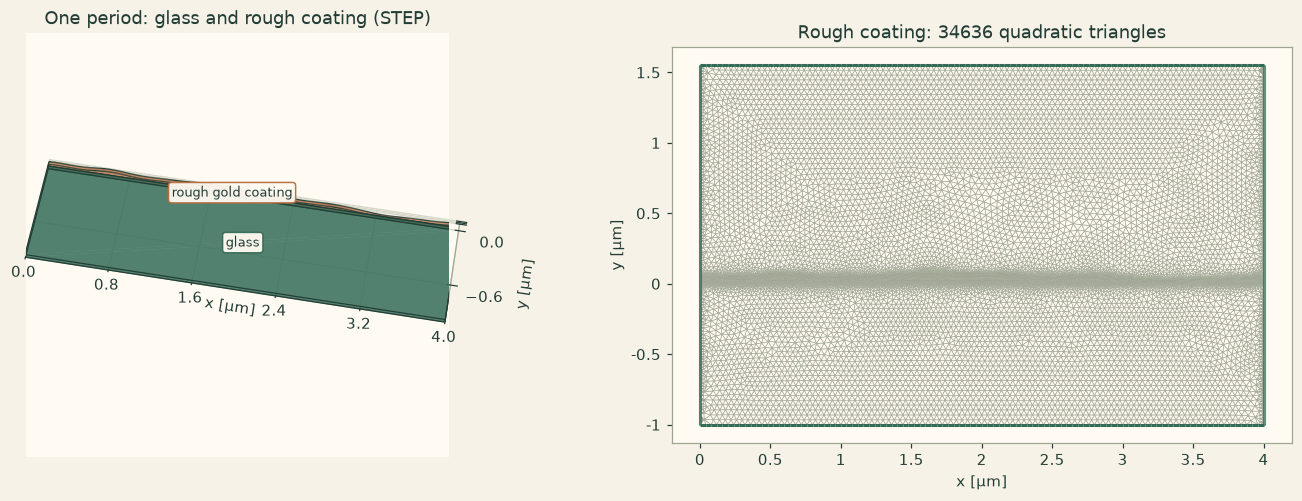
section cuts the plates at mid-depth. Quadratic triangles of 40 nm in air and glass and 6 nm in the coating, which is thinner than the skin depth of gold (about 30 nm) only by a factor of two; scaled turns the micrometres of the drawing into metres. The periodic sides get matching nodes.
plates = {
    name: load(f"rough_surface_scattering_floquet{suffix}.step")
    for name, suffix in (
        ("cell", ""),
        ("glass", "_glass"),
        ("flat", "_flat"),
        ("rough", "_rough"),
    )
}
cut = lambda part: part.section((0, 0, 1), origin=(0, 0, 0.025))
cell = cut(plates["cell"])
sides = cell.boundaries
meshes = {
    name: scaled(
        TriangularMesher(
            target_size=0.04,
            embedded_regions=(
                cut(plates["glass"]).named("glass"),
                cut(plates[name]).named("gold"),
            ),
            region_sizes={"gold": 0.006},
            hard_sizes={"x_min": 0.006, "x_max": 0.006},
            grading=0.3,
        ).generate(cell),
        "um",
    )
    for name in ("flat", "rough")
}

fig = plots.figure(1, 2, size=(16, 5))
plots.geometry(
    [plates["glass"].named("glass"), plates["rough"].named("rough gold coating")],
    camera=plots.Camera(elevation=60, azimuth=-80),
    title="One period: glass and rough coating (STEP)",
    length_unit="um",
    drawing_unit="um",
    ax=fig[0],
)
plots.mesh(
    meshes["rough"],
    groups=("all",),
    legend=False,
    length_unit="um",
    title=f"Rough coating: {meshes['rough'].cell_count} quadratic triangles",
    ax=fig[1],
)
plots.show()
Model
One solve per coating and polarization at \(\lambda_0=633\) nm; the orders on the air side give the reflectance, those on the glass side the transmittance.
wavelength, gold, n_glass = 633e-9, -11.7 + 1.26j, 1.5
material = RegionwiseElectromagneticMaterial(
    {
        "gold": IsotropicElectromagneticMaterial(relative_permittivity=gold),
        "glass": IsotropicElectromagneticMaterial(relative_permittivity=n_glass**2),
    },
    default=IsotropicElectromagneticMaterial(),
)
numerics = Numerics(
    spatial=FiniteElement(element=Lagrange(order=2)),
    linear_solver=ComplexSparseDirect(),
)
solve = lambda coating, polarization: (
    lambda m: (
        Simulation(
            problem=Problem(
                name="Coated glass",
                geometry=cell,
                physics=(m,),
                boundary_conditions=(
                    BlochPeriodicBoundary(
                        physics=m,
                        pair=PeriodicPair(sides.x_min, sides.x_max),
                        wavevector=(0.0, 0.0, 0.0),
                    ),
                    FloquetPort(
                        physics=m, boundary=sides.y_max, incident_amplitude=1.0
                    ),
                    FloquetPort(physics=m, boundary=sides.y_min),
                ),
            ),
            mesh=meshes[coating],
            numerics=numerics,
        ).solve_stationary(),
        m,
    )
)(
    FrequencyDomainMaxwell(
        domain=cell.domain(),
        frequency=light / wavelength,
        material=material,
        polarization=polarization,
        phasor_convention="exp(-i*omega*t)",
        amplitude_convention="peak",
    )
)
solved = {
    (coating, polarization): solve(coating, polarization)
    for coating in ("flat", "rough")
    for polarization in ("Ez", "Hz")
}
runs = {key: diffraction_efficiencies(*value) for key, value in solved.items()}
impedance = np.sqrt(VACUUM_PERMEABILITY / VACUUM_PERMITTIVITY)
incident = {"Ez": 4e-6 / (2 * impedance), "Hz": 4e-6 * impedance / 2}
absorbed = {
    key: result.field(m.absorbed_power_density).integrate().value / incident[key[1]]
    for key, (result, m) in solved.items()
}
Results
Reflectance \(R\) (all orders in the air), transmittance \(T\) (all orders in the glass), absorptance \(A\) from the power dissipated in the gold (per period, relative to the incident power \(W|E_0|^2/2\eta_0\) or \(W\eta_0|H_0|^2/2\)), and the energy balance \(R+T+A-1\); the diffuse part is the power outside the specular orders.
film = CoherentOpticalStack(
    layers=(OpticalLayer(thickness=50e-9, index=np.sqrt(gold)),)
)
exact = {
    "Ez": film(wavelength, 1.0, 1.0, n_glass, polarization="s"),
    "Hz": film(wavelength, 1.0, 1.0, n_glass, polarization="p"),
}
print(
    "coating  polarization      R         T         A      R+T+A-1   diffuse R   diffuse T   orders   thin-film solution R / T / A"
)
for (coating, polarization), orders in runs.items():
    R = sum(v for (port, order), v in orders.items() if port == 0)
    T = sum(v for (port, order), v in orders.items() if port == 1)
    ref = exact[polarization]
    print(
        f"{coating:7s}  {polarization:12s} {R:9.5f} {T:9.5f} {absorbed[(coating, polarization)]:9.5f} {R + T + absorbed[(coating, polarization)] - 1:+9.1e} {R - orders.get((0, 0), 0.0):11.2e} {T - orders.get((1, 0), 0.0):11.2e} {len(orders):8d}   "
        + (
            f"{ref.reflected:.5f} / {ref.transmitted:.5f} / {1 - ref.reflected - ref.transmitted:.5f}"
            if coating == "flat"
            else ""
        )
    )
for polarization in ("Ez", "Hz"):
    flat = runs[("flat", polarization)]
    print(
        f"flat coating, {polarization}: |R - R_film| = {abs(sum(v for (p, _), v in flat.items() if p == 0) - exact[polarization].reflected):.1e}, "
        f"|T - T_film| = {abs(sum(v for (p, _), v in flat.items() if p == 1) - exact[polarization].transmitted):.1e}"
    )
Figure
The power reflected into each diffraction order by the rough coating, against the angle of the order in the air, for both polarizations (the specular order is off the scale).
angle = lambda order: np.degrees(np.arcsin(np.clip(order * wavelength / 4e-6, -1, 1)))
fig = plots.figure(1, 2, size=(16, 5.5))
for panel, polarization in enumerate(("Ez", "Hz")):
    orders = {
        o: v for (p, o), v in runs[("rough", polarization)].items() if p == 0 and o != 0
    }
    plots.line(
        points={
            "rough coating, reflected orders": (
                angle(np.array(list(orders))),
                np.array(list(orders.values())),
            )
        },
        scale="logy",
        ylimits=(1e-5, 1e-1),
        xlabel="angle of the order in air [°]",
        ylabel="power in the order",
        title=f"Diffuse reflection, {'s' if polarization == 'Ez' else 'p'} polarization",
        legend="upper right",
        ax=fig[panel],
    )
plots.show()
Going further
Raise the roughness in rough_surface_scattering_floquet_geometry.py or shorten its correlation length: the diffuse part grows and, for p polarization, rough gold couples light into surface plasmons, which shows as a dip in the reflectance. A nonzero Bloch wavevector gives oblique incidence.